

This website is currently being migrated. For the most up-to-date astrobiology news, resources, and community announcements, please visit our new home at science.nasa.gov/astrobiology

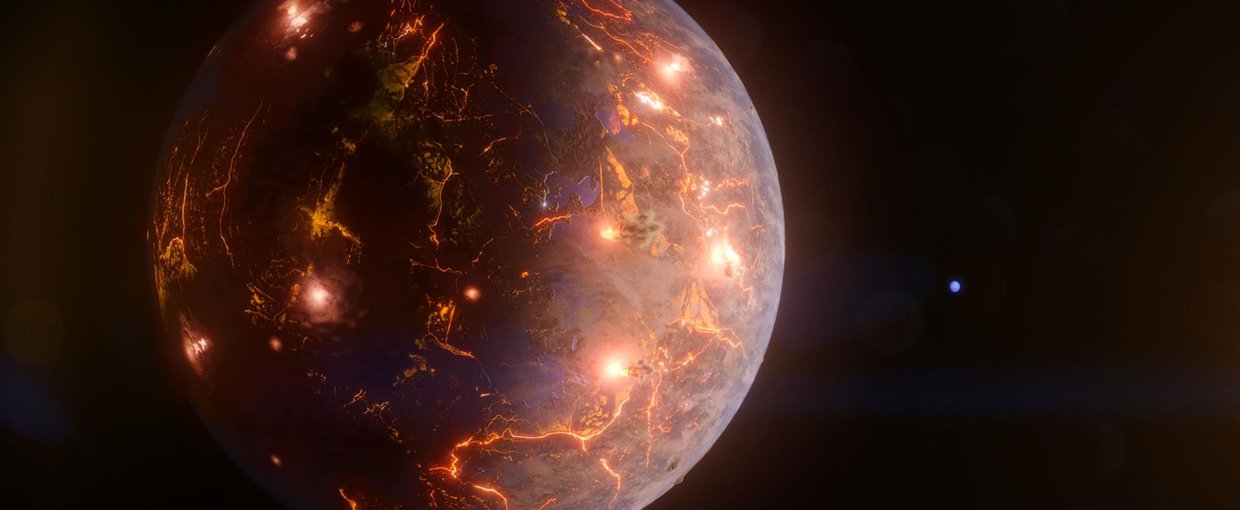
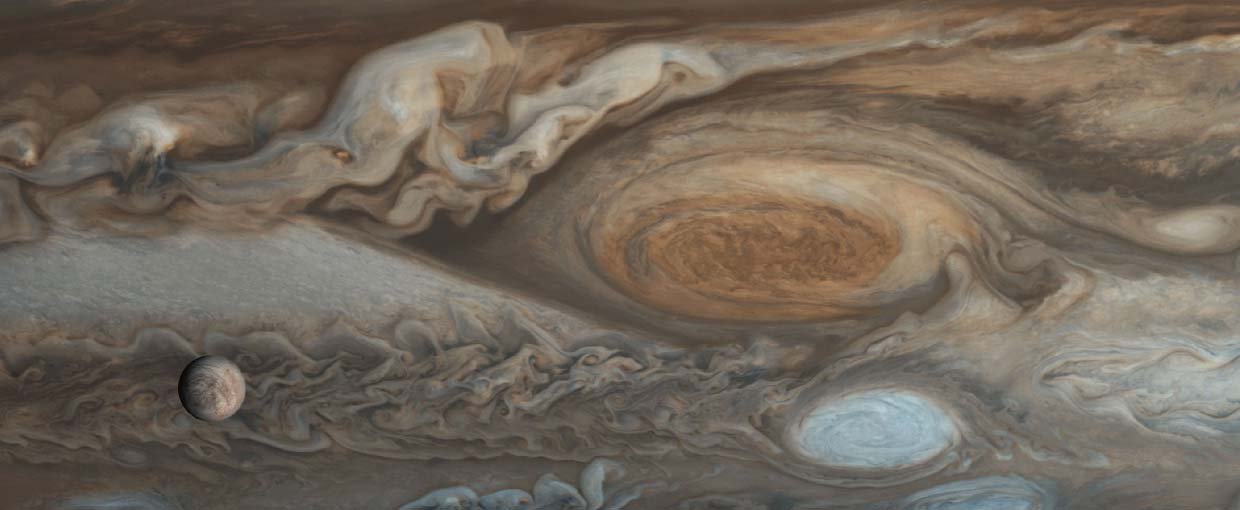
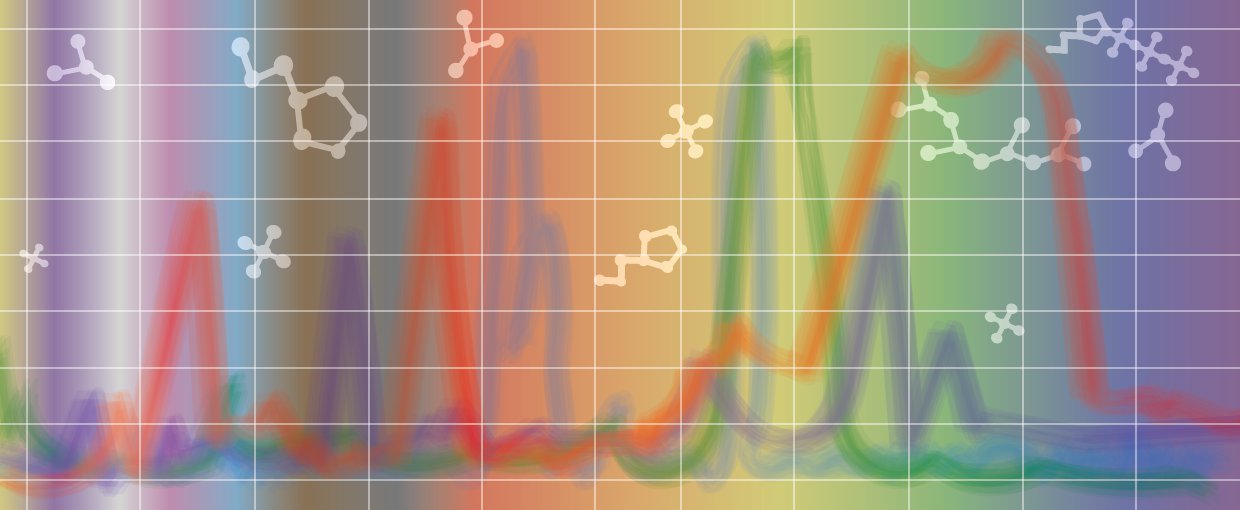
A volcanically active planet is shown in closeup at the left side of the image with glowing eruptions and lines of lava on the surface. To the right and in the distance is a faint blue glowing ball representing the more massive planet in the system.Sixteen frames from Voyager 1's flyby of Jupiter in 1979 were merged to create this image. Jupiter's Great Red Spot is visible in the center. Jupiter's moon Europa can be seen in the foreground at the bottom left of the image.The frame is a horizontal rainbow of color on a grid. Shadows of molecules can be seen through the light as well as the jagged peaks and troughs of spectral lines.
Fizzy Super Earths and Lava Worlds“Fizzy Super-Earths: Impacts of Magma Composition on the Bulk Density and Structure of Lava Worlds.” in The Astrophysical Journal.01/03
Identifying Hydrothermal Activity on Icy Ocean Worlds“Ethene-ethanol ratios as potential indicators of hydrothermal activity at Enceladus, Europa, and other icy ocean worlds.” In Icarus.02/03
NASA Raman Spectroscopic Database"The NASA Raman spectroscopic database: Ramdb version 1.00.” In Icarus.03/03
NextPrevious
Go Explore
December 2025Draft genomes of three abundant bacterial isolates from hypersaline Don Juan Pond, Antarctica

Shaffer, J. M. C., Jarratt, A., Boles, B. W., & Mikucki, J. A. (2025). Draft genomes of three abundant bacterial isolates from hypersaline Don Juan Pond, Antarctica. Microbiology Resource Announcements. doi:10.1128/mra.00279-25

Expanding the Ice Inventory of NGC 1333 IRAS 2A with INDRA Using JWST Observations: Tracing Organic Refractories and Beyond

Rayalacheruvu, P., Majumdar, L., Rocha, W. R. M., Ressler, M. E., Giri, P. R., Maitrey, S., … Klaassen, P. D. (2025). Expanding the Ice Inventory of NGC 1333 IRAS 2A with INDRA Using JWST Observations: Tracing Organic Refractories and Beyond. The Astrophysical Journal Supplement Series, 281(2), 51. doi:10.3847/1538-4365/ae112f

Subsurface Life on Earth as a Key to Unlock Extraterrestrial Mysteries

Vidal, E., Lindsay, M. R., Bradley, J. A., Osburn, M. R., & Emil Ruff, S. (2025). Subsurface Life on Earth as a Key to Unlock Extraterrestrial Mysteries. Microbial Biotechnology, 18(12), None. doi:10.1111/1751-7915.70286

TRIDENT Ice Mining Drill for Lunar Volatile Prospecting for PRIME-1 and VIPER Missions

Zacny, K., Chu, P., Vendiola, V., Paulsen, G., Creekmore, P., Goldman, S., … Gansler, K. (2025). TRIDENT Ice Mining Drill for Lunar Volatile Prospecting for PRIME-1 and VIPER Missions. The Planetary Science Journal, 6(12), 297. doi:10.3847/psj/ae0b51

Planetary Impacts: Friend or Foe?

Black, B.A., & Bermingham, K.R. (2025) Planetary Impacts: Friend or Foe? Astrobiology. doi: 10.1177/1531107425139921

Strontium-84 Enrichments in Presolar Grains Provide First Evidence of p-process Nucleosynthesis in Core-collapse Supernovae

Pal, I. et. al. (2025) Strontium-84 Enrichments in Presolar Grains Provide First Evidence of p-process Nucleosynthesis in Core-collapse Supernovae. The Astrophysical Journal Letters, 994(L21). doi:10.3847/2041-8213/ae182f

Interferometric Detection and Orbit Modeling of the Subcomponent in the Hot-dust System κ Tuc A: A Low-mass Star on an Eccentric Orbit in a Hierarchical-quintuple System

Stuber, T.A., et. al. (2025) Interferometric Detection and Orbit Modeling of the Subcomponent in the Hot-dust System κ Tuc A: A Low-mass Star on an Eccentric Orbit in a Hierarchical-quintuple System. The Astronomical Journal, 171(1). doi: 10.3847/1538-3881/adfe66

November 2025Altitude Profile and Isotopic Composition for N2 From Pioneer Venus Mass Spectra

Mogul, R., Limaye, S.S., & Way, M.J. (2025) Altitude Profile and Isotopic Composition for N2 From Pioneer Venus Mass Spectra. Geophysical Research Letters, 52(23). doi:10.1029/2025GL118909

Differentiation, the Exception, Not the Rule: Evidence for Full Miscibility in Sub-Neptune Interiors

Young, E. D., Werlen, A., Marcum, S. P., Stixrude, L., & Dullemond, C. P. (2025). Differentiation, the Exception, Not the Rule: Evidence for Full Miscibility in Sub-Neptune Interiors. The Planetary Science Journal, 6(11), 251. doi:10.3847/psj/ae1012

Global distribution, hierarchical clustering classification, and significance of Holocene braid deltas

Muhlbauer, J. G., & Fedo, C. M. (2025). Global distribution, hierarchical clustering classification, and significance of Holocene braid deltas. Geology. doi:10.1130/g53851.1