


This website is currently being migrated. For the most up-to-date astrobiology news, resources, and community announcements, please visit our new home at science.nasa.gov/astrobiology

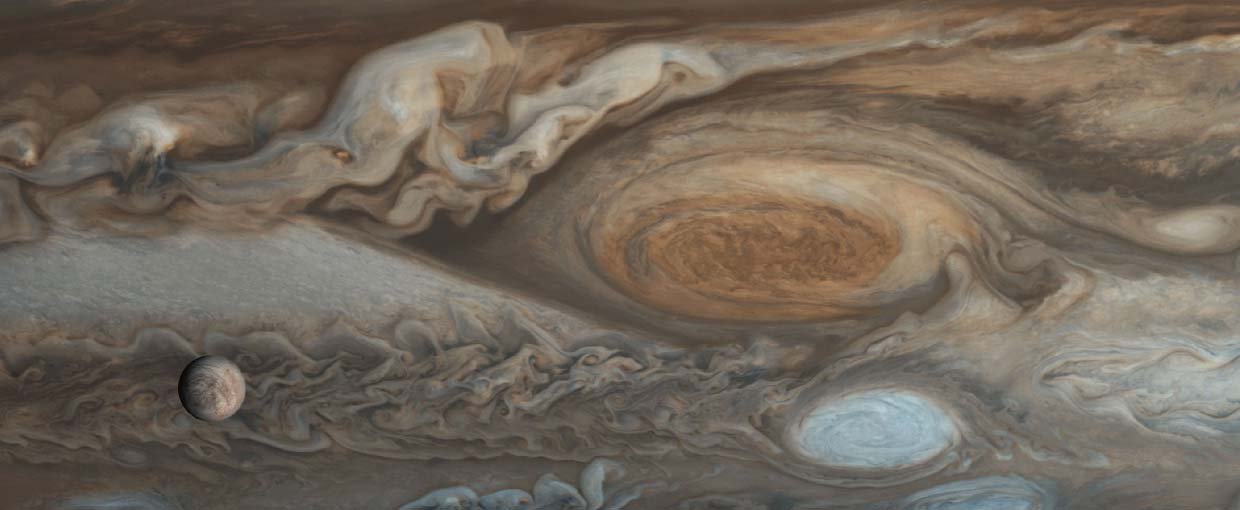
A volcanically active planet is shown in closeup at the left side of the image with glowing eruptions and lines of lava on the surface. To the right and in the distance is a faint blue glowing ball representing the more massive planet in the system.Sixteen frames from Voyager 1's flyby of Jupiter in 1979 were merged to create this image. Jupiter's Great Red Spot is visible in the center. Jupiter's moon Europa can be seen in the foreground at the bottom left of the image.The frame is a horizontal rainbow of color on a grid. Shadows of molecules can be seen through the light as well as the jagged peaks and troughs of spectral lines.
Fizzy Super Earths and Lava Worlds“Fizzy Super-Earths: Impacts of Magma Composition on the Bulk Density and Structure of Lava Worlds.” in The Astrophysical Journal.01/03
Identifying Hydrothermal Activity on Icy Ocean Worlds“Ethene-ethanol ratios as potential indicators of hydrothermal activity at Enceladus, Europa, and other icy ocean worlds.” In Icarus.02/03
NASA Raman Spectroscopic Database"The NASA Raman spectroscopic database: Ramdb version 1.00.” In Icarus.03/03
NextPrevious
Go Explore
May 2015Niche and metabolic principles explain patterns of diversity and distribution: theory and a case study with soil bacterial communities

Okie, J. G., Van Horn, D. J., Storch, D., Barrett, J. E., Gooseff, M. N., Kopsova, L., & Takacs-Vesbach, C. D. (2015). Niche and metabolic principles explain patterns of diversity and distribution: theory and a case study with soil bacterial communities. Proceedings of the Royal Society B: Biological Sciences, 282(1809), 20142630. doi:10.1098/rspb.2014.2630

A Cryogenian chronology: Two long-lasting synchronous Neoproterozoic glaciations

Rooney, A. D., Strauss, J. V., Brandon, A. D., & Macdonald, F. A. (2015). A Cryogenian chronology: Two long-lasting synchronous Neoproterozoic glaciations. Geology, 43(5), 459–462. doi:10.1130/g36511.1

Theoretical analysis of the cost of antagonistic activity for aquatic bacteria in oligotrophic environments

Aguirre-Von-Wobeser, E., Eguiarte, L. E., Souza, V., & Soberón-Chávez, G. (2015). Frontiers in Microbiology, 6(None), None. doi:10.3389/fmicb.2015.00490

From Chemical Gardens to Fuel Cells: Generation of Electrical Potential and Current Across Self-Assembling Iron Mineral Membranes

Barge, L. M., Abedian, Y., Russell, M. J., Doloboff, I. J., Cartwright, J. H. E., Kidd, R. D., & Kanik, I. (2015). Angew. Chem., 127(28), 8302–8305. doi:10.1002/ange.201501663

Framework for analyzing ecological trait-based models in multidimensional niche spaces

Biancalani, T., DeVille, L., & Goldenfeld, N. (2015). Phys. Rev. E, 91(5), None. doi:10.1103/physreve.91.052107

The Gemini NICI Planet-Finding Campaign: asymmetries in the HD 141569 disc

Biller, B. A., Liu, M. C., Rice, K., Wahhaj, Z., Nielsen, E., Hayward, T., … Kuchner, M. J. (2015). Monthly Notices of the Royal Astronomical Society, 450(4), 4446–4457. doi:10.1093/mnras/stv870

Cometary Isotopic Measurements

Bockelée-Morvan, D., Calmonte, U., Charnley, S., Duprat, J., Engrand, C., Gicquel, A., … Hässig, M. (2015). Space Sci Rev, 197(1-4), 47–83. doi:10.1007/s11214-015-0156-9

Genome expansion via lineage splitting and genome reduction in the cicada endosymbiont Hodgkinia

Campbell, M. A., Van Leuven, J. T., Meister, R. C., Carey, K. M., Simon, C., & McCutcheon, J. P. (2015). Proc Natl Acad Sci USA, 112(33), 10192–10199. doi:10.1073/pnas.1421386112

The radiation stability of glycine in solid CO2 – In situ laboratory measurements with applications to Mars

Gerakines, P. A., & Hudson, R. L. (2015). Icarus, 252(None), 466–472. doi:10.1016/j.icarus.2015.02.008