


This website is currently being migrated. For the most up-to-date astrobiology news, resources, and community announcements, please visit our new home at science.nasa.gov/astrobiology

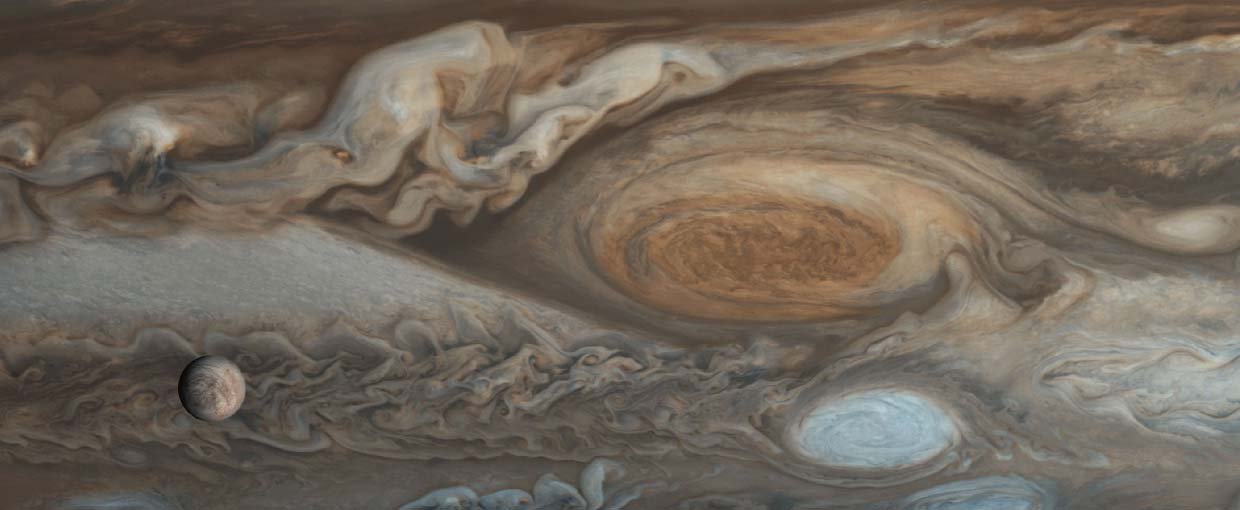
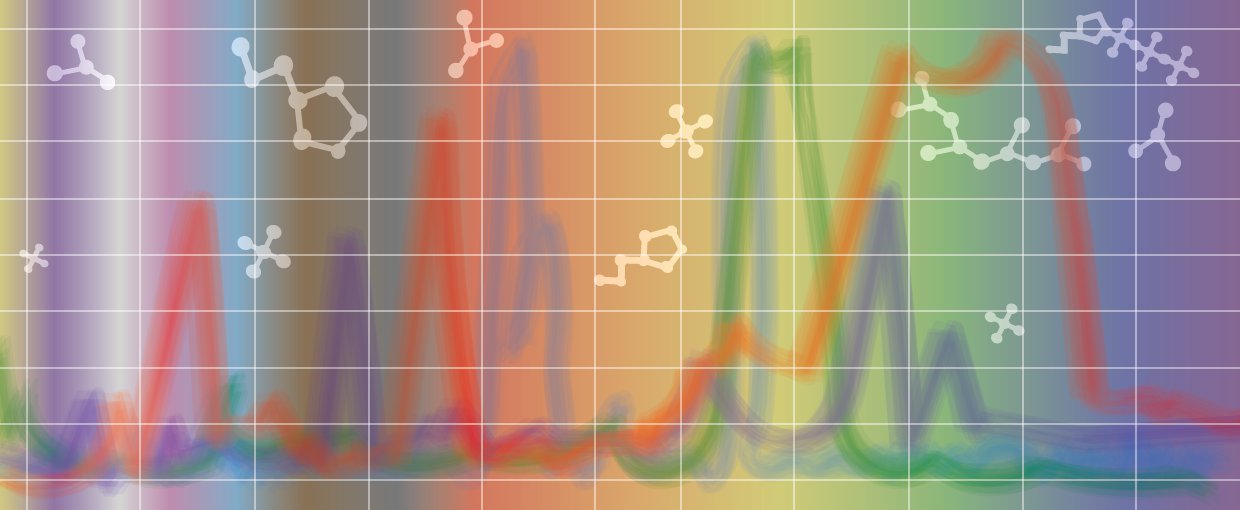
A volcanically active planet is shown in closeup at the left side of the image with glowing eruptions and lines of lava on the surface. To the right and in the distance is a faint blue glowing ball representing the more massive planet in the system.Sixteen frames from Voyager 1's flyby of Jupiter in 1979 were merged to create this image. Jupiter's Great Red Spot is visible in the center. Jupiter's moon Europa can be seen in the foreground at the bottom left of the image.The frame is a horizontal rainbow of color on a grid. Shadows of molecules can be seen through the light as well as the jagged peaks and troughs of spectral lines.
Fizzy Super Earths and Lava Worlds“Fizzy Super-Earths: Impacts of Magma Composition on the Bulk Density and Structure of Lava Worlds.” in The Astrophysical Journal.01/03
Identifying Hydrothermal Activity on Icy Ocean Worlds“Ethene-ethanol ratios as potential indicators of hydrothermal activity at Enceladus, Europa, and other icy ocean worlds.” In Icarus.02/03
NASA Raman Spectroscopic Database"The NASA Raman spectroscopic database: Ramdb version 1.00.” In Icarus.03/03
NextPrevious
Go Explore
May 2015Uranium and molybdenum isotope evidence for an episode of widespread ocean oxygenation during the late Ediacaran Period

Kendall, B., Komiya, T., Lyons, T. W., Bates, S. M., Gordon, G. W., Romaniello, S. J., … Jiang, G. (2015). Geochimica et Cosmochimica Acta, 156(None), 173–193. doi:10.1016/j.gca.2015.02.025

Prebiotic Alternatives to Proteins: Structure and Function of Hyperbranched Polyesters

Mamajanov, I., Callahan, M. P., Dworkin, J. P., & Cody, G. D. (2015). Orig Life Evol Biosph, 45(1-2), 123–137. doi:10.1007/s11084-015-9430-9

Limited Zn and Ni mobility during simulated iron formation diagenesis

Robbins, L. J., Swanner, E. D., Lalonde, S. V., Eickhoff, M., Paranich, M. L., Reinhard, C. T., … Peacock, C. L. (2015). Chemical Geology, 402(None), 30–39. doi:10.1016/j.chemgeo.2015.02.037

Nonphotosynthetic Pigments as Potential Biosignatures

Schwieterman, E. W., Cockell, C. S., & Meadows, V. S. (2015). Astrobiology, 15(5), 341–361. doi:10.1089/ast.2014.1178

Tectonostratigraphic evolution of the c. 780-730 Ma Beck Spring Dolomite: Basin Formation in the core of Rodinia

Smith, E. F., MacDonald, F. A., Crowley, J. L., Hodgin, E. B., & Schrag, D. P. (2015). Geological Society, London, Special Publications, 424(1), 213–239. doi:10.1144/sp424.6

CONSTRAINING THE ABUNDANCES OF COMPLEX ORGANICS IN THE INNER REGIONS OF SOLAR-TYPE PROTOSTARS

Taquet, V., López-Sepulcre, A., Ceccarelli, C., Neri, R., Kahane, C., & Charnley, S. B. (2015). The Astrophysical Journal, 804(2), 81. doi:10.1088/0004-637x/804/2/81

A CATALOG OF STELLAR EVOLUTION PROFILES AND THE EFFECTS OF VARIABLE COMPOSITION ON HABITABLE SYSTEMS

Truitt, A., Young, P. A., Spacek, A., Probst, L., & Dietrich, J. (2015). The Astrophysical Journal, 804(2), 145. doi:10.1088/0004-637x/804/2/145

Comparison of Archaeal and Bacterial Diversity in Methane Seep Carbonate Nodules and Host Sediments, Eel River Basin and Hydrate Ridge, USA

Mason, O. U., Case, D. H., Naehr, T. H., Lee, R. W., Thomas, R. B., Bailey, J. V., & Orphan, V. J. (2015). Microbial Ecology, 70(3), 766–784. doi:10.1007/s00248-015-0615-6