

This website is currently being migrated. For the most up-to-date astrobiology news, resources, and community announcements, please visit our new home at science.nasa.gov/astrobiology

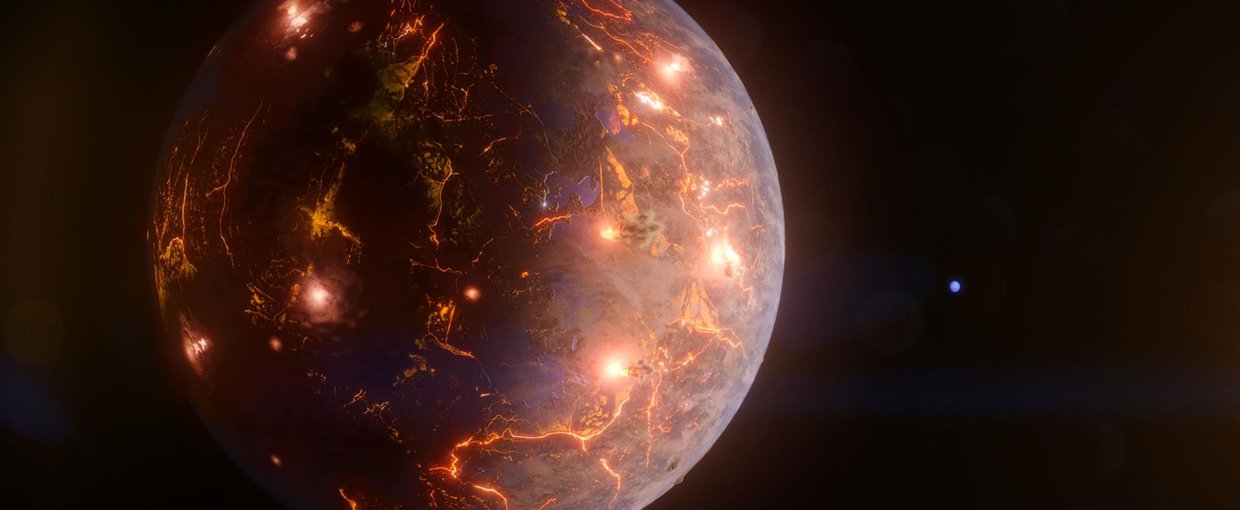
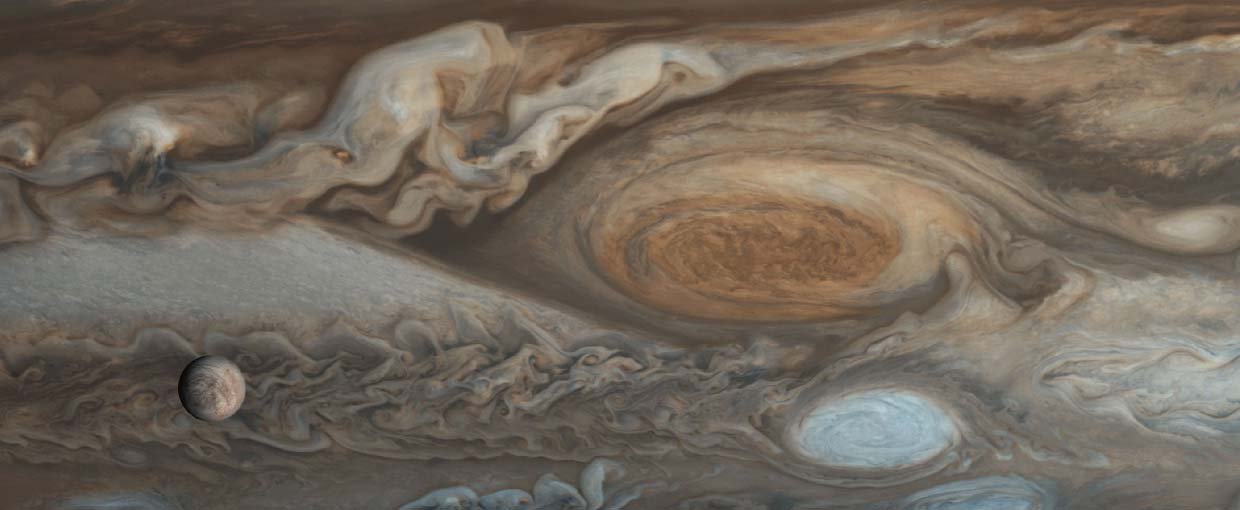
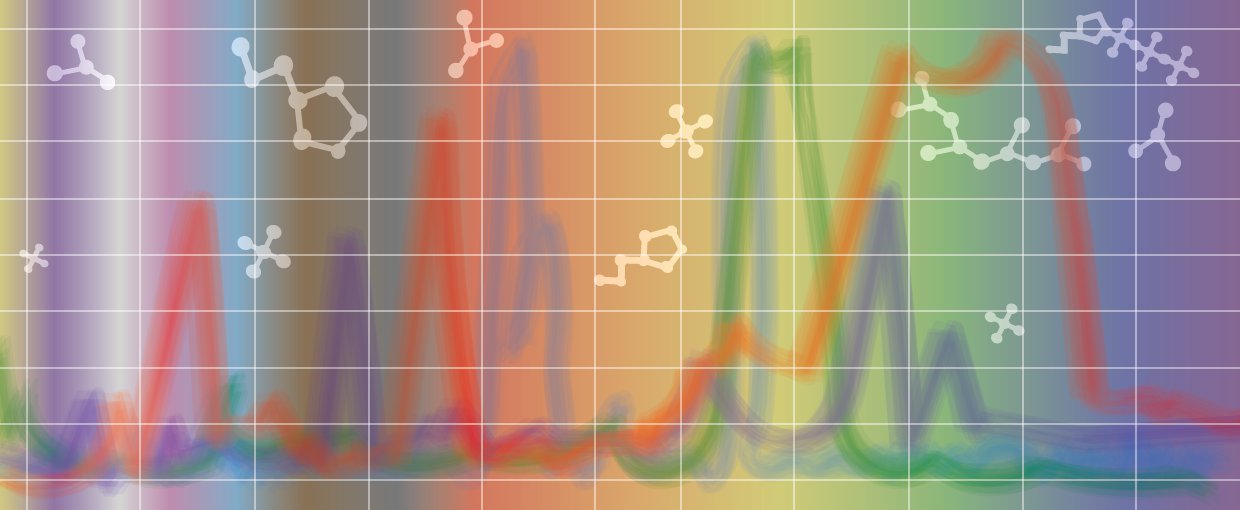
A volcanically active planet is shown in closeup at the left side of the image with glowing eruptions and lines of lava on the surface. To the right and in the distance is a faint blue glowing ball representing the more massive planet in the system.Sixteen frames from Voyager 1's flyby of Jupiter in 1979 were merged to create this image. Jupiter's Great Red Spot is visible in the center. Jupiter's moon Europa can be seen in the foreground at the bottom left of the image.The frame is a horizontal rainbow of color on a grid. Shadows of molecules can be seen through the light as well as the jagged peaks and troughs of spectral lines.
Fizzy Super Earths and Lava Worlds“Fizzy Super-Earths: Impacts of Magma Composition on the Bulk Density and Structure of Lava Worlds.” in The Astrophysical Journal.01/03
Identifying Hydrothermal Activity on Icy Ocean Worlds“Ethene-ethanol ratios as potential indicators of hydrothermal activity at Enceladus, Europa, and other icy ocean worlds.” In Icarus.02/03
NASA Raman Spectroscopic Database"The NASA Raman spectroscopic database: Ramdb version 1.00.” In Icarus.03/03
NextPrevious
Go Explore
June 2015Transient Sulfate Aerosols as a Signature of Exoplanet Volcanism

Misra, A., Krissansen-Totton, J., Koehler, M. C., & Sholes, S. (2015). Astrobiology, 15(6), 462–477. doi:10.1089/ast.2014.1204

New Insights into the Evolution of the Human Diet from Faecal Biomarker Analysis in Wild Chimpanzee and Gorilla Faeces

Sistiaga, A., Wrangham, R., Rothman, J. M., & Summons, R. E. (2015). PLoS ONE, 10(6), e0128931. doi:10.1371/journal.pone.0128931

Metabolic precursors in astrophysical ice analogs: implications for meteorites and comets

Smith, K. E., Gerakines, P. A., & Callahan, M. P. (2015). Chem. Commun., 51(59), 11787–11790. doi:10.1039/c5cc03272e

Metabolic precursors in astrophysical ice analogs: implications for meteorites and comets

Smith, K. E., Gerakines, P. A., & Callahan, M. P. (2015). Chem. Commun., 51(59), 11787–11790. doi:10.1039/c5cc03272e

The Composition of the Protosolar Disk and the Formation Conditions for Comets

Willacy, K., Alexander, C., Ali-Dib, M., Ceccarelli, C., Charnley, S. B., Doronin, M., … Ellinger, Y. (2015). Space Sci Rev, 197(1-4), 151–190. doi:10.1007/s11214-015-0167-6

Biochemical and Structural Characterization of Enolase from Chloroflexus aurantiacus: Evidence for a Thermophilic Origin

Zadvornyy, O. A., Boyd, E. S., Posewitz, M. C., Zorin, N. A., & Peters, J. W. (2015). Frontiers in Bioengineering and Biotechnology, 3(None), None. doi:10.3389/fbioe.2015.00074

Subsurface hydrothermal processes and the bioenergetics of chemolithoautotrophy at the shallow-sea vents off Panarea Island (Italy)

Price, R. E., LaRowe, D. E., Italiano, F., Savov, I., Pichler, T., & Amend, J. P. (2015). Chemical Geology, 407-408(None), 21–45. doi:10.1016/j.chemgeo.2015.04.011

Bacillus rigiliprofundi sp. nov., an endospore-forming, Mn-oxidizing, moderately halophilic bacterium isolated from deep subseafloor basaltic crust

Sylvan, J. B., Amend, J. P., Momper, L. M., Edwards, K. J., Toner, B. M., & Hoffman, C. L. (2015). International Journal of Systematic and Evolutionary Microbiology, 65(6), 1992–1998. doi:10.1099/ijs.0.000211

May 2015Framework for analyzing ecological trait-based models in multidimensional niche spaces

Biancalani, T., DeVille, L., & Goldenfeld, N. (2015). Framework for analyzing ecological trait-based models in multidimensional niche spaces. Physical Review E, 91(5), None. doi:10.1103/physreve.91.052107

Microbes that Meddle with Metals

Glass, J. B. (2015). Microbes that Meddle with Metals. Microbe Magazine, 10(5), 197–202. doi:10.1128/microbe.10.197.1