


This website is currently being migrated. For the most up-to-date astrobiology news, resources, and community announcements, please visit our new home at science.nasa.gov/astrobiology

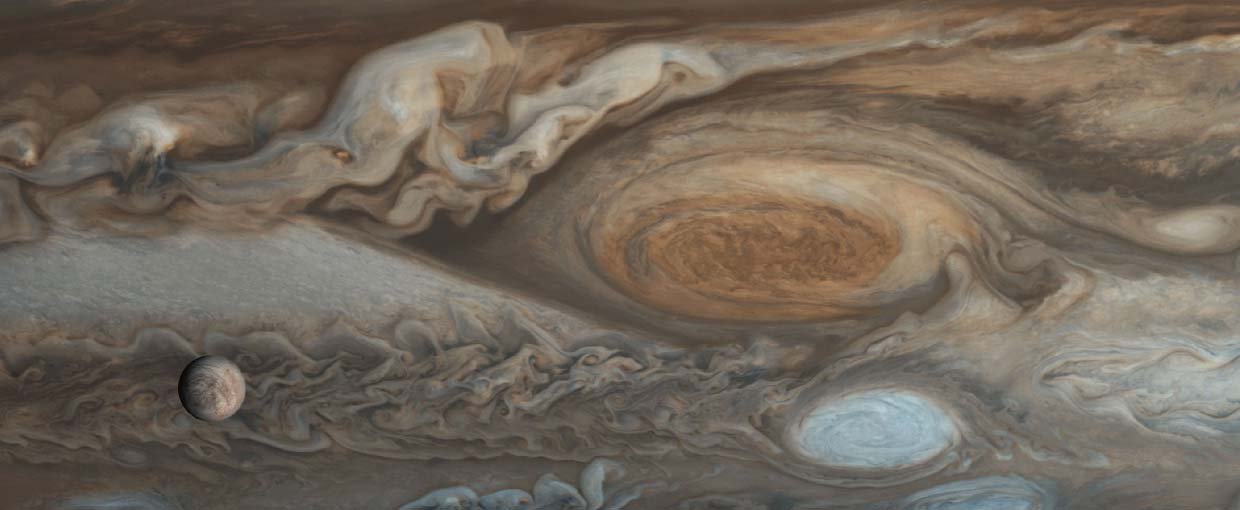
A volcanically active planet is shown in closeup at the left side of the image with glowing eruptions and lines of lava on the surface. To the right and in the distance is a faint blue glowing ball representing the more massive planet in the system.Sixteen frames from Voyager 1's flyby of Jupiter in 1979 were merged to create this image. Jupiter's Great Red Spot is visible in the center. Jupiter's moon Europa can be seen in the foreground at the bottom left of the image.The frame is a horizontal rainbow of color on a grid. Shadows of molecules can be seen through the light as well as the jagged peaks and troughs of spectral lines.
Fizzy Super Earths and Lava Worlds“Fizzy Super-Earths: Impacts of Magma Composition on the Bulk Density and Structure of Lava Worlds.” in The Astrophysical Journal.01/03
Identifying Hydrothermal Activity on Icy Ocean Worlds“Ethene-ethanol ratios as potential indicators of hydrothermal activity at Enceladus, Europa, and other icy ocean worlds.” In Icarus.02/03
NASA Raman Spectroscopic Database"The NASA Raman spectroscopic database: Ramdb version 1.00.” In Icarus.03/03
NextPrevious
Go Explore
April 2017Shifting microbial communities sustain multiyear iron reduction and methanogenesis in ferruginous sediment incubations

Bray, M. S., Wu, J., Reed, B. C., Kretz, C. B., Belli, K. M., Simister, R. L., … Glass, J. B. (2017). Shifting microbial communities sustain multiyear iron reduction and methanogenesis in ferruginous sediment incubations. Geobiology. doi:10.1111/gbi.12239

Reconstructed ancestral enzymes suggest long-term cooling of Earth’s photic zone since the Archean

Garcia, A. K., Schopf, J. W., Yokobori, S-I., Akanuma, S., & Yamagishi, A. (2017). Reconstructed ancestral enzymes suggest long-term cooling of Earth’s photic zone since the Archean. Proceedings of the National Academy of Sciences, 114(18), 4619–4624. doi:10.1073/pnas.1702729114

Perspectives on Proterozoic surface ocean redox from iodine contents in ancient and recent carbonate

Hardisty, D. S., Lu, Z., Bekker, A., Diamond, C. W., Gill, B. C., Jiang, G., … Lyons, T. W. (2017). Perspectives on Proterozoic surface ocean redox from iodine contents in ancient and recent carbonate. Earth and Planetary Science Letters, 463, 159–170. doi:10.1016/j.epsl.2017.01.032

Global water cycle and the coevolution of the Earth’s interior and surface environment

Korenaga, J., Planavsky, N. J., & Evans, D. A. D. (2017). Global water cycle and the coevolution of the Earth’s interior and surface environment. Philosophical Transactions of the Royal Society A: Mathematical, Physical and Engineering Sciences, 375(2094), 20150393. doi:10.1098/rsta.2015.0393

Reflections on O2 as a Biosignature in Exoplanetary Atmospheres

Meadows, V. S. (2017). Reflections on O2 as a Biosignature in Exoplanetary Atmospheres. Astrobiology. doi:10.1089/ast.2016.1578

Paleoecology and paleoceanography of the Athel silicilyte, Ediacaran-Cambrian boundary, Sultanate of Oman

Stolper, D. A., Love, G. D., Bates, S., Lyons, T. W., Young, E., Sessions, A. L., & Grotzinger, J. P. (2017). Paleoecology and paleoceanography of the Athel silicilyte, Ediacaran-Cambrian boundary, Sultanate of Oman. Geobiology, 15(3), 401–426. doi:10.1111/gbi.12236

Salt partitioning between water and high-pressure ices. Implication for the dynamics and habitability of icy moons and water-rich planetary bodies

Journaux, B., Daniel, I., Petitgirard, S., Cardon, H., Perrillat, J-P., Caracas, R., & Mezouar, M. (2017). Salt partitioning between water and high-pressure ices. Implication for the dynamics and habitability of icy moons and water-rich planetary bodies. Earth and Planetary Science Letters, 463, 36–47. doi:10.1016/j.epsl.2017.01.017

Silicate-Promoted Phosphorylation of Glycerol in Non-Aqueous Solvents: A Prebiotically Plausible Route to Organophosphates

Gull, M., Cafferty, B. J., Hud, N. V., & Pasek, M. A. (2017). Silicate-Promoted Phosphorylation of Glycerol in Non-Aqueous Solvents: A Prebiotically Plausible Route to Organophosphates. None. doi:10.20944/preprints201704.0168.v1

Shifting microbial communities sustain multiyear iron reduction and methanogenesis in ferruginous sediment incubations

Bray, M.S., Wu, J., Reed, B.C., Kretz, C.B., Belli, K.M., Simister, R.L., Henny, C., Stewart, F.J., DiChristina, T.J., Brandes, J.A., Fowle, D.A., Crowe, S.A., Glass, J.B. (2017) Geobiology, 15(5), 678–689.

A geochemical study of the Ediacaran discoidal fossil Aspidella preserved in limestones: Implications for its taphonomy and paleoecology

Bykova, N., Gill, B. C., Grazhdankin, D., Rogov, V., & Xiao, S. (2017). A geochemical study of the Ediacaran discoidal fossil Aspidella preserved in limestones: Implications for its taphonomy and paleoecology. Geobiology, 15(4), 572–587. doi:10.1111/gbi.12240