


This website is currently being migrated. For the most up-to-date astrobiology news, resources, and community announcements, please visit our new home at science.nasa.gov/astrobiology

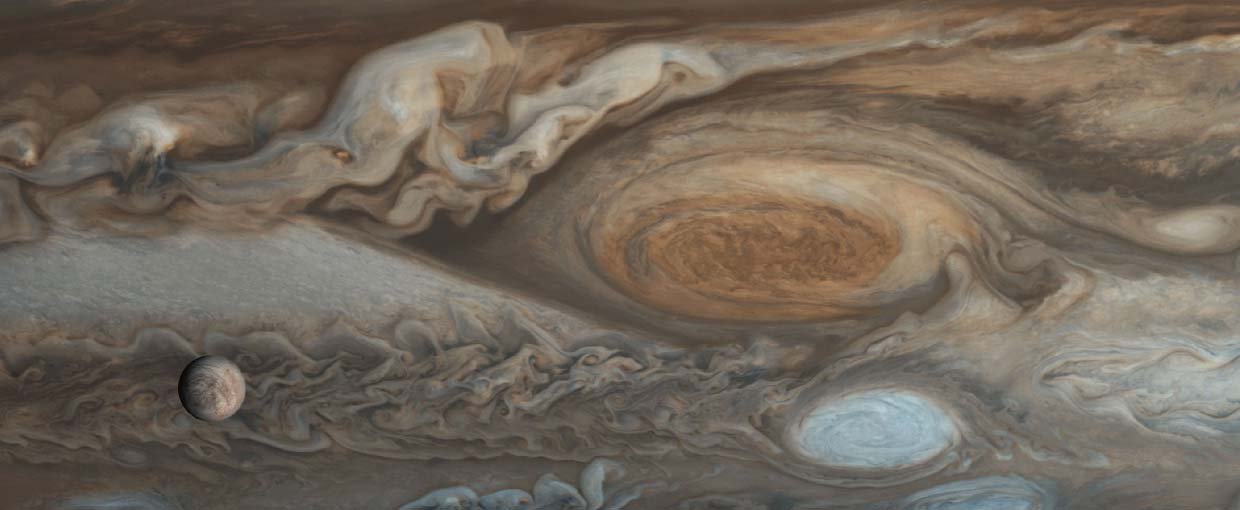
A volcanically active planet is shown in closeup at the left side of the image with glowing eruptions and lines of lava on the surface. To the right and in the distance is a faint blue glowing ball representing the more massive planet in the system.Sixteen frames from Voyager 1's flyby of Jupiter in 1979 were merged to create this image. Jupiter's Great Red Spot is visible in the center. Jupiter's moon Europa can be seen in the foreground at the bottom left of the image.The frame is a horizontal rainbow of color on a grid. Shadows of molecules can be seen through the light as well as the jagged peaks and troughs of spectral lines.
Fizzy Super Earths and Lava Worlds“Fizzy Super-Earths: Impacts of Magma Composition on the Bulk Density and Structure of Lava Worlds.” in The Astrophysical Journal.01/03
Identifying Hydrothermal Activity on Icy Ocean Worlds“Ethene-ethanol ratios as potential indicators of hydrothermal activity at Enceladus, Europa, and other icy ocean worlds.” In Icarus.02/03
NASA Raman Spectroscopic Database"The NASA Raman spectroscopic database: Ramdb version 1.00.” In Icarus.03/03
NextPrevious
Go Explore
May 2017Quantification of oxygen isotope SIMS matrix effects in olivine samples: Correlation with sputter rate

Isa, J., Kohl, I. E., Liu, M-C., Wasson, J. T., Young, E. D., & McKeegan, K. D. (2017). Quantification of oxygen isotope SIMS matrix effects in olivine samples: Correlation with sputter rate. Chemical Geology, 458, 14–21. doi:10.1016/j.chemgeo.2017.03.020

Constraining climate sensitivity and continental versus seafloor weathering using an inverse geological carbon cycle model

Krissansen-Totton, J., & Catling, D. C. (2017). Constraining climate sensitivity and continental versus seafloor weathering using an inverse geological carbon cycle model. Nature Communications, 8, 15423. doi:10.1038/ncomms15423

Global Diversity of Desert Hypolithic Cyanobacteria

Lacap-Bugler, D. C., Lee, K. K., Archer, S., Gillman, L. N., Lau, M. C. Y., Leuzinger, S., … Pointing, S. B. (2017). Global Diversity of Desert Hypolithic Cyanobacteria. Frontiers in Microbiology, 8, None. doi:10.3389/fmicb.2017.00867

Cryostratigraphy and the Sublimation Unconformity in Permafrost from an Ultraxerous Environment, University Valley, McMurdo Dry Valleys of Antarctica

Lapalme, C. M., Lacelle, D., Pollard, W., Fortier, D., Davila, A., & McKay, C. P. (2017). Cryostratigraphy and the Sublimation Unconformity in Permafrost from an Ultraxerous Environment, University Valley, McMurdo Dry Valleys of Antarctica. Permafrost and Periglacial Processes. doi:10.1002/ppp.1948

Biogeography of cryoconite bacterial communities on glaciers of the Tibetan Plateau

Liu, Y., Vick-Majors, T. J., Priscu, J. C., Yao, T., Kang, S., Liu, K., … Li, Y. (2017). Biogeography of cryoconite bacterial communities on glaciers of the Tibetan Plateau. FEMS Microbiology Ecology, 93(6), None. doi:10.1093/femsec/fix072

A Study of the Microbial Spatial Heterogeneity of Bahamian Thrombolites Using Molecular, Biochemical, and Stable Isotope Analyses

Louyakis, A. S., Mobberley, J. M., Vitek, B. E., Visscher, P. T., Hagan, P. D., Reid, R. P., … Foster, J. S. (2017). A Study of the Microbial Spatial Heterogeneity of Bahamian Thrombolites Using Molecular, Biochemical, and Stable Isotope Analyses. Astrobiology, 17(5), 413–430. doi:10.1089/ast.2016.1563

A Supernova at 50 pc: Effects on the Earth's Atmosphere and Biota

Melott, A. L., Thomas, B. C., Kachelrieß, M., Semikoz, D. V., & Overholt, A. C. (2017). A Supernova at 50 pc: Effects on the Earth's Atmosphere and Biota. The Astrophysical Journal, 840(2), 105. doi:10.3847/1538-4357/aa6c57

Snowball Earth: Asynchronous coupling of sea-glacier flow with a global climate model

Pollard, D., Kasting, J. F., & Zugger, M. E. (2017). Snowball Earth: Asynchronous coupling of sea-glacier flow with a global climate model. Journal of Geophysical Research: Atmospheres, 122(10), 5157–5171. doi:10.1002/2017jd026621

Cometary dust: the diversity of primitive refractory grains

Wooden, D. H., Ishii, H. A., & Zolensky, M. E. (2017). Cometary dust: the diversity of primitive refractory grains. Philosophical Transactions of the Royal Society A: Mathematical, Physical and Engineering Sciences, 375(2097), 20160260. doi:10.1098/rsta.2016.0260

Expansion of photic-zone euxinia during the Permian–Triassic biotic crisis and its causes: Microbial biomarker records

Zhou, W., Algeo, T. J., Ruan, X., Luo, G., Chen, Z-Q., & Xie, S. (2017). Expansion of photic-zone euxinia during the Permian–Triassic biotic crisis and its causes: Microbial biomarker records. Palaeogeography, Palaeoclimatology, Palaeoecology, 474, 140–151. doi:10.1016/j.palaeo.2016.06.027