


This website is currently being migrated. For the most up-to-date astrobiology news, resources, and community announcements, please visit our new home at science.nasa.gov/astrobiology

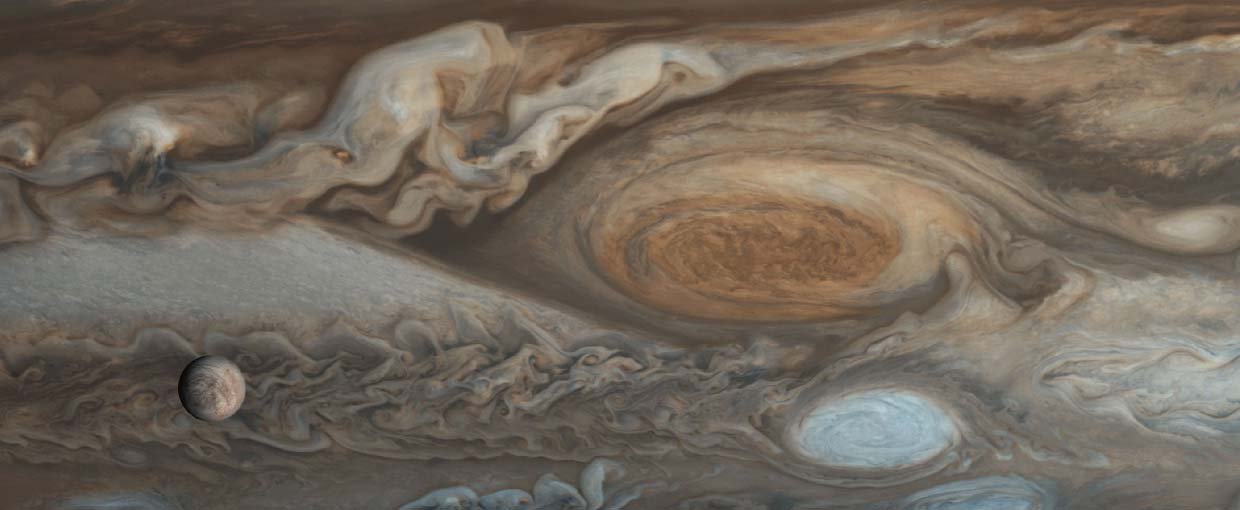
A volcanically active planet is shown in closeup at the left side of the image with glowing eruptions and lines of lava on the surface. To the right and in the distance is a faint blue glowing ball representing the more massive planet in the system.Sixteen frames from Voyager 1's flyby of Jupiter in 1979 were merged to create this image. Jupiter's Great Red Spot is visible in the center. Jupiter's moon Europa can be seen in the foreground at the bottom left of the image.The frame is a horizontal rainbow of color on a grid. Shadows of molecules can be seen through the light as well as the jagged peaks and troughs of spectral lines.
Fizzy Super Earths and Lava Worlds“Fizzy Super-Earths: Impacts of Magma Composition on the Bulk Density and Structure of Lava Worlds.” in The Astrophysical Journal.01/03
Identifying Hydrothermal Activity on Icy Ocean Worlds“Ethene-ethanol ratios as potential indicators of hydrothermal activity at Enceladus, Europa, and other icy ocean worlds.” In Icarus.02/03
NASA Raman Spectroscopic Database"The NASA Raman spectroscopic database: Ramdb version 1.00.” In Icarus.03/03
NextPrevious
Go Explore
March 2017Sulfur Hazes in Giant Exoplanet Atmospheres: Impacts on Reflected Light Spectra

Gao, P., Marley, M. S., Zahnle, K., Robinson, T. D., & Lewis, N. K. (2017). Sulfur Hazes in Giant Exoplanet Atmospheres: Impacts on Reflected Light Spectra. The Astronomical Journal, 153(3), 139. doi:10.3847/1538-3881/aa5fab

Discontinuous drainage systems formed by highland precipitation and ground-water outflow in the Navua Valles and southwest Hadriacus Mons regions, Mars

Hargitai, H. I., Gulick, V. C., & Glines, N. H. (2017). Discontinuous drainage systems formed by highland precipitation and ground-water outflow in the Navua Valles and southwest Hadriacus Mons regions, Mars. Icarus. doi:10.1016/j.icarus.2017.03.005

Noise-induced symmetry breaking far from equilibrium and the emergence of biological homochirality

Jafarpour, F., Biancalani, T., & Goldenfeld, N. (2017). Noise-induced symmetry breaking far from equilibrium and the emergence of biological homochirality. Physical Review E, 95(3), None. doi:10.1103/physreve.95.032407

Metagenome sequencing and 98 microbial genomes from Juan de Fuca Ridge flank subsurface fluids

Jungbluth, S. P., Amend, J. P., & Rappé, M. S. (2017). Metagenome sequencing and 98 microbial genomes from Juan de Fuca Ridge flank subsurface fluids. Scientific Data, 4, 170037. doi:10.1038/sdata.2017.37

Thermally anomalous features in the subsurface of Enceladus’s south polar terrain

Le Gall, A., Leyrat, C., Janssen, M. A., Choblet, G., Tobie, G., Bourgeois, O., … Paganelli, F. (2017). Thermally anomalous features in the subsurface of Enceladus’s south polar terrain. Nature Astronomy, 1(4), 0063. doi:10.1038/s41550-017-0063

An efficient microbial fuel cell using a CNT–RTIL based nanocomposite

Mahrokh, L., Ghourchian, H., Nealson, K. H., & Mahrokh, M. (2017). An efficient microbial fuel cell using a CNT–RTIL based nanocomposite. J. Mater. Chem. A, 5(17), 7979–7991. doi:10.1039/c6ta09766a

Tracking electron uptake from a cathode into Shewanella cells: implications for generating maintenance energy from solid substrates.

Rowe, A. R., Rajeev, P., Jain, A., Pirbadian, S., Okamotao, A., Gralnick, J. A., … Nealson, K. (2017). Tracking electron uptake from a cathode into Shewanella cells: implications for generating maintenance energy from solid substrates.. None. doi:10.1101/116475

Evolution of mutation rates in hypermutable populations of Escherichia coli propagated at very small effective population size

Singh, T., Hyun, M., & Sniegowski, P. (2017). Evolution of mutation rates in hypermutable populations of Escherichia coli propagated at very small effective population size . Biology Letters, 13(3), 20160849. doi:10.1098/rsbl.2016.0849

Submarine Basaltic Glass Colonization by the Heterotrophic Fe(II)-Oxidizing and Siderophore-Producing Deep-Sea Bacterium Pseudomonas stutzeri VS-10: The Potential Role of Basalt in Enhancing Growth

Sudek, L. A., Wanger, G., Templeton, A. S., Staudigel, H., & Tebo, B. M. (2017). Submarine Basaltic Glass Colonization by the Heterotrophic Fe(II)-Oxidizing and Siderophore-Producing Deep-Sea Bacterium Pseudomonas stutzeri VS-10: The Potential Role of Basalt in Enhancing Growth. Frontiers in Microbiology, 8, None. doi:10.3389/fmicb.2017.00363

Constraints on Climate and Habitability for Earth-like Exoplanets Determined from a General Circulation Model

Wolf, E. T., Shields, A. L., Kopparapu, R. K., Haqq-Misra, J., & Toon, O. B. (2017). Constraints on Climate and Habitability for Earth-like Exoplanets Determined from a General Circulation Model. The Astrophysical Journal, 837(2), 107. doi:10.3847/1538-4357/aa5ffc