

This website is currently being migrated. For the most up-to-date astrobiology news, resources, and community announcements, please visit our new home at science.nasa.gov/astrobiology

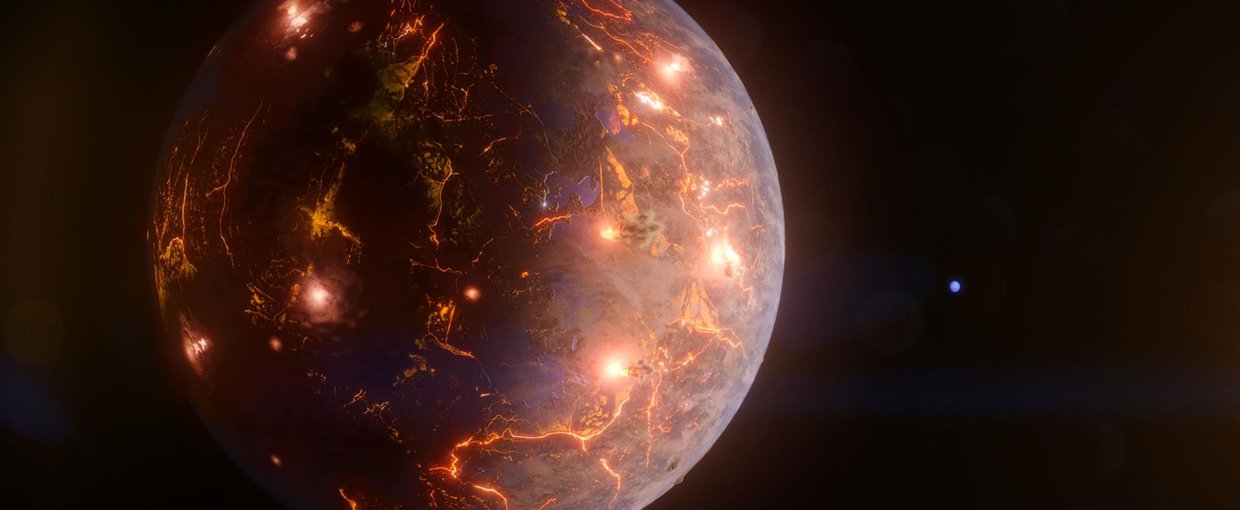
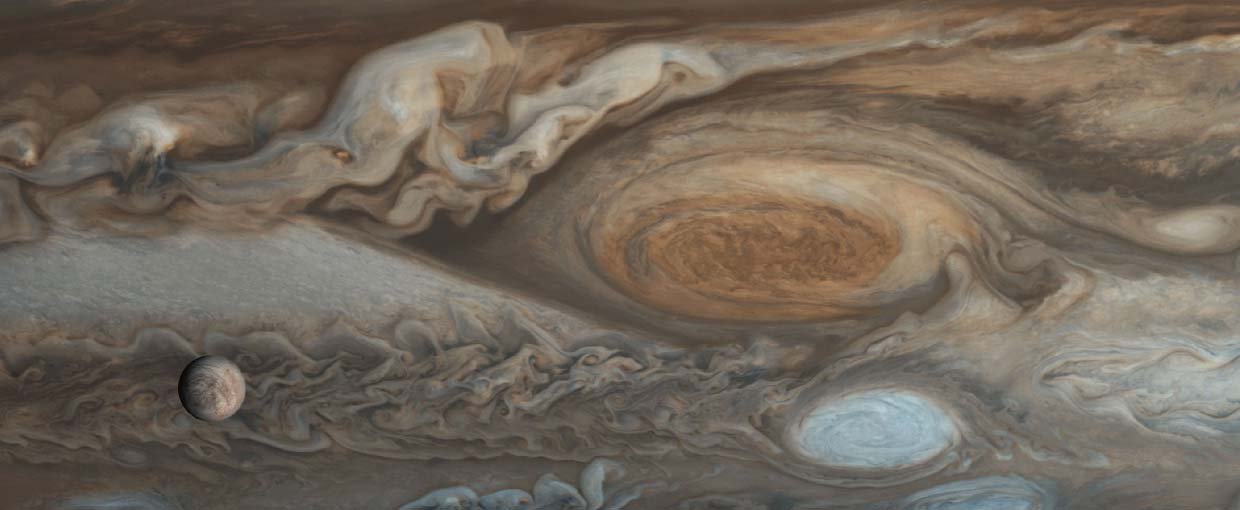
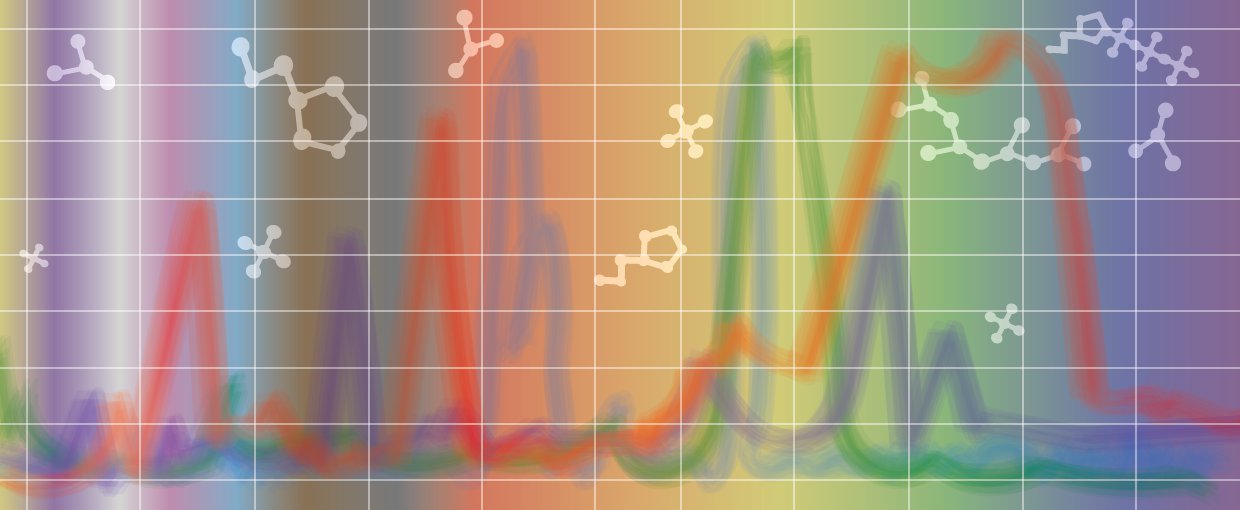
A volcanically active planet is shown in closeup at the left side of the image with glowing eruptions and lines of lava on the surface. To the right and in the distance is a faint blue glowing ball representing the more massive planet in the system.Sixteen frames from Voyager 1's flyby of Jupiter in 1979 were merged to create this image. Jupiter's Great Red Spot is visible in the center. Jupiter's moon Europa can be seen in the foreground at the bottom left of the image.The frame is a horizontal rainbow of color on a grid. Shadows of molecules can be seen through the light as well as the jagged peaks and troughs of spectral lines.
Fizzy Super Earths and Lava Worlds“Fizzy Super-Earths: Impacts of Magma Composition on the Bulk Density and Structure of Lava Worlds.” in The Astrophysical Journal.01/03
Identifying Hydrothermal Activity on Icy Ocean Worlds“Ethene-ethanol ratios as potential indicators of hydrothermal activity at Enceladus, Europa, and other icy ocean worlds.” In Icarus.02/03
NASA Raman Spectroscopic Database"The NASA Raman spectroscopic database: Ramdb version 1.00.” In Icarus.03/03
NextPrevious
Go Explore
January 2010Deciphering Spectral Fingerprints of Habitable Exoplanets

Kaltenegger, L., Selsis, F., Fridlund, M., Lammer, H., Beichman, C., Danchi, W., … Eiroa, C. (2010). Astrobiology, 10(1), 89–102. doi:10.1089/ast.2009.0381

THE IMPORTANCE OF COMPARTMENTALIZATION IN METABOLIC FLUX MODELS: YEAST AS AN ECOSYSTEM OF ORGANELLES

Klitgord, N., & SEGRÈ, D. (2010). Genome Informatics 2009. doi:10.1142/9781848165786_0005

Geophysical and Atmospheric Evolution of Habitable Planets

Lammer, H., Selsis, F., Chassefière, E., Breuer, D., Grießmeier, J-M., Kulikov, Y. N., … Erkaev, N. V. (2010). Astrobiology, 10(1), 45–68. doi:10.1089/ast.2009.0368

MICROBIAL BIOSIGNATURES IN IRON-MINERALIZED PHOTOTROPHIC MATS AT CHOCOLATE POTS HOT SPRINGS, YELLOWSTONE NATIONAL PARK, UNITED STATES

Parenteau, M. N., & Cady, S. L. (2010). PALAIOS, 25(2), 97–111. doi:10.2110/palo.2008.p08-133r

A SYMPLECTIC INTEGRATOR FOR HILL'S EQUATIONS

Quinn, T., Perrine, R. P., Richardson, D. C., & Barnes, R. (2010). The Astronomical Journal, 139(2), 803–807. doi:10.1088/0004-6256/139/2/803

The Far Future of Exoplanet Direct Characterization

Schneider, J., Léger, A., Fridlund, M., White, G. J., Eiroa, C., Henning, T., … Herbst, T. (2010). Astrobiology, 10(1), 121–126. doi:10.1089/ast.2009.0371

Microbial Provinces in the Subseafloor

Schrenk, M. O., Huber, J. A., & Edwards, K. J. (2010). Annu. Rev. Marine. Sci., 2(1), 279–304. doi:10.1146/annurev-marine-120308-081000

Where's the glass? Biomarkers, molecular clocks, and microRNAs suggest a 200-Myr missing Precambrian fossil record of siliceous sponge spicules

Sperling, E. A., Robinson, J. M., Pisani, D., & Peterson, K. J. (2010). Geobiology, 8(1), 24–36. doi:10.1111/j.1472-4669.2009.00225.x

Sound velocities and thermodynamic properties of water to 700 MPa and −10 to 100 °C

Vance, S., & Michael Brown, J. (2010). J. Acoust. Soc. Am., 127(1), 174. doi:10.1121/1.3257223

Biological influences on modern sulfates: Textures and composition of gypsum deposits from Guerrero Negro, Baja California Sur, Mexico

Vogel, M. B., Des Marais, D. J., Parenteau, M. N., Jahnke, L. L., Turk, K. A., & Kubo, M. D. Y. (2010). Sedimentary Geology, 223(3-4), 265–280. doi:10.1016/j.sedgeo.2009.11.013