

This website is currently being migrated. For the most up-to-date astrobiology news, resources, and community announcements, please visit our new home at science.nasa.gov/astrobiology

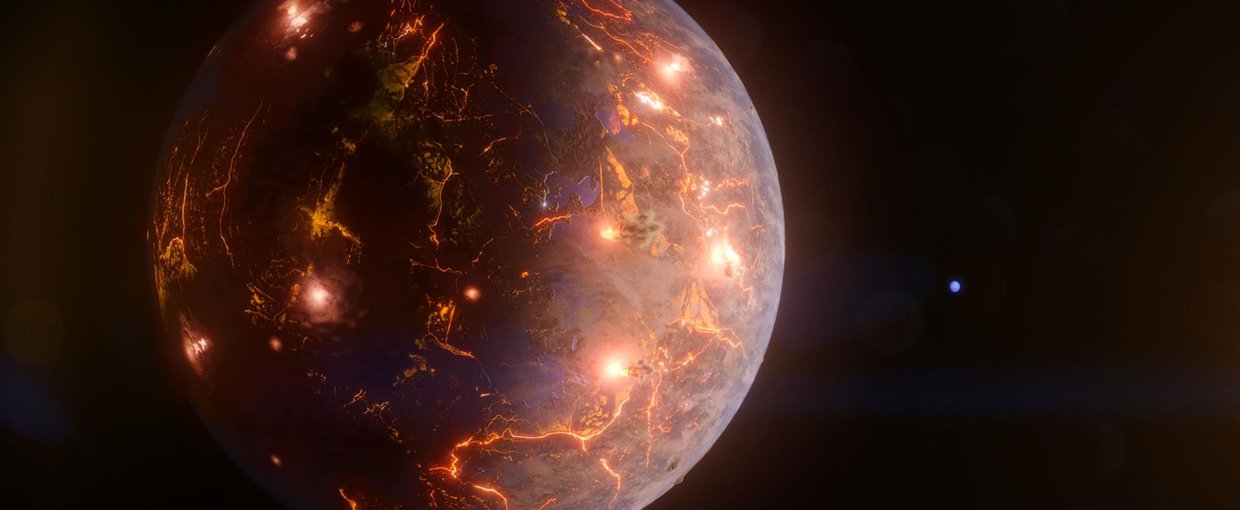
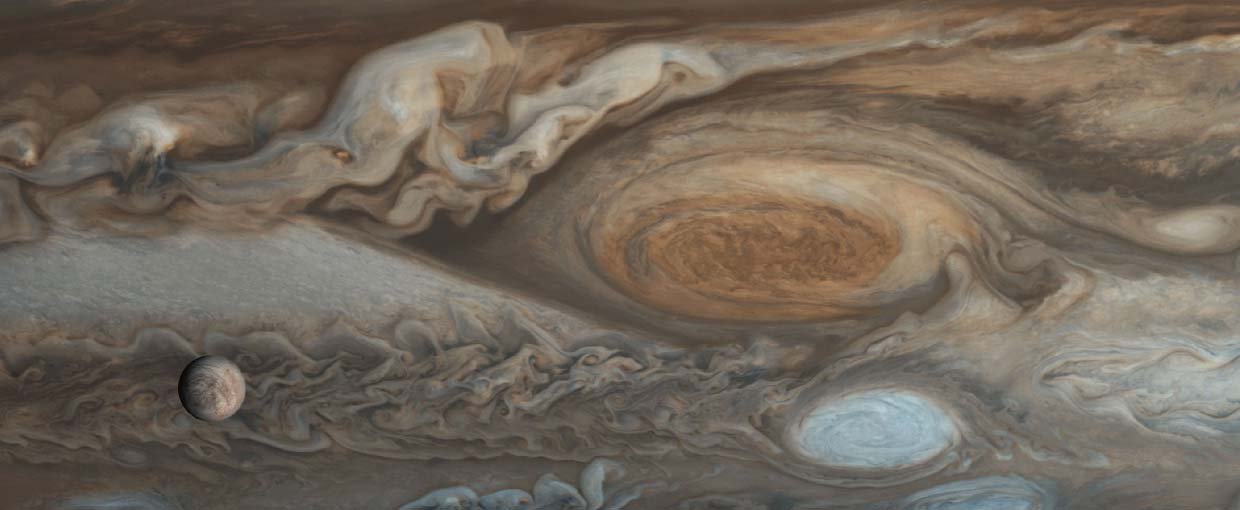
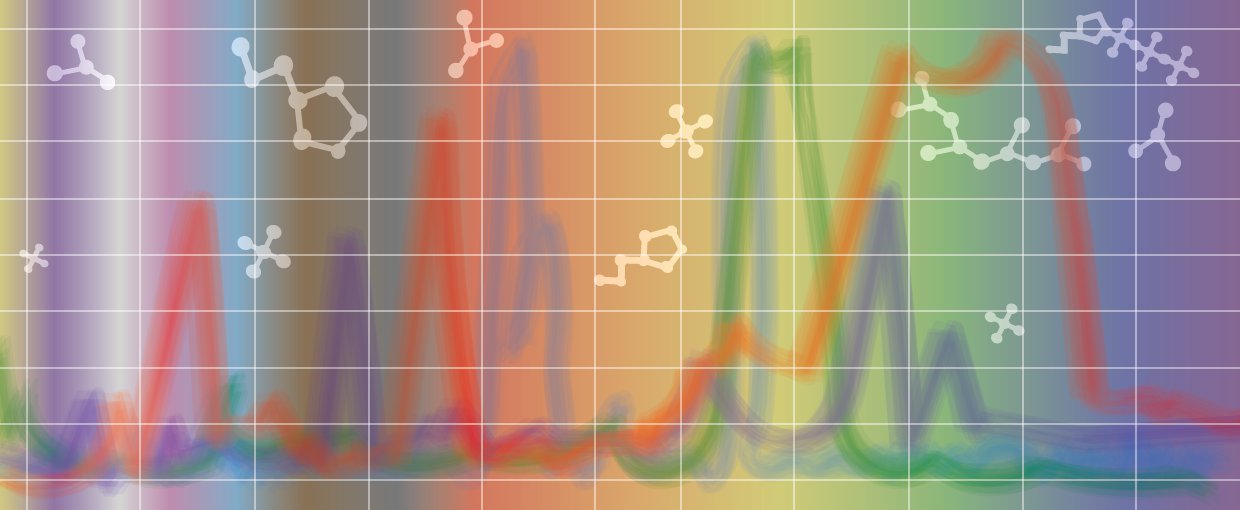
A volcanically active planet is shown in closeup at the left side of the image with glowing eruptions and lines of lava on the surface. To the right and in the distance is a faint blue glowing ball representing the more massive planet in the system.Sixteen frames from Voyager 1's flyby of Jupiter in 1979 were merged to create this image. Jupiter's Great Red Spot is visible in the center. Jupiter's moon Europa can be seen in the foreground at the bottom left of the image.The frame is a horizontal rainbow of color on a grid. Shadows of molecules can be seen through the light as well as the jagged peaks and troughs of spectral lines.
Fizzy Super Earths and Lava Worlds“Fizzy Super-Earths: Impacts of Magma Composition on the Bulk Density and Structure of Lava Worlds.” in The Astrophysical Journal.01/03
Identifying Hydrothermal Activity on Icy Ocean Worlds“Ethene-ethanol ratios as potential indicators of hydrothermal activity at Enceladus, Europa, and other icy ocean worlds.” In Icarus.02/03
NASA Raman Spectroscopic Database"The NASA Raman spectroscopic database: Ramdb version 1.00.” In Icarus.03/03
NextPrevious
Go Explore
February 2010Substrate specificity and evolutionary implications of a NifDK enzyme carrying NifB-co at its active site

Soboh, B., Boyd, E. S., Zhao, D., Peters, J. W., & Rubio, L. M. (2010). FEBS Letters, 584(8), 1487–1492. doi:10.1016/j.febslet.2010.02.064

Mapping Mars geochemically

Taylor, G. J., Martel, L. M. V., Karunatillake, S., Gasnault, O., & Boynton, W. V. (2010). Geology, 38(2), 183–186. doi:10.1130/g30470.1

January 2010Origin and Formation of Planetary Systems

Alibert, Y., Broeg, C., Benz, W., Wuchterl, G., Grasset, O., Sotin, C., … Eiroa, C. (2010). Astrobiology, 10(1), 19–32. doi:10.1089/ast.2009.0372

Pseudofossils in relict methane seep carbonates resemble endemic microbial consortia

Bailey, J. V., Raub, T. D., Meckler, A. N., Harrison, B. K., Raub, T. M. D., Green, A. M., & Orphan, V. J. (2010). Palaeogeography, Palaeoclimatology, Palaeoecology, 285(1-2), 131–142. doi:10.1016/j.palaeo.2009.11.002

CoRoT-7b: SUPER-EARTH OR SUPER-Io?

Barnes, R., Raymond, S. N., Greenberg, R., Jackson, B., & Kaib, N. A. (2010). The Astrophysical Journal, 709(2), L95–L98. doi:10.1088/2041-8205/709/2/l95

Kepler Planet-Detection Mission: Introduction and First Results

Borucki, W. J., Koch, D., Basri, G., Batalha, N., Brown, T., Caldwell, D., … Caldwell, J. (2010). Science, 327(5968), 977–980. doi:10.1126/science.1185402

Origin and Evolution of Life on Terrestrial Planets

Brack, A., Horneck, G., Cockell, C. S., Bérces, A., Belisheva, N. K., Eiroa, C., … Henning, T. (2010). Astrobiology, 10(1), 69–76. doi:10.1089/ast.2009.0374

Archaea and bacteria with surprising microdiversity show shifts in dominance over 1,000-year time scales in hydrothermal chimneys

Brazelton, W. J., Ludwig, K. A., Sogin, M. L., Andreishcheva, E. N., Kelley, D. S., Shen, C-C., … Edwards, R. L. (2010). Proceedings of the National Academy of Sciences, 107(4), 1612–1617. doi:10.1073/pnas.0905369107

Phosphorus and iron cycling in deep saprolite, Luquillo Mountains, Puerto Rico

Buss, H. L., Mathur, R., White, A. F., & Brantley, S. L. (2010). Chemical Geology, 269(1-2), 52–61. doi:10.1016/j.chemgeo.2009.08.001

Atmospheric origins of perchlorate on Mars and in the Atacama

Catling, D. C., Claire, M. W., Zahnle, K. J., Quinn, R. C., Clark, B. C., Hecht, M. H., & Kounaves, S. (2010). Journal of Geophysical Research, 115(None), None. doi:10.1029/2009je003425