

This website is currently being migrated. For the most up-to-date astrobiology news, resources, and community announcements, please visit our new home at science.nasa.gov/astrobiology

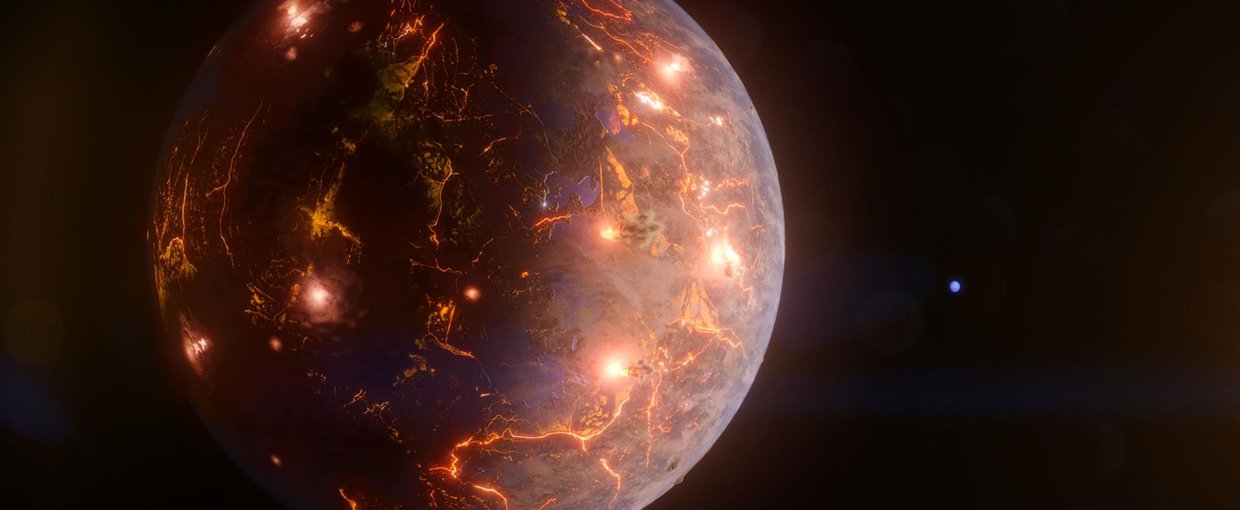
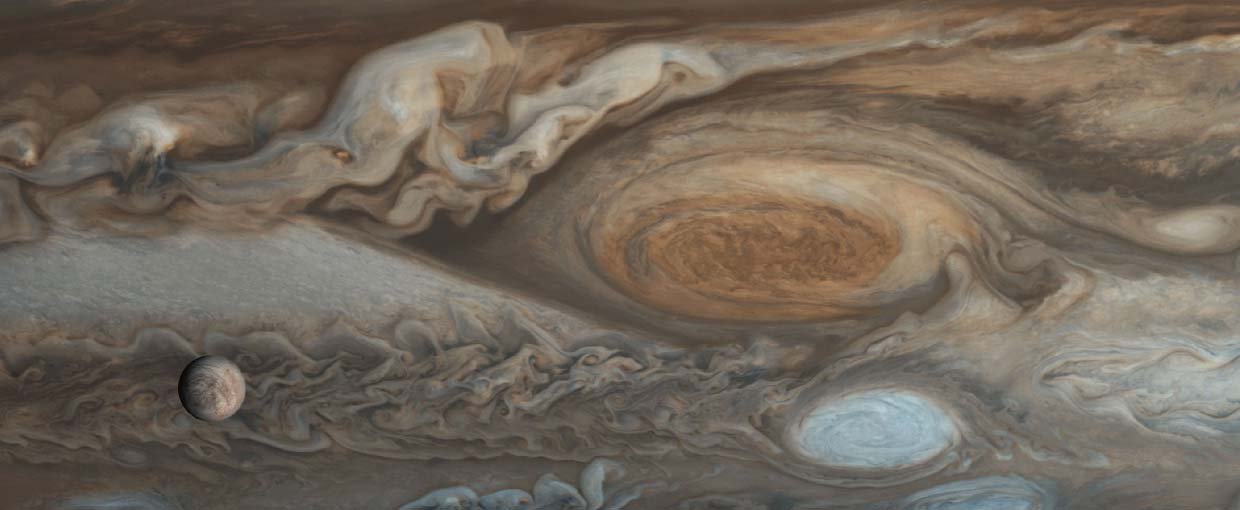
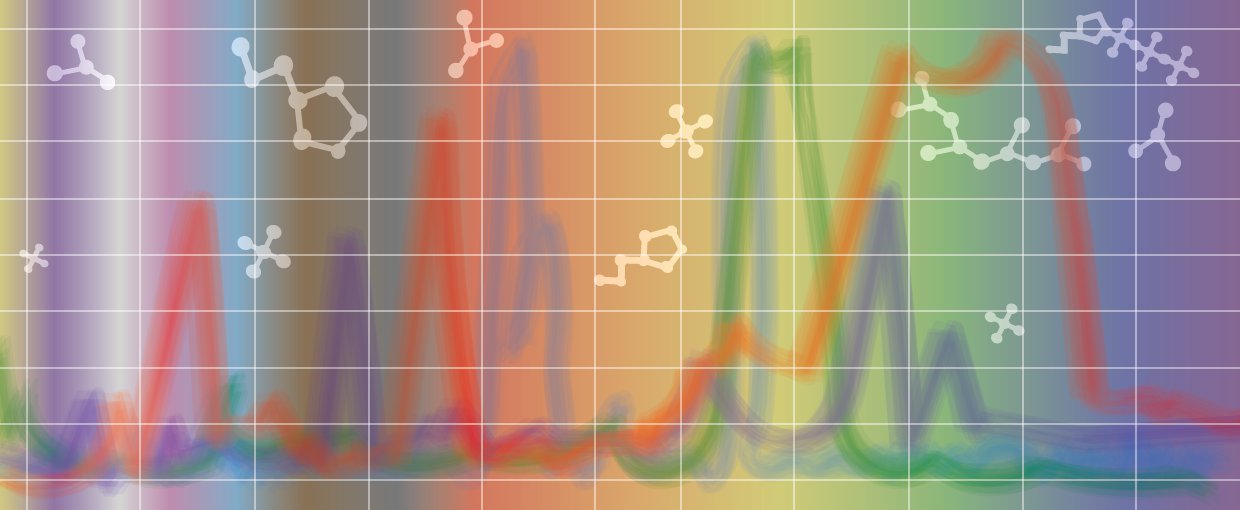
A volcanically active planet is shown in closeup at the left side of the image with glowing eruptions and lines of lava on the surface. To the right and in the distance is a faint blue glowing ball representing the more massive planet in the system.Sixteen frames from Voyager 1's flyby of Jupiter in 1979 were merged to create this image. Jupiter's Great Red Spot is visible in the center. Jupiter's moon Europa can be seen in the foreground at the bottom left of the image.The frame is a horizontal rainbow of color on a grid. Shadows of molecules can be seen through the light as well as the jagged peaks and troughs of spectral lines.
Fizzy Super Earths and Lava Worlds“Fizzy Super-Earths: Impacts of Magma Composition on the Bulk Density and Structure of Lava Worlds.” in The Astrophysical Journal.01/03
Identifying Hydrothermal Activity on Icy Ocean Worlds“Ethene-ethanol ratios as potential indicators of hydrothermal activity at Enceladus, Europa, and other icy ocean worlds.” In Icarus.02/03
NASA Raman Spectroscopic Database"The NASA Raman spectroscopic database: Ramdb version 1.00.” In Icarus.03/03
NextPrevious
Go Explore
March 2012Inverse method for estimating respiration rates from decay time series

Forney, D. C., & Rothman, D. H. (2012). Biogeosciences Discuss., 9(3), 3795–3828. doi:10.5194/bgd-9-3795-2012

ON THE EFFECT OF GIANT PLANETS ON THE SCATTERING OF PARENT BODIES OF IRON METEORITE FROM THE TERRESTRIAL PLANET REGION INTO THE ASTEROID BELT: A CONCEPT STUDY

Haghighipour, N., & Scott, E. R. D. (2012). The Astrophysical Journal, 749(2), 113. doi:10.1088/0004-637x/749/2/113

Laboratory spectroscopic analyses of electron irradiated alkanes and alkenes in solar system ices

Hand, K. P., & Carlson, R. W. (2012). Journal of Geophysical Research: Planets, 117(E3), n/a–n/a. doi:10.1029/2011je003888

Scouring the surface: Ejecta dynamics and the LCROSS impact event

Hermalyn, B., Schultz, P. H., Shirley, M., Ennico, K., & Colaprete, A. (2012). Icarus, 218(1), 654–665. doi:10.1016/j.icarus.2011.12.025

Biogeochemical Processes at Hydrothermal Vents: Microbes and Minerals, Bioenergetics, and Carbon Fluxes

Holden, J., Breier, J., Rogers, K., Schulte, M., & Toner, B. (2012). oceanog, 25(1), 196–208. doi:10.5670/oceanog.2012.18

Mixed Molecular and Atomic Phase of Dense Hydrogen

Howie, R. T., Guillaume, C. L., Scheler, T., Goncharov, A. F., & Gregoryanz, E. (2012). Physical Review Letters, 108(12), None. doi:10.1103/physrevlett.108.125501

DISCOVERY OF MAIN-BELT COMET P/2006 VW 139 BY Pan-STARRS1

Hsieh, H. H., Yang, B., Haghighipour, N., Kaluna, H. M., Fitzsimmons, A., Denneau, L., … Novaković, B. (2012). The Astrophysical Journal, 748(1), L15. doi:10.1088/2041-8205/748/1/l15

OBSERVATIONAL AND DYNAMICAL CHARACTERIZATION OF MAIN-BELT COMET P/2010 R2 (La Sagra)

Hsieh, H. H., Yang, B., Haghighipour, N., Novaković, B., Jedicke, R., Wainscoat, R. J., … Denneau, L. (2012). The Astronomical Journal, 143(5), 104. doi:10.1088/0004-6256/143/5/104

PROPER MOTIONS OF THE HH 110/270 SYSTEM

Kajdič, P., Reipurth, B., Raga, A. C., Bally, J., & Walawender, J. (2012). The Astronomical Journal, 143(5), 106. doi:10.1088/0004-6256/143/5/106

LABORATORY IR STUDIES AND ASTROPHYSICAL IMPLICATIONS OF C 2 H 2 -CONTAINING BINARY ICES

Knez, C., Moore, M. H., Ferrante, R. F., & Hudson, R. L. (2012). The Astrophysical Journal, 748(2), 95. doi:10.1088/0004-637x/748/2/95