

This website is currently being migrated. For the most up-to-date astrobiology news, resources, and community announcements, please visit our new home at science.nasa.gov/astrobiology

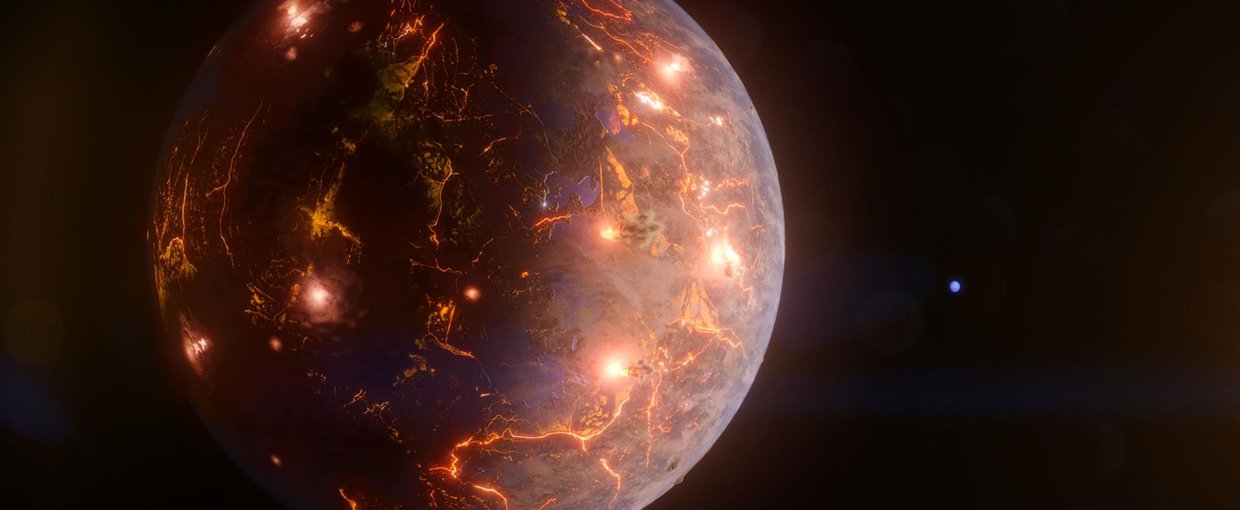
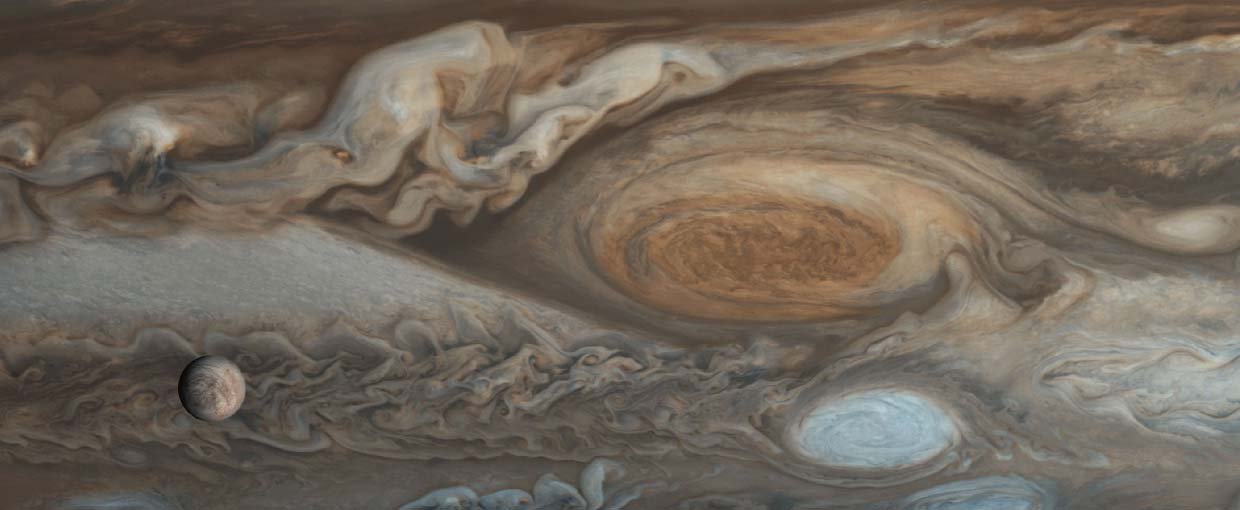
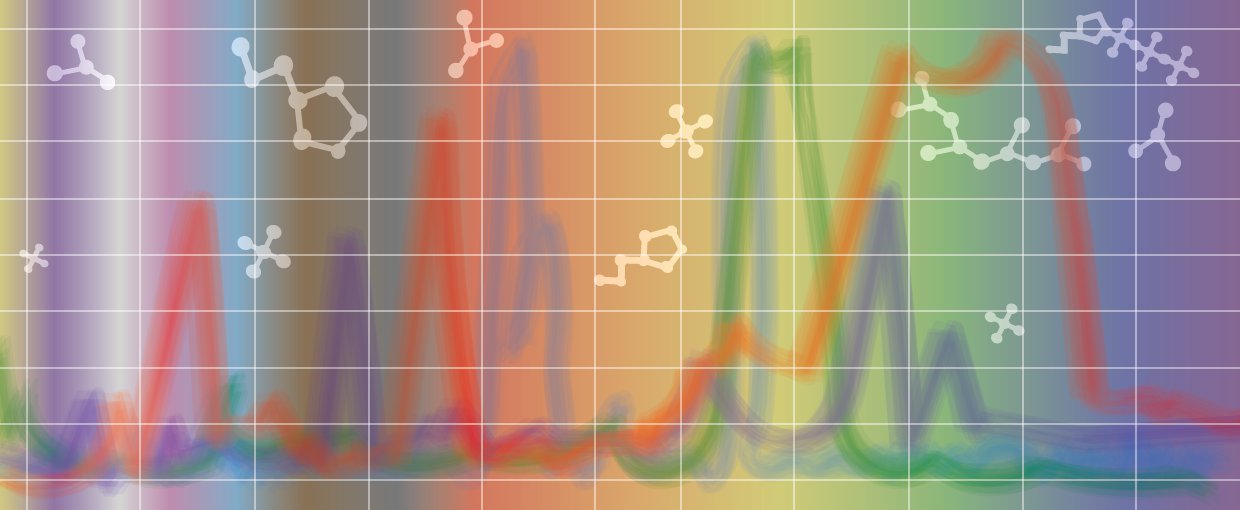
A volcanically active planet is shown in closeup at the left side of the image with glowing eruptions and lines of lava on the surface. To the right and in the distance is a faint blue glowing ball representing the more massive planet in the system.Sixteen frames from Voyager 1's flyby of Jupiter in 1979 were merged to create this image. Jupiter's Great Red Spot is visible in the center. Jupiter's moon Europa can be seen in the foreground at the bottom left of the image.The frame is a horizontal rainbow of color on a grid. Shadows of molecules can be seen through the light as well as the jagged peaks and troughs of spectral lines.
Fizzy Super Earths and Lava Worlds“Fizzy Super-Earths: Impacts of Magma Composition on the Bulk Density and Structure of Lava Worlds.” in The Astrophysical Journal.01/03
Identifying Hydrothermal Activity on Icy Ocean Worlds“Ethene-ethanol ratios as potential indicators of hydrothermal activity at Enceladus, Europa, and other icy ocean worlds.” In Icarus.02/03
NASA Raman Spectroscopic Database"The NASA Raman spectroscopic database: Ramdb version 1.00.” In Icarus.03/03
NextPrevious
Go Explore
April 2014Follow the Plume: The Habitability of Enceladus

McKay, C. P., Anbar, A. D., Porco, C., & Tsou, P. (2014). Astrobiology, 14(4), 352–355. doi:10.1089/ast.2014.1158

Speciation of and D/H partitioning between fluids and melts in silicate-D-O-H-C-N systems determined in-situ at upper mantle temperatures, pressures, and redox conditions

Mysen, B. O., Tomita, T., Ohtani, E., & Suzuki, A. (2014). American Mineralogist, 99(4), 578–588. doi:10.2138/am.2014.4575

The origin and evolution of the Peace Vallis fan system that drains to the Curiosity landing area, Gale Crater, Mars

Palucis, M. C., Dietrich, W. E., Hayes, A. G., Williams, R. M. E., Gupta, S., Mangold, N., … Newsom, H. (2014). Journal of Geophysical Research: Planets, 119(4), 705–728. doi:10.1002/2013je004583

An Earth-Sized Planet in the Habitable Zone of a Cool Star

Quintana, E. V., Barclay, T., Raymond, S. N., Rowe, J. F., Bolmont, E., Caldwell, D. A., … Howell, S. B. (2014). Science, 344(6181), 277–280. doi:10.1126/science.1249403

THE EFFECT OF PLANETS BEYOND THE ICE LINE ON THE ACCRETION OF VOLATILES BY HABITABLE-ZONE ROCKY PLANETS

Quintana, E. V., & Lissauer, J. J. (2014). The Astrophysical Journal, 786(1), 33. doi:10.1088/0004-637x/786/1/33

The Drive to Life on Wet and Icy Worlds

Russell, M. J., Barge, L. M., Bhartia, R., Bocanegra, D., Bracher, P. J., Branscomb, E., … Kidd, R. (2014). Astrobiology, 14(4), 308–343. doi:10.1089/ast.2013.1110

Characterization of the dominant impactor signature for Apollo 17 impact melt rocks

Sharp, M., Gerasimenko, I., Loudin, L. C., Liu, J., James, O. B., Puchtel, I. S., & Walker, R. J. (2014). Geochimica et Cosmochimica Acta, 131(None), 62–80. doi:10.1016/j.gca.2014.01.014

Physics of crustal fracturing and chert dike formation triggered by asteroid impact, ∼3.26 Ga, Barberton greenstone belt, South Africa

Sleep, N. H., & Lowe, D. R. (2014). Geochem. Geophys. Geosyst., 15(4), 1054–1070. doi:10.1002/2014gc005229

Widespread delayed mixing in early to middle Cambrian marine shelfal settings

Tarhan, L. G., & Droser, M. L. (2014). Palaeogeography, Palaeoclimatology, Palaeoecology, 399(None), 310–322. doi:10.1016/j.palaeo.2014.01.024

Phototrophic biofilm assembly in microbial-mat-derived unicyanobacterial consortia: model systems for the study of autotroph-heterotroph interactions

Cole, J. K., Hutchison, J. R., Renslow, R. S., Kim, Y-M., Chrisler, W. B., Engelmann, H. E., … Lindemann, S. R. (2014). Phototrophic biofilm assembly in microbial-mat-derived unicyanobacterial consortia: model systems for the study of autotroph-heterotroph interactions. Frontiers in Microbiology, 5, None. doi:10.3389/fmicb.2014.00109