


This website is currently being migrated. For the most up-to-date astrobiology news, resources, and community announcements, please visit our new home at science.nasa.gov/astrobiology

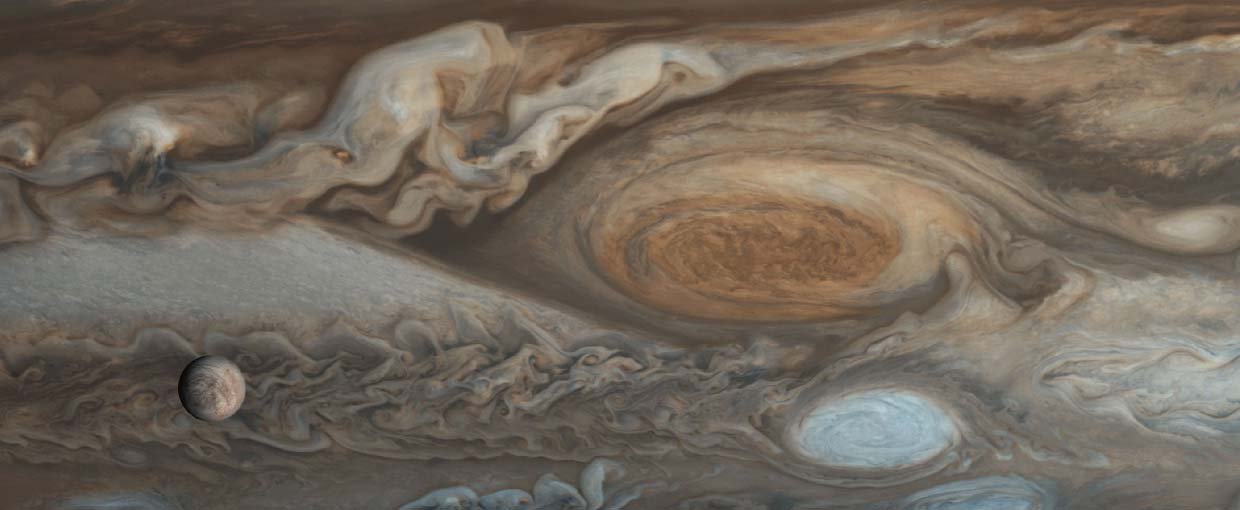
A volcanically active planet is shown in closeup at the left side of the image with glowing eruptions and lines of lava on the surface. To the right and in the distance is a faint blue glowing ball representing the more massive planet in the system.Sixteen frames from Voyager 1's flyby of Jupiter in 1979 were merged to create this image. Jupiter's Great Red Spot is visible in the center. Jupiter's moon Europa can be seen in the foreground at the bottom left of the image.The frame is a horizontal rainbow of color on a grid. Shadows of molecules can be seen through the light as well as the jagged peaks and troughs of spectral lines.
Fizzy Super Earths and Lava Worlds“Fizzy Super-Earths: Impacts of Magma Composition on the Bulk Density and Structure of Lava Worlds.” in The Astrophysical Journal.01/03
Identifying Hydrothermal Activity on Icy Ocean Worlds“Ethene-ethanol ratios as potential indicators of hydrothermal activity at Enceladus, Europa, and other icy ocean worlds.” In Icarus.02/03
NASA Raman Spectroscopic Database"The NASA Raman spectroscopic database: Ramdb version 1.00.” In Icarus.03/03
NextPrevious
Go Explore
November 2015 Mercury-T : A new code to study tidally evolving multi-planet systems. Applications to Kepler-62

Bolmont, E., Raymond, S. N., Leconte, J., Hersant, F., & Correia, A. C. M. (2015). A&A, 583(None), A116. doi:10.1051/0004-6361/201525909

The role of experiments in investigating the taphonomy of exceptional preservation

Briggs, D. E. G., & McMahon, S. (2015). Palaeontology, 59(1), 1–11. doi:10.1111/pala.12219

RESOLVING THE HD 100546 PROTOPLANETARY SYSTEM WITH THE GEMINI PLANET IMAGER: EVIDENCE FOR MULTIPLE FORMING, ACCRETING PLANETS

Currie, T., Cloutier, R., Brittain, S., Grady, C., Burrows, A., Muto, T., … Kenyon, S. J. (2015). The Astrophysical Journal, 814(2), L27. doi:10.1088/2041-8205/814/2/l27

Early metazoan life: divergence, environment and ecology

Erwin, D. H. (2015). Philosophical Transactions of the Royal Society B: Biological Sciences, 370(1684), 20150036–20150036. doi:10.1098/rstb.2015.0036

A Uniform System for the Annotation of Vertebrate microRNA Genes and the Evolution of the Human microRNAome

Fromm, B., Billipp, T., Peck, L. E., Johansen, M., Tarver, J. E., King, B. L., … Newcomb, J. M. (2015). Annual Review of Genetics, 49(1), 213–242. doi:10.1146/annurev-genet-120213-092023

Cryptic Cross-Linkages Among Biogeochemical Cycles: Novel Insights from Reactive Intermediates

Hansel, C. M., Ferdelman, T. G., & Tebo, B. M. (2015). ELEMENTS, 11(6), 409–414. doi:10.2113/gselements.11.6.409

Transient episodes of mild environmental oxygenation and oxidative continental weathering during the late Archean

Kendall, B., Creaser, R. A., Reinhard, C. T., Lyons, T. W., & Anbar, A. D. (2015). Science Advances, 1(10), e1500777–e1500777. doi:10.1126/sciadv.1500777

Marine organic matter cycling during the Ediacaran Shuram excursion

Lee, C., Love, G. D., Fischer, W. W., Grotzinger, J. P., & Halverson, G. P. (2015). Geology, None(None), G37236.1. doi:10.1130/g37236.1

Ediacaran Marine Redox Heterogeneity and Early Animal Ecosystems

Li, C., Planavsky, N. J., Shi, W., Zhang, Z., Zhou, C., Cheng, M., … Tarhan, L. G. (2015). Scientific Reports, 5(None), 17097. doi:10.1038/srep17097

Emerging Biogeochemical Views of Earth's Ancient Microbial Worlds

Lyons, T. W., Fike, D. A., & Zerkle, A. (2015). ELEMENTS, 11(6), 415–421. doi:10.2113/gselements.11.6.415