


This website is currently being migrated. For the most up-to-date astrobiology news, resources, and community announcements, please visit our new home at science.nasa.gov/astrobiology

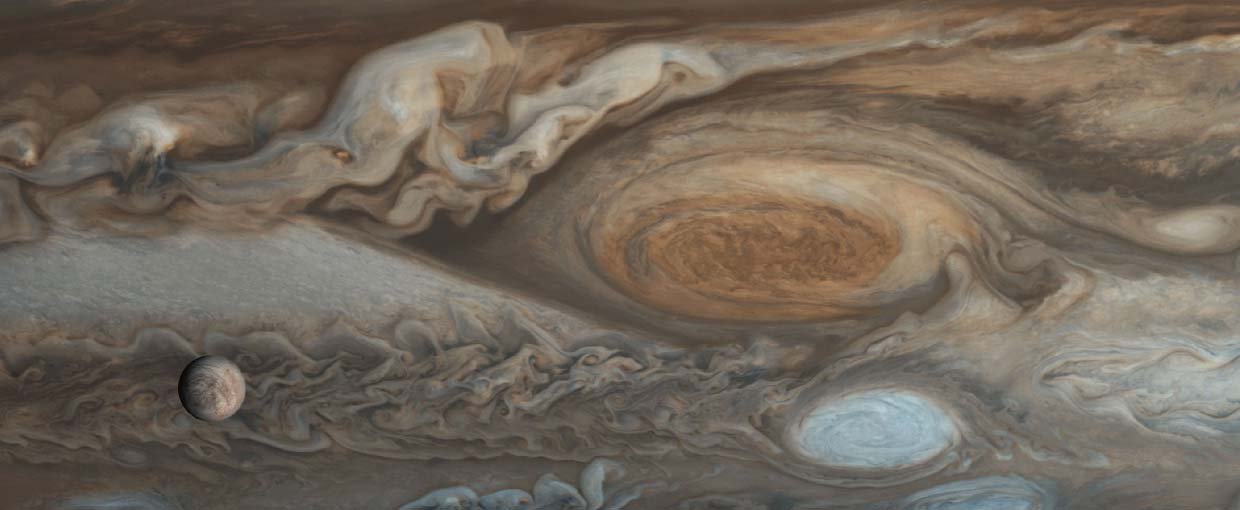
A volcanically active planet is shown in closeup at the left side of the image with glowing eruptions and lines of lava on the surface. To the right and in the distance is a faint blue glowing ball representing the more massive planet in the system.Sixteen frames from Voyager 1's flyby of Jupiter in 1979 were merged to create this image. Jupiter's Great Red Spot is visible in the center. Jupiter's moon Europa can be seen in the foreground at the bottom left of the image.The frame is a horizontal rainbow of color on a grid. Shadows of molecules can be seen through the light as well as the jagged peaks and troughs of spectral lines.
Fizzy Super Earths and Lava Worlds“Fizzy Super-Earths: Impacts of Magma Composition on the Bulk Density and Structure of Lava Worlds.” in The Astrophysical Journal.01/03
Identifying Hydrothermal Activity on Icy Ocean Worlds“Ethene-ethanol ratios as potential indicators of hydrothermal activity at Enceladus, Europa, and other icy ocean worlds.” In Icarus.02/03
NASA Raman Spectroscopic Database"The NASA Raman spectroscopic database: Ramdb version 1.00.” In Icarus.03/03
NextPrevious
Go Explore
December 2015Euxinic conditions recorded in the ca. 1.93Ga Bravo Lake Formation, Nunavut (Canada): Implications for oceanic redox evolution

Partin, C. A., Bekker, A., Planavsky, N. J., & Lyons, T. W. (2015). Chemical Geology, 417(None), 148–162. doi:10.1016/j.chemgeo.2015.09.004

Large Carbonate Associated Sulfate isotopic variability between brachiopods, micrite, and other sedimentary components in Late Ordovician strata

Present, T. M., Paris, G., Burke, A., Fischer, W. W., & Adkins, J. F. (2015). Earth and Planetary Science Letters, 432(None), 187–198. doi:10.1016/j.epsl.2015.10.005

The Ecological Physiology of Earth's Second Oxygen Revolution

Sperling, E. A., Knoll, A. H., & Girguis, P. R. (2015). Annual Review of Ecology, Evolution, and Systematics, 46(1), 215–235. doi:10.1146/annurev-ecolsys-110512-135808

Science objectives and performances of NOMAD, a spectrometer suite for the ExoMars TGO mission

Vandaele, A. C., Neefs, E., Drummond, R., Thomas, I. R., Daerden, F., Lopez-Moreno, J-J., … Rodriguez, J. (2015). Planetary and Space Science, 119(None), 233–249. doi:10.1016/j.pss.2015.10.003

Methane Seep Carbonates Host Distinct, Diverse, and Dynamic Microbial Assemblages

Case, D. H., Pasulka, A. L., Marlow, J. J., Grupe, B. M., Levin, L. A., & Orphan, V. J. (2015). mBio, 6(6), e01348–15. doi:10.1128/mbio.01348-15

Genomic Reconstruction of an Uncultured Hydrothermal Vent Gammaproteobacterial Methanotroph (Family Methylothermaceae) Indicates Multiple Adaptations to Oxygen Limitation

Skennerton, C. T., Ward, L. M., Michel, A., Metcalfe, K., Valiente, C., Mullin, S., … Chan, K. Y. (2015). Frontiers in Microbiology, 6(None), None. doi:10.3389/fmicb.2015.01425

November 2015Capabilities and performance of the Automated Planet Finder telescope with the implementation of a dynamic scheduler

Burt, J., Holden, B., Hanson, R., Laughlin, G., Vogt, S., Butler, P., … Deich, W. (2015). Capabilities and performance of the Automated Planet Finder telescope with the implementation of a dynamic scheduler. Journal of Astronomical Telescopes, Instruments, and Systems, 1(4), 044003. doi:10.1117/1.jatis.1.4.044003

Photoevaporation and Disk Dispersal

Gorti, U. (2015). Photoevaporation and Disk Dispersal. Proceedings of the International Astronomical Union, 10(S314), 153–158. doi:10.1017/s1743921315006420

PERSPECTIVE

PERSPECTIVE (2015). Elements, 11(6), 384–385. doi:10.2113/gselements.11.6.384

In situ Detection of Microbial Life in the Deep Biosphere in Igneous Ocean Crust

Salas, E. C., Bhartia, R., Anderson, L., Hug, W. F., Reid, R. D., Iturrino, G., & Edwards, K. J. (2015). In situ Detection of Microbial Life in the Deep Biosphere in Igneous Ocean Crust. Frontiers in Microbiology, 6, None. doi:10.3389/fmicb.2015.01260