

This website is currently being migrated. For the most up-to-date astrobiology news, resources, and community announcements, please visit our new home at science.nasa.gov/astrobiology

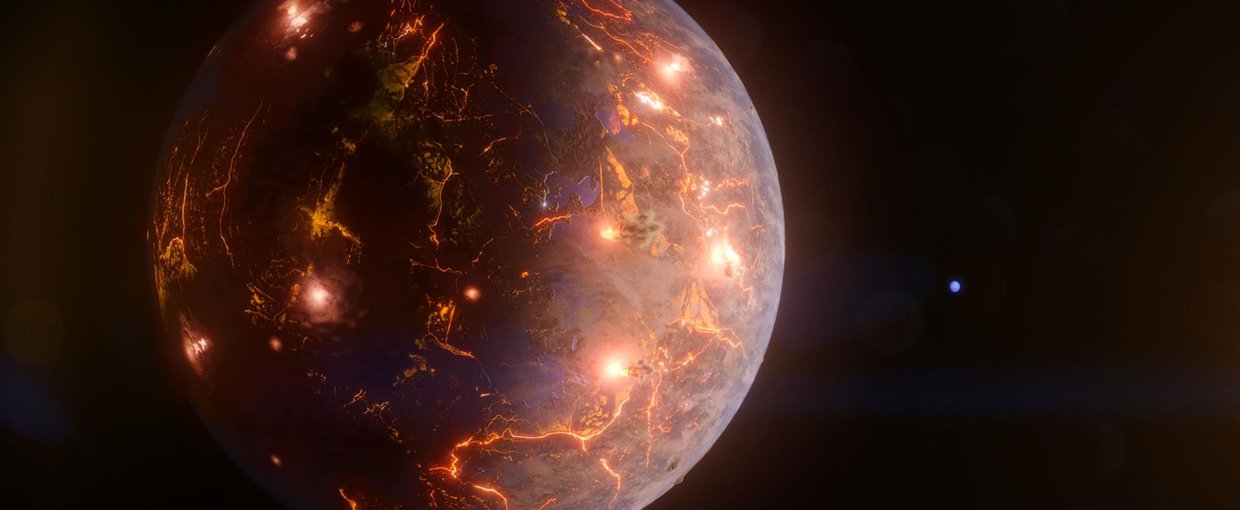
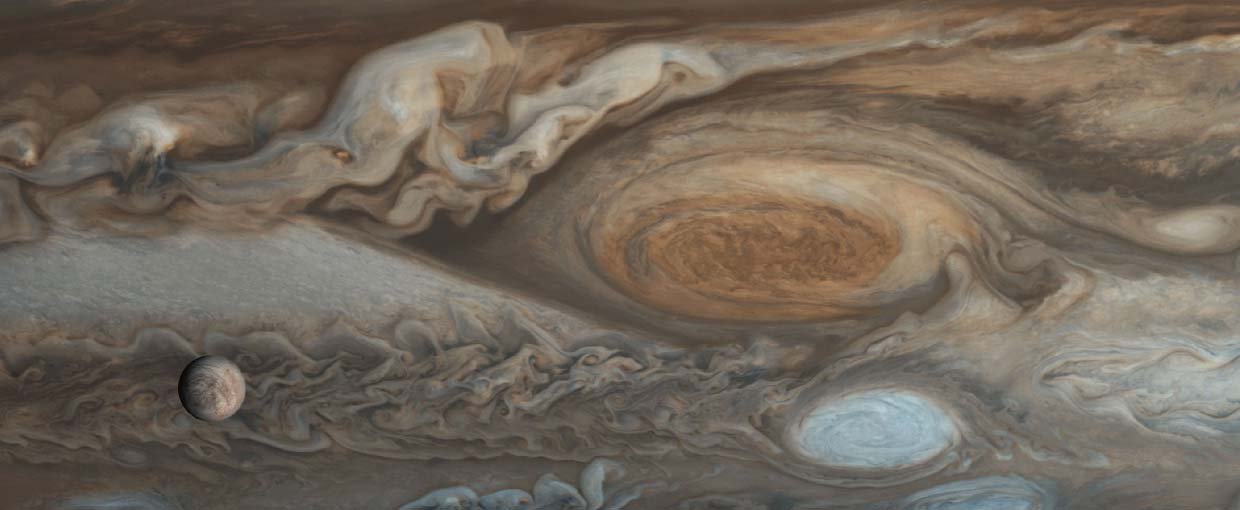
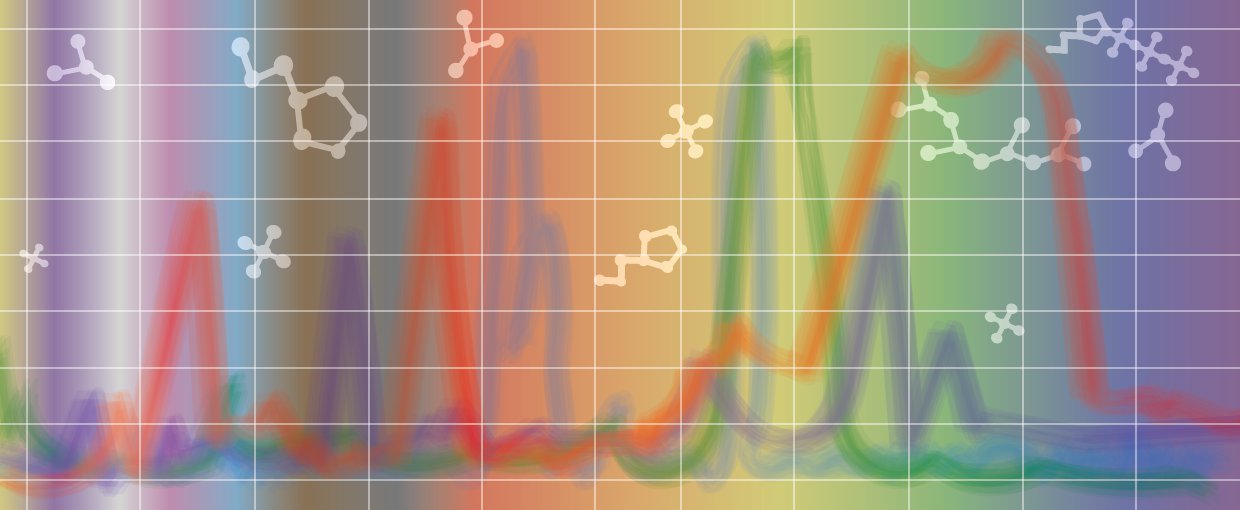
A volcanically active planet is shown in closeup at the left side of the image with glowing eruptions and lines of lava on the surface. To the right and in the distance is a faint blue glowing ball representing the more massive planet in the system.Sixteen frames from Voyager 1's flyby of Jupiter in 1979 were merged to create this image. Jupiter's Great Red Spot is visible in the center. Jupiter's moon Europa can be seen in the foreground at the bottom left of the image.The frame is a horizontal rainbow of color on a grid. Shadows of molecules can be seen through the light as well as the jagged peaks and troughs of spectral lines.
Fizzy Super Earths and Lava Worlds“Fizzy Super-Earths: Impacts of Magma Composition on the Bulk Density and Structure of Lava Worlds.” in The Astrophysical Journal.01/03
Identifying Hydrothermal Activity on Icy Ocean Worlds“Ethene-ethanol ratios as potential indicators of hydrothermal activity at Enceladus, Europa, and other icy ocean worlds.” In Icarus.02/03
NASA Raman Spectroscopic Database"The NASA Raman spectroscopic database: Ramdb version 1.00.” In Icarus.03/03
NextPrevious
Go Explore
July 2022The Dynamical Viability of an Extended Jupiter Ring System

Kane, S. R., & Li, Z. (2022). The Dynamical Viability of an Extended Jupiter Ring System. The Planetary Science Journal, 3(7), 179. doi:10.3847/psj/ac7de6

Methods and limitations of stable isotope measurements via direct elution of chromatographic peaks using gas chromotography-Orbitrap mass spectrometry

Zeichner, S. S., Wilkes, E. B., Hofmann, A. E., Chimiak, L., Sessions, A. L., Makarov, A., & Eiler, J. M. (2022). Methods and limitations of stable isotope measurements via direct elution of chromatographic peaks using gas chromotography-Orbitrap mass spectrometry. International Journal of Mass Spectrometry, 477, 116848. doi:10.1016/j.ijms.2022.116848

TEM analyses of in situ presolar grains from unequilibrated ordinary chondrite LL3.0 Semarkona

Singerling, S. A., Nittler, L. R., Barosch, J., Dobrică, E., Brearley, A. J., & Stroud, R. M. (2022). TEM analyses of in situ presolar grains from unequilibrated ordinary chondrite LL3.0 Semarkona. Geochimica et Cosmochimica Acta, 328, 130–152. doi:10.1016/j.gca.2022.05.007

Vanadium isotope fractionation during hydrothermal sedimentation: Implications for the vanadium cycle in the oceans

Wu, F., Owens, J. D., German, C. R., Mills, R. A., & Nielsen, S. G. (2022). Vanadium isotope fractionation during hydrothermal sedimentation: Implications for the vanadium cycle in the oceans. Geochimica et Cosmochimica Acta, 328, 168–184. doi:10.1016/j.gca.2022.05.002

Sulfur cycling at natural hydrocarbon and sulfur seeps in Santa Paula Creek, CA

Aronson, H. S., Monteverde, D. R., Barnes, B. D., Johnson, B. R., Zawaski, M. J., Speth, D. R., … , . (2022). Sulfur cycling at natural hydrocarbon and sulfur seeps in Santa Paula Creek, <scp>CA</scp>. Geobiology. doi:10.1111/gbi.12512

Correlative Analysis of P-bearing Assemblages in the QUE 97008 and Orgueil Chondrites.

Benner, M. C., Zega, T. J., & Ziurys, L. M. (2022). Correlative Analysis of P-bearing Assemblages in the QUE 97008 and Orgueil Chondrites.. Microscopy and Microanalysis, 28(S1), 2682–2684. doi:10.1017/s1431927622010145

Long-term tidal evolution of the TRAPPIST-1 system

Brasser, R., Pichierri, G., Dobos, V., & Barr, A. C. (2022). Long-term tidal evolution of the TRAPPIST-1 system. Monthly Notices of the Royal Astronomical Society, 515(2), 2373–2385. doi:10.1093/mnras/stac1907

Shock-formed carbon materials with intergrown sp 3 - and sp 2 -bonded nanostructured units

Németh, P., Lancaster, H. J., Salzmann, C. G., McColl, K., Fogarassy, Z., Garvie, L. A. J., … McMillan, P. F. (2022). Shock-formed carbon materials with intergrown sp <sup>3</sup> - and sp <sup>2</sup> -bonded nanostructured units. Proceedings of the National Academy of Sciences, 119(30), None. doi:10.1073/pnas.2203672119

Protecting ocean worlds: Europa Clipper planetary protection inputs to a probabilistic risk-based approach

Smith, A. L., & Hendrickson, R. C. (2022). Protecting ocean worlds: Europa Clipper planetary protection inputs to a probabilistic risk-based approach. International Journal of Astrobiology, None, 1–14. doi:10.1017/s1473550422000192

The Unrestrained Use of Python Libraries for Bridging the Gap Between Planetary and Material Sciences

Zanetta, P-M. (2022). The Unrestrained Use of Python Libraries for Bridging the Gap Between Planetary and Material Sciences. Microscopy and Microanalysis, 28(S1), 2686–2688. doi:10.1017/s1431927622010157