

This website is currently being migrated. For the most up-to-date astrobiology news, resources, and community announcements, please visit our new home at science.nasa.gov/astrobiology

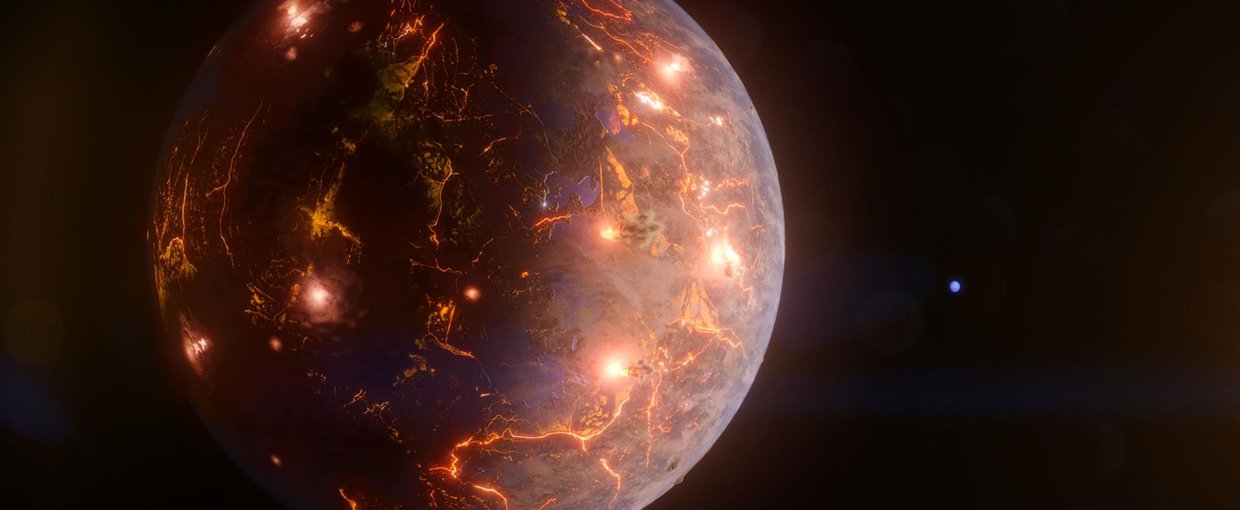
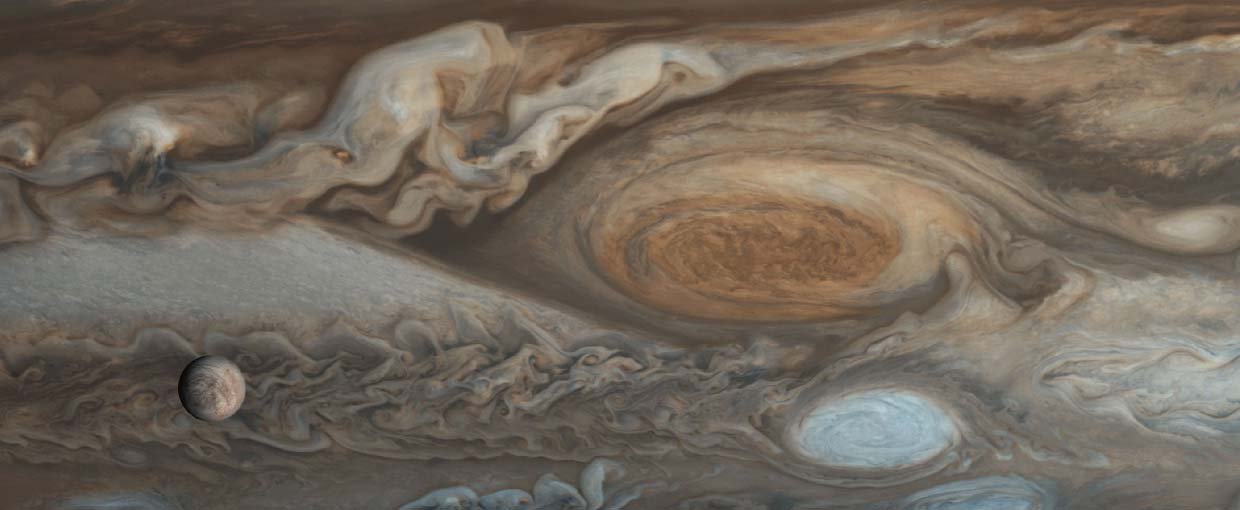
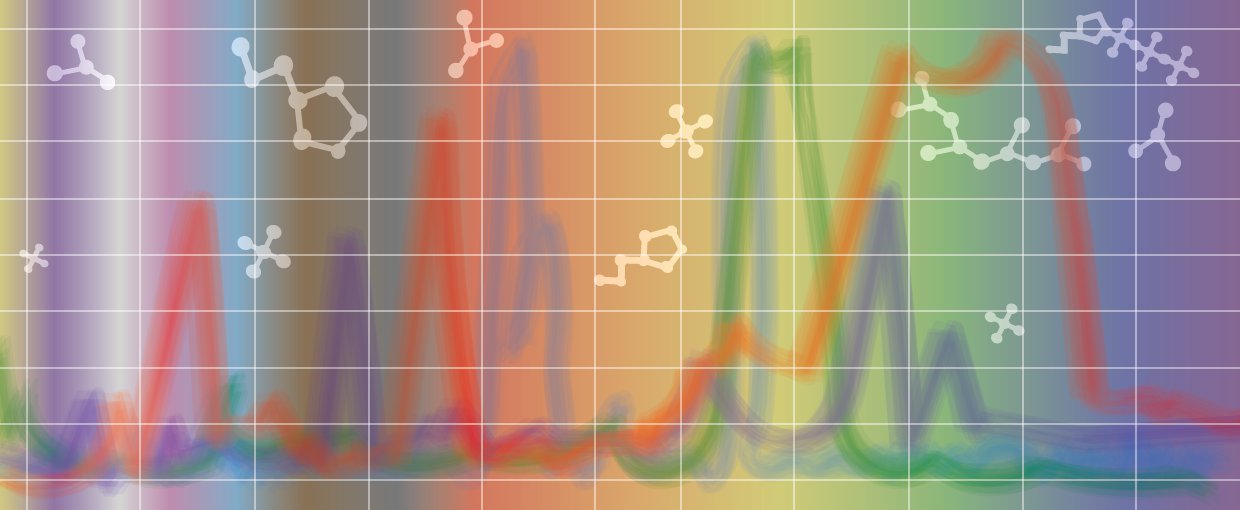
A volcanically active planet is shown in closeup at the left side of the image with glowing eruptions and lines of lava on the surface. To the right and in the distance is a faint blue glowing ball representing the more massive planet in the system.Sixteen frames from Voyager 1's flyby of Jupiter in 1979 were merged to create this image. Jupiter's Great Red Spot is visible in the center. Jupiter's moon Europa can be seen in the foreground at the bottom left of the image.The frame is a horizontal rainbow of color on a grid. Shadows of molecules can be seen through the light as well as the jagged peaks and troughs of spectral lines.
Fizzy Super Earths and Lava Worlds“Fizzy Super-Earths: Impacts of Magma Composition on the Bulk Density and Structure of Lava Worlds.” in The Astrophysical Journal.01/03
Identifying Hydrothermal Activity on Icy Ocean Worlds“Ethene-ethanol ratios as potential indicators of hydrothermal activity at Enceladus, Europa, and other icy ocean worlds.” In Icarus.02/03
NASA Raman Spectroscopic Database"The NASA Raman spectroscopic database: Ramdb version 1.00.” In Icarus.03/03
NextPrevious
Go Explore
September 2022The TRAPPIST-1 Habitable Atmosphere Intercomparison (THAI). I. Dry Cases—The Fellowship of the GCMs

Turbet, M., Fauchez, T. J., Sergeev, D. E., Boutle, I. A., Tsigaridis, K., Way, M. J., … Sohl, L. (2022). The TRAPPIST-1 Habitable Atmosphere Intercomparison (THAI). I. Dry Cases—The Fellowship of the GCMs. The Planetary Science Journal, 3(9), 211. doi:10.3847/psj/ac6cf0

Compositional Controls on the Distribution of Brine in Europa's Ice Shell

Wolfenbarger, N. S., Fox‐Powell, M. G., Buffo, J. J., Soderlund, K. M., & Blankenship, D. D. (2022). Compositional Controls on the Distribution of Brine in Europa's Ice Shell. Journal of Geophysical Research: Planets, 127(9), None. doi:10.1029/2022je007305

Ca-isotopes as a robust tracer of magmatic differentiation

Fu, H., Jacobsen, S. B., Larsen, B. T., & Eriksen, Z. T. (2022). Ca-isotopes as a robust tracer of magmatic differentiation. Earth and Planetary Science Letters, 594, 117743. doi:10.1016/j.epsl.2022.117743

Water Vapor Adsorption Provides Daily, Sustainable Water to Soils of the Hyperarid Atacama Desert

Glaser, D. M., Hartnett, H. E., Finn, D. R., Perez-Montaño, S., Cadillo-Quiroz, H., & Desch, S. (2022). Water Vapor Adsorption Provides Daily, Sustainable Water to Soils of the Hyperarid Atacama Desert. Astrobiology. doi:10.1089/ast.2021.0171

System Architecture and Planetary Obliquity: Implications for Long-term Habitability

Vervoort, P., Horner, J., Kane, S. R., Kirtland Turner, S., & Gilmore, J. B. (2022). System Architecture and Planetary Obliquity: Implications for Long-term Habitability. The Astronomical Journal, 164(4), 130. doi:10.3847/1538-3881/ac87fd

Migration Traps as the Root Cause of the Kepler Dichotomy

Zawadzki, B., Carrera, D., & Ford, E. B. (2022). Migration Traps as the Root Cause of the Kepler Dichotomy. The Astrophysical Journal, 937(2), 53. doi:10.3847/1538-4357/ac8b04

Searching for technosignatures in exoplanetary systems with current and future missions

Haqq-Misra, J., Schwieterman, E. W., Socas-Navarro, H., Kopparapu, R., Angerhausen, D., Beatty, T. G., … Apai, D. (2022). Searching for technosignatures in exoplanetary systems with current and future missions. Acta Astronautica, 198, 194–207. doi:10.1016/j.actaastro.2022.05.040

Deuterium Isotope Fractionation of Polycyclic Aromatic Hydrocarbons in Meteorites as an Indicator of Interstellar/Protosolar Processing History

Graham, H. V., Elsila, J. E., Dworkin, J. P., Sandford, S. A., & Aponte, J. C. (2022). Deuterium Isotope Fractionation of Polycyclic Aromatic Hydrocarbons in Meteorites as an Indicator of Interstellar/Protosolar Processing History. Life, 12(9), 1368. doi:10.3390/life12091368

Spectral Detection of Nanophase Iron Minerals Produced by Fe(III)-Reducing Hyperthermophilic Crenarchaea

Kashyap, S., Sklute, E. C., Wang, P., Tague Jr., T. J., Dyar, M. D., & Holden, J. F. (2022). Spectral Detection of Nanophase Iron Minerals Produced by Fe(III)-Reducing Hyperthermophilic Crenarchaea. Astrobiology. doi:10.1089/ast.2022.0042

Physiological and metabolic responses of chemolithoautotrophic NO3−$$ {\mathrm{NO}}_3^{-} $$ reducers to high hydrostatic pressure

Pérez‐Rodríguez, I., Sievert, S. M., Fogel, M. L., & Foustoukos, D. I. (2022). Physiological and metabolic responses of chemolithoautotrophic NO3−$$ {\mathrm{NO}}_3^{-} $$ reducers to high hydrostatic pressure. Geobiology. doi:10.1111/gbi.12522