

This website is currently being migrated. For the most up-to-date astrobiology news, resources, and community announcements, please visit our new home at science.nasa.gov/astrobiology

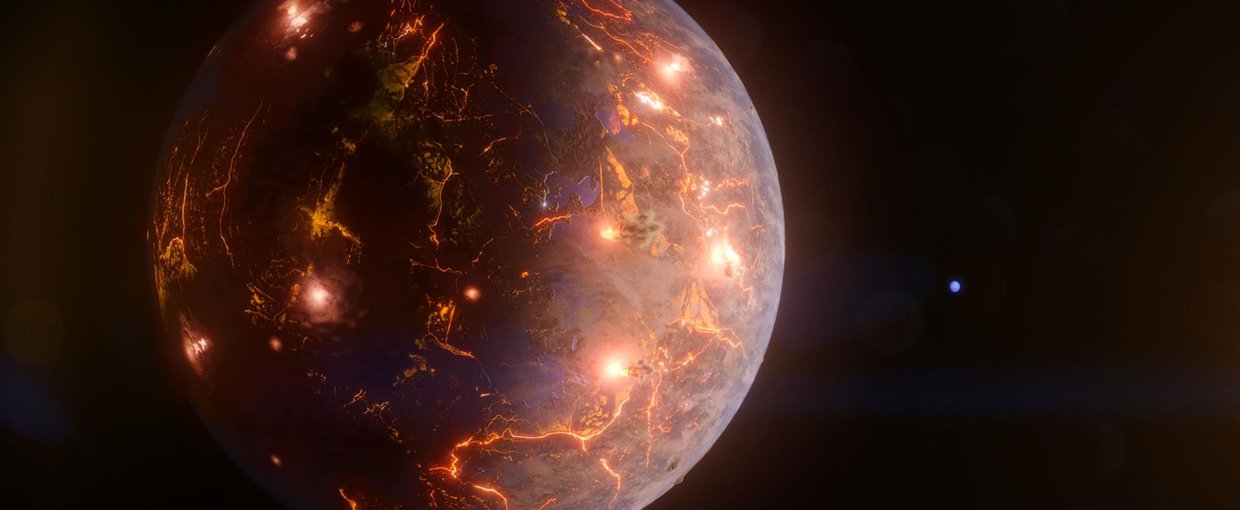
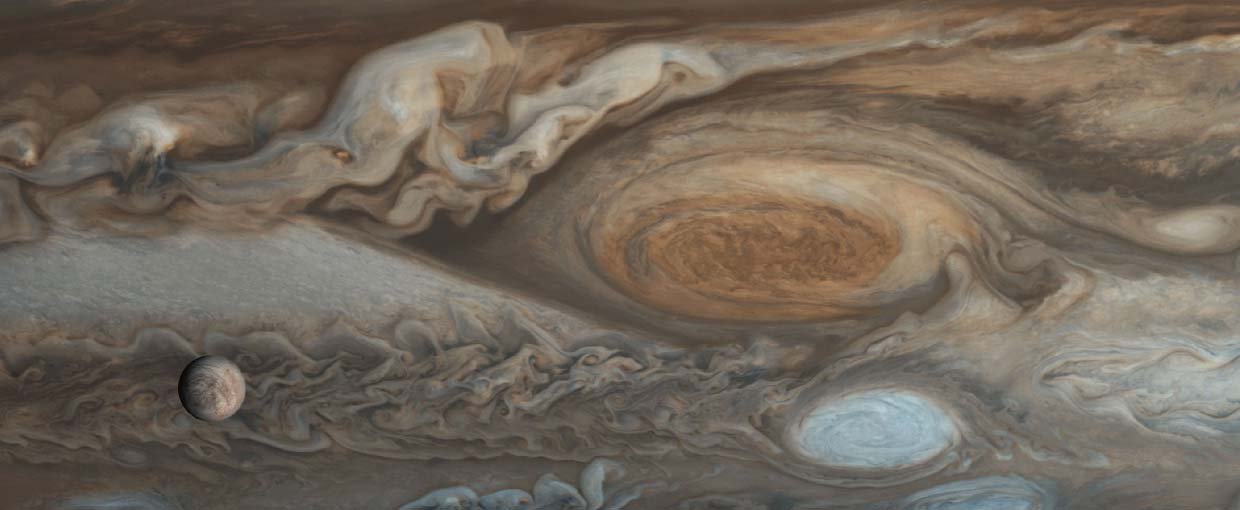
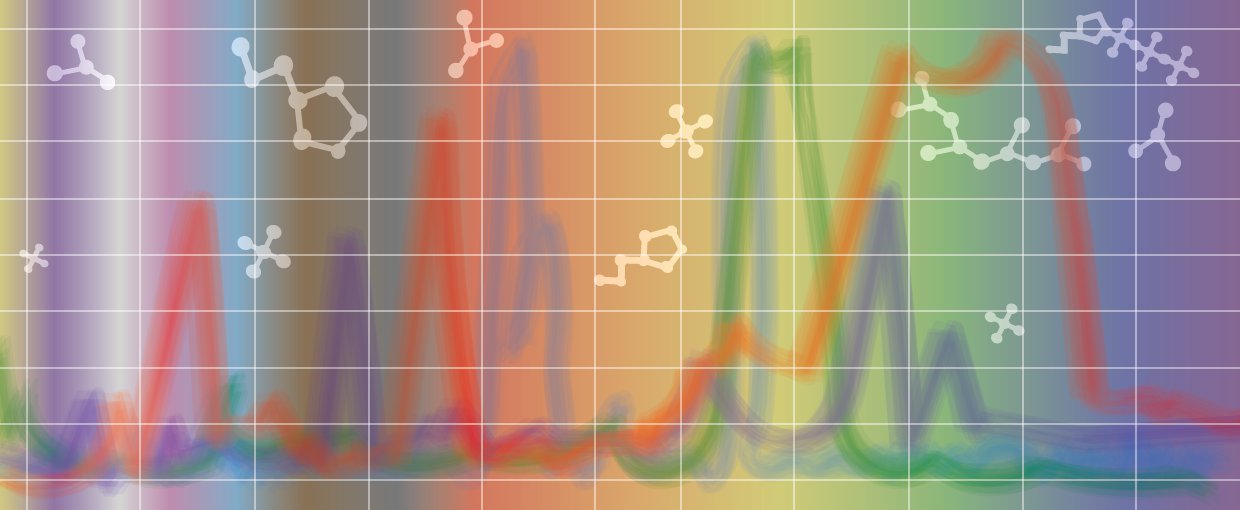
A volcanically active planet is shown in closeup at the left side of the image with glowing eruptions and lines of lava on the surface. To the right and in the distance is a faint blue glowing ball representing the more massive planet in the system.Sixteen frames from Voyager 1's flyby of Jupiter in 1979 were merged to create this image. Jupiter's Great Red Spot is visible in the center. Jupiter's moon Europa can be seen in the foreground at the bottom left of the image.The frame is a horizontal rainbow of color on a grid. Shadows of molecules can be seen through the light as well as the jagged peaks and troughs of spectral lines.
Fizzy Super Earths and Lava Worlds“Fizzy Super-Earths: Impacts of Magma Composition on the Bulk Density and Structure of Lava Worlds.” in The Astrophysical Journal.01/03
Identifying Hydrothermal Activity on Icy Ocean Worlds“Ethene-ethanol ratios as potential indicators of hydrothermal activity at Enceladus, Europa, and other icy ocean worlds.” In Icarus.02/03
NASA Raman Spectroscopic Database"The NASA Raman spectroscopic database: Ramdb version 1.00.” In Icarus.03/03
NextPrevious
Go Explore
November 2022The Exoplanet Radius Valley from Gas-driven Planet Migration and Breaking of Resonant Chains

Izidoro, A., Schlichting, H. E., Isella, A., Dasgupta, R., Zimmermann, C., & Bitsch, B. (2022). The Exoplanet Radius Valley from Gas-driven Planet Migration and Breaking of Resonant Chains. The Astrophysical Journal Letters, 939(2), L19. doi:10.3847/2041-8213/ac990d

Accreting protoplanets: Spectral signatures and magnitude of gas and dust extinction at H α

Marleau, G.-D. , Aoyama, Y., Kuiper, R., Follette, K., Turner, N. J., Cugno, G., Manara, C. F., Haffert, S. Y., Kitzmann, D., Ringqvist, S. C., Wagner, K. R., van Boekel, R., Sallum, S., Janson, M., Schmidt, T. O. B., Venuti, L., Lovis, Ch., & Mordasini, C. (2022). Accreting protoplanets: Spectral signatures and magnitude of gas and dust extinction at H α. Astronomy & Astrophysics, 657, A38. doi: 10.1051/0004-6361/202037494

Buffering of mantle conditions through water cycling and thermal feedbacks maintains magmatism over geologic time

Seales, J., Lenardic, A., & Richards, M. (2022). Buffering of mantle conditions through water cycling and thermal feedbacks maintains magmatism over geologic time. Communications Earth & Environment, 3(1), None. doi:10.1038/s43247-022-00617-0

Exploiting Unary Relations with Stacked Learning for Relation Extraction

Zhuang, Y., Riloff, E., Wagstaff, K., Francis, R., Golombek, M., Tamppari, L. (2022). Exploiting Unary Relations with Stacked Learning for Relation Extraction. Proceedings of the Third Workshop on Scholarly Document Processing, 126–137.

October 2022The Demographics of Kepler's Earths and Super-Earths into the Habitable Zone

Bergsten, G. J., Pascucci, I., Mulders, G. D., Fernandes, R. B., & Koskinen, T. T. (2022). The Demographics of Kepler's Earths and Super-Earths into the Habitable Zone. The Astronomical Journal, 164(5), 190. doi:10.3847/1538-3881/ac8fea

The Long-Term Evolution of the Atmosphere of Venus: Processes and Feedback Mechanisms

Gillmann, C., Way, M. J., Avice, G., Breuer, D., Golabek, G. J., Höning, D., … Zolotov, M. Y. (2022). The Long-Term Evolution of the Atmosphere of Venus: Processes and Feedback Mechanisms. Space Science Reviews, 218(7), None. doi:10.1007/s11214-022-00924-0

Utilizing a Global Network of Telescopes to Update the Ephemeris for the Highly Eccentric Planet HD 80606 b and to Ensure the Efficient Scheduling of JWST

Pearson, K. A., Beichman, C., Fulton, B. J., Esposito, T. M., Zellem, R. T., Ciardi, D. R., … Wünsche, A. (2022). Utilizing a Global Network of Telescopes to Update the Ephemeris for the Highly Eccentric Planet HD 80606 b and to Ensure the Efficient Scheduling of JWST. The Astronomical Journal, 164(5), 178. doi:10.3847/1538-3881/ac8dee

Early Nitrogenase Ancestors Encompassed Novel Active Site Diversity

Schwartz, S. L., Garcia, A. K., Kaçar, B., & Fournier, G. P. (2022). Early Nitrogenase Ancestors Encompassed Novel Active Site Diversity. Molecular Biology and Evolution, 39(11), None. doi:10.1093/molbev/msac226

Experimental serpentinization of iron-rich olivine (hortonolite): Implications for hydrogen generation and secondary mineralization on Mars and icy moons

McCollom, T. M., Klein, F., Moskowitz, B., & Solheid, P. (2022). Experimental serpentinization of iron-rich olivine (hortonolite): Implications for hydrogen generation and secondary mineralization on Mars and icy moons. Geochimica et Cosmochimica Acta, 335, 98–110. doi:10.1016/j.gca.2022.08.025

Alternative Methylated Biosignatures. I. Methyl Bromide, a Capstone Biosignature

Leung, M., Schwieterman, E. W., Parenteau, M. N., & Fauchez, T. J. (2022). Alternative Methylated Biosignatures. I. Methyl Bromide, a Capstone Biosignature. The Astrophysical Journal, 938(1), 6. doi:10.3847/1538-4357/ac8799