


This website is currently being migrated. For the most up-to-date astrobiology news, resources, and community announcements, please visit our new home at science.nasa.gov/astrobiology

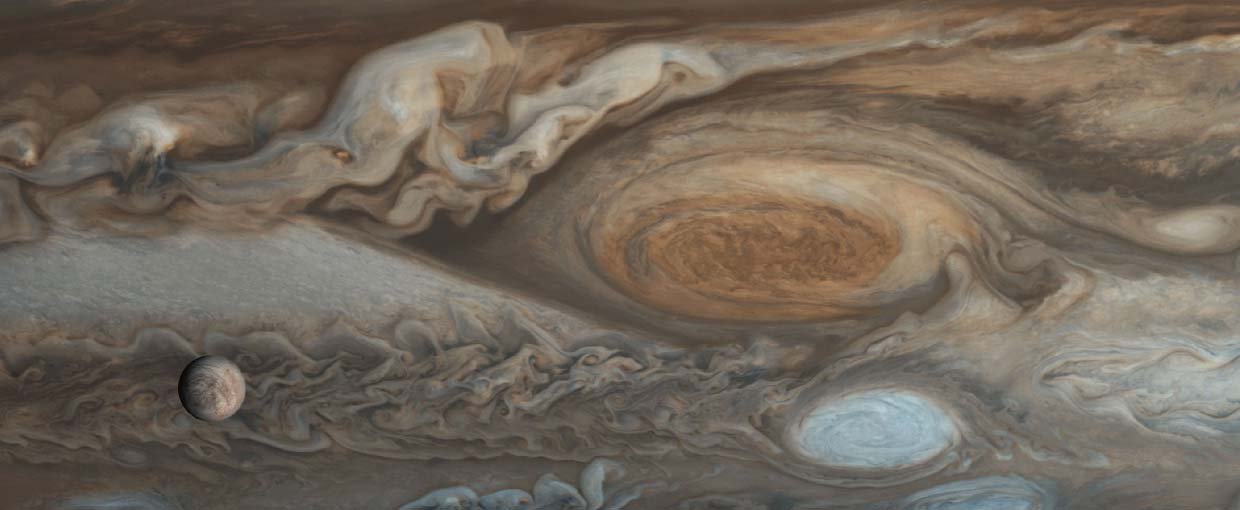
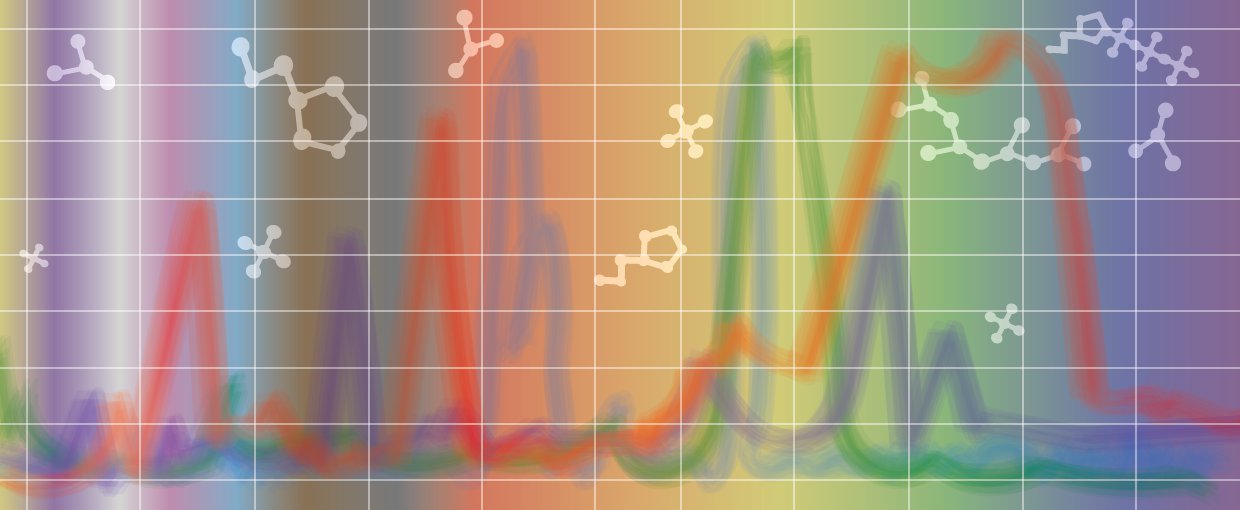
A volcanically active planet is shown in closeup at the left side of the image with glowing eruptions and lines of lava on the surface. To the right and in the distance is a faint blue glowing ball representing the more massive planet in the system.Sixteen frames from Voyager 1's flyby of Jupiter in 1979 were merged to create this image. Jupiter's Great Red Spot is visible in the center. Jupiter's moon Europa can be seen in the foreground at the bottom left of the image.The frame is a horizontal rainbow of color on a grid. Shadows of molecules can be seen through the light as well as the jagged peaks and troughs of spectral lines.
Fizzy Super Earths and Lava Worlds“Fizzy Super-Earths: Impacts of Magma Composition on the Bulk Density and Structure of Lava Worlds.” in The Astrophysical Journal.01/03
Identifying Hydrothermal Activity on Icy Ocean Worlds“Ethene-ethanol ratios as potential indicators of hydrothermal activity at Enceladus, Europa, and other icy ocean worlds.” In Icarus.02/03
NASA Raman Spectroscopic Database"The NASA Raman spectroscopic database: Ramdb version 1.00.” In Icarus.03/03
NextPrevious
Go Explore
April 2023Technical comment on “Reexamination of 2.5-Ga ‘whiff’ of oxygen interval points to anoxic ocean before GOE”

Anbar, A. D., Buick, R., Gordon, G. W., Johnson, A. C., Kendall, B., Lyons, T. W., … Stüeken, E. E. (2023). Technical comment on “Reexamination of 2.5-Ga ‘whiff’ of oxygen interval points to anoxic ocean before GOE”. Science Advances, 9(14), None. doi:10.1126/sciadv.abq3736

Viruses of sulfur oxidizing phototrophs encode genes for pigment, carbon, and sulfur metabolisms

Hesketh-Best, P. J., Bosco-Santos, A., Garcia, S. L., O’Beirne, M. D., Werne, J. P., Gilhooly, W. P., & Silveira, C. B. (2023). Viruses of sulfur oxidizing phototrophs encode genes for pigment, carbon, and sulfur metabolisms. Communications Earth & Environment, 4(1), None. doi:10.1038/s43247-023-00796-4

Phosphorus availability on the early Earth and the impacts of life

Walton, C. R., Ewens, S., Coates, J. D., Blake, R. E., Planavsky, N. J., Reinhard, C., … Pasek, M. A. (2023). Phosphorus availability on the early Earth and the impacts of life. Nature Geoscience. doi:10.1038/s41561-023-01167-6

Formation of Amino Acids and Carboxylic Acids in Weakly Reducing Planetary Atmospheres by Solar Energetic Particles from the Young Sun

Kobayashi, K., Ise, J-I., Aoki, R., Kinoshita, M., Naito, K., Udo, T., … Airapetian, V. S. (2023). Formation of Amino Acids and Carboxylic Acids in Weakly Reducing Planetary Atmospheres by Solar Energetic Particles from the Young Sun. Life, 13(5), 1103. doi:10.3390/life13051103

No magma ocean surface after giant impacts between rocky planets

Caracas, R., & Stewart, S. T. (2023). No magma ocean surface after giant impacts between rocky planets. Earth and Planetary Science Letters, 608, 118014. doi:10.1016/j.epsl.2023.118014

Survival and dynamics of rings of co-orbital planets under perturbations

Raymond, S. N., Veras, D., Clement, M. S., Izidoro, A., Kipping, D., & Meadows, V. (2023). Survival and dynamics of rings of co-orbital planets under perturbations. Monthly Notices of the Royal Astronomical Society, 522(4), 4875–4879. doi:10.1093/mnras/stad1294

Earth shaped by primordial H2 atmospheres

Young, E. D., Shahar, A., & Schlichting, H. E. (2023). Earth shaped by primordial H2 atmospheres. Nature, 616(7956), 306–311. doi:10.1038/s41586-023-05823-0

March 2023Routes to reduction of phosphate by high-energy events

Bindi, L., Feng, T., & Pasek, M. A. (2023). Routes to reduction of phosphate by high-energy events. Communications Earth & Environment, 4(1), None. doi:10.1038/s43247-023-00736-2

Blur remediation in NEAR MSI images

Golish, D. R., DellaGiustina, D. N., Becker, K. J., Bennett, C. A., Robinson, M., & Crombie, M. K. (2023). Blur remediation in NEAR MSI images. Icarus, None, 115536. doi:10.1016/j.icarus.2023.115536

Multi-faceted metagenomic analysis of spacecraft associated surfaces reveal planetary protection relevant microbial composition

Highlander, S. K., Wood, J. M., Gillece, J. D., Folkerts, M., Fofanov, V., Furstenau, T., … Keim, P. S. (2023). Multi-faceted metagenomic analysis of spacecraft associated surfaces reveal planetary protection relevant microbial composition. PLOS ONE, 18(3), e0282428. doi:10.1371/journal.pone.0282428