

This website is currently being migrated. For the most up-to-date astrobiology news, resources, and community announcements, please visit our new home at science.nasa.gov/astrobiology

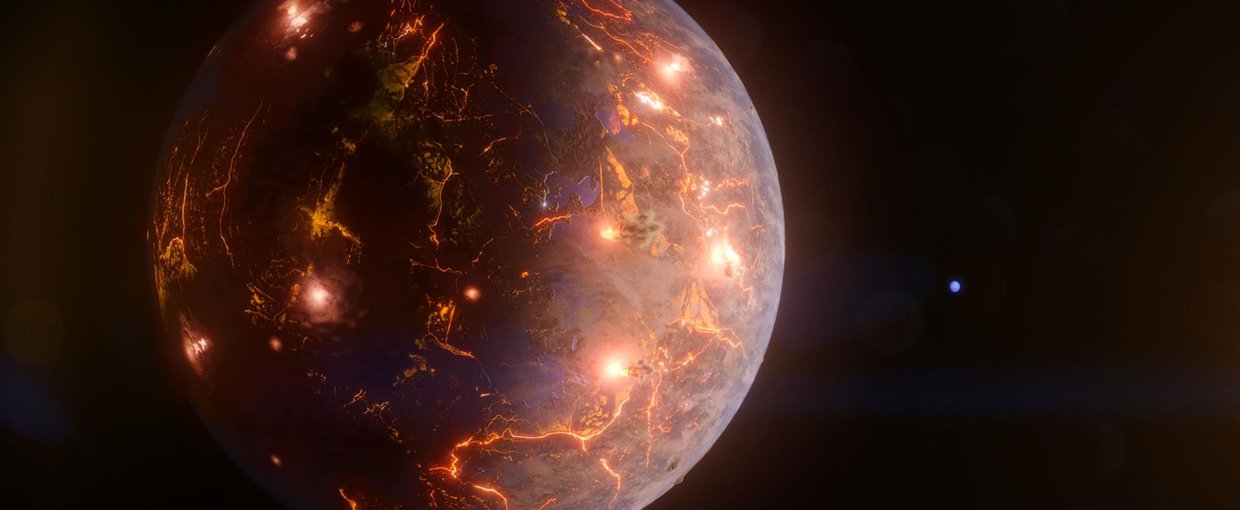
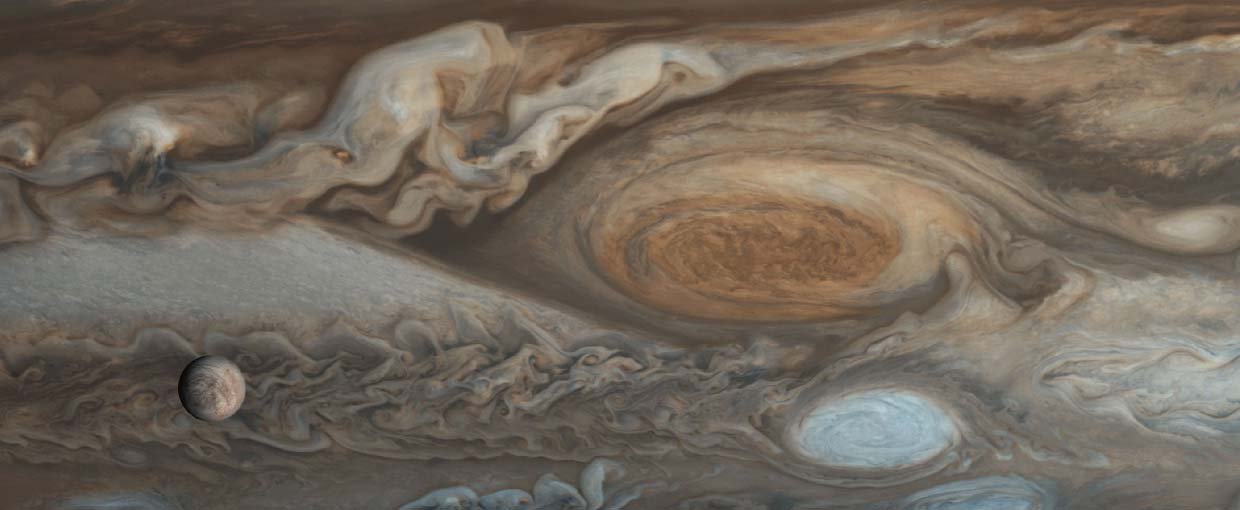
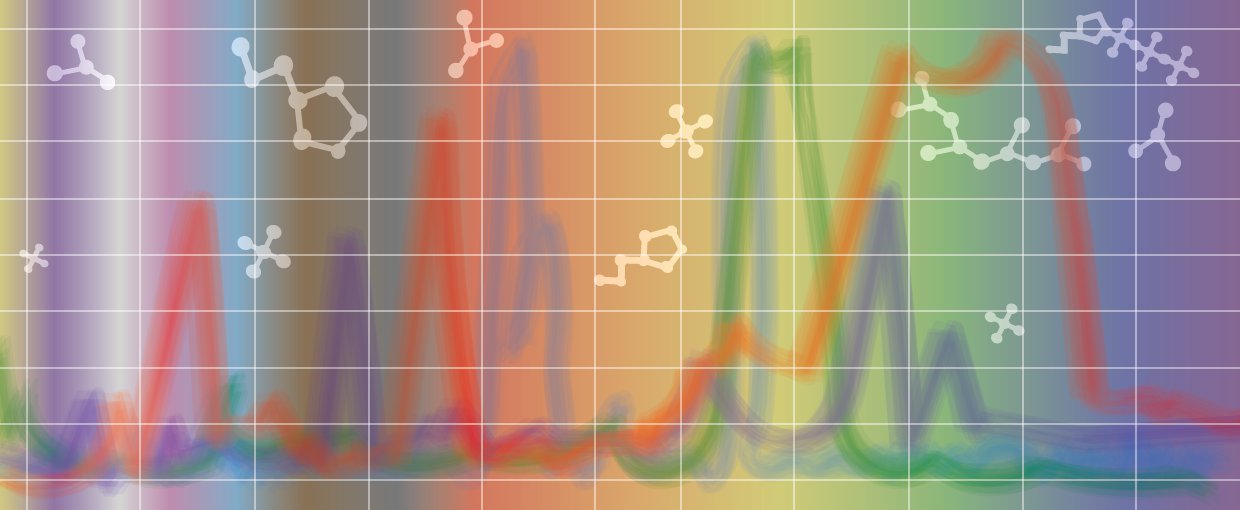
A volcanically active planet is shown in closeup at the left side of the image with glowing eruptions and lines of lava on the surface. To the right and in the distance is a faint blue glowing ball representing the more massive planet in the system.Sixteen frames from Voyager 1's flyby of Jupiter in 1979 were merged to create this image. Jupiter's Great Red Spot is visible in the center. Jupiter's moon Europa can be seen in the foreground at the bottom left of the image.The frame is a horizontal rainbow of color on a grid. Shadows of molecules can be seen through the light as well as the jagged peaks and troughs of spectral lines.
Fizzy Super Earths and Lava Worlds“Fizzy Super-Earths: Impacts of Magma Composition on the Bulk Density and Structure of Lava Worlds.” in The Astrophysical Journal.01/03
Identifying Hydrothermal Activity on Icy Ocean Worlds“Ethene-ethanol ratios as potential indicators of hydrothermal activity at Enceladus, Europa, and other icy ocean worlds.” In Icarus.02/03
NASA Raman Spectroscopic Database"The NASA Raman spectroscopic database: Ramdb version 1.00.” In Icarus.03/03
NextPrevious
Go Explore
December 2008TURBULENT CONVECTION IN STELLAR INTERIORS. II. THE VELOCITY FIELD

Arnett, D., Meakin, C., & Young, P. A. (2008). The Astrophysical Journal, 690(2), 1715–1729. doi:10.1088/0004-637x/690/2/1715

A JUPITER-LIKE PLANET ORBITING THE NEARBY M DWARF GJ 832

Bailey, J., Butler, R. P., Tinney, C. G., Jones, H. R. A., O'Toole, S., Carter, B. D., & Marcy, G. W. (2008). The Astrophysical Journal, 690(1), 743–747. doi:10.1088/0004-637x/690/1/743

THE 5.25 AND 5.7 μm ASTRONOMICAL POLYCYCLIC AROMATIC HYDROCARBON EMISSION FEATURES

Boersma, C., Mattioda, A. L., Bauschlicher, C. W., Peeters, E., Tielens, A. G. G. M., & Allamandola, L. J. (2008). The Astrophysical Journal, 690(2), 1208–1221. doi:10.1088/0004-637x/690/2/1208

PHOTOEVAPORATION OF CIRCUMSTELLAR DISKS BY FAR-ULTRAVIOLET, EXTREME-ULTRAVIOLET AND X-RAY RADIATION FROM THE CENTRAL STAR

Gorti, U., & Hollenbach, D. (2008). The Astrophysical Journal, 690(2), 1539–1552. doi:10.1088/0004-637x/690/2/1539

Strong water absorption in the dayside emission spectrum of the planet HD 189733b

Grillmair, C. J., Burrows, A., Charbonneau, D., Armus, L., Stauffer, J., Meadows, V., … Cleve, J. v. (2008). Nature, 456(7223), 767–769. doi:10.1038/nature07574

A Revised, Hazy Methane Greenhouse for the Archean Earth

Haqq-Misra, J. D., Domagal-Goldman, S. D., Kasting, P. J., & Kasting, J. F. (2008). Astrobiology, 8(6), 1127–1137. doi:10.1089/ast.2007.0197

Short- and Long-Term Olivine Weathering in Svalbard: Implications for Mars

Hausrath, E. M., Treiman, A. H., Vicenzi, E., Bish, D. L., Blake, D., Sarrazin, P., … Hoehler, T. (2008). Astrobiology, 8(6), 1079–1092. doi:10.1089/ast.2007.0195

WATER, O 2 , AND ICE IN MOLECULAR CLOUDS

Hollenbach, D., Kaufman, M. J., Bergin, E. A., & Melnick, G. J. (2008). The Astrophysical Journal, 690(2), 1497–1521. doi:10.1088/0004-637x/690/2/1497

Extrasolar Planet Eccentricities from Scattering in the Presence of Residual Gas Disks

Moeckel, N., Raymond, S. N., & Armitage, P. J. (2008). The Astrophysical Journal, 688(2), 1361–1367. doi:10.1086/592286

Crystal Structure of the L Protein of Rhodobacter sphaeroides Light-Independent Protochlorophyllide Reductase with MgADP Bound: A Homologue of the Nitrogenase Fe Protein † ‡

Sarma, R., Barney, B. M., Hamilton, T. L., Jones, A., Seefeldt, L. C., & Peters, J. W. (2008). Biochemistry, 47(49), 13004–13015. doi:10.1021/bi801058r