


This website is currently being migrated. For the most up-to-date astrobiology news, resources, and community announcements, please visit our new home at science.nasa.gov/astrobiology

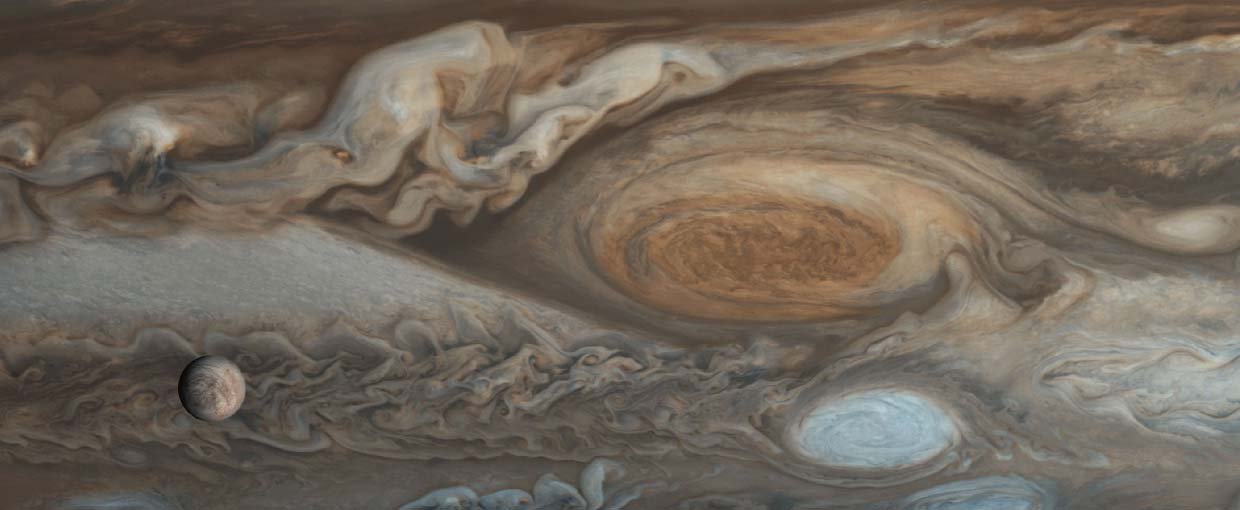
A volcanically active planet is shown in closeup at the left side of the image with glowing eruptions and lines of lava on the surface. To the right and in the distance is a faint blue glowing ball representing the more massive planet in the system.Sixteen frames from Voyager 1's flyby of Jupiter in 1979 were merged to create this image. Jupiter's Great Red Spot is visible in the center. Jupiter's moon Europa can be seen in the foreground at the bottom left of the image.The frame is a horizontal rainbow of color on a grid. Shadows of molecules can be seen through the light as well as the jagged peaks and troughs of spectral lines.
Fizzy Super Earths and Lava Worlds“Fizzy Super-Earths: Impacts of Magma Composition on the Bulk Density and Structure of Lava Worlds.” in The Astrophysical Journal.01/03
Identifying Hydrothermal Activity on Icy Ocean Worlds“Ethene-ethanol ratios as potential indicators of hydrothermal activity at Enceladus, Europa, and other icy ocean worlds.” In Icarus.02/03
NASA Raman Spectroscopic Database"The NASA Raman spectroscopic database: Ramdb version 1.00.” In Icarus.03/03
NextPrevious
Go Explore
March 2009A recurrent magnesium-binding motif provides a framework for the ribosomal peptidyl transferase center

Hsiao, C., & Williams, L. D. (2009). Nucleic Acids Research, 37(10), 3134–3142. doi:10.1093/nar/gkp119

The impact and recovery of asteroid 2008 TC3

Jenniskens, P., Shaddad, M. H., Numan, D., Elsir, S., Kudoda, A. M., Zolensky, M. E., … Le, L. (2009). Nature, 458(7237), 485–488. doi:10.1038/nature07920

Tertiary interactions within the ribosomal exit tunnel

Kosolapov, A., & Deutsch, C. (2009). Nature Structural & Molecular Biology, 16(4), 405–411. doi:10.1038/nsmb.1571

INFALL AND ROTATION MOTIONS IN THE HH 111 PROTOSTELLAR SYSTEM: A FLATTENED ENVELOPE IN TRANSITION TO A DISK?

Lee, C-F., Mao, Y-Y., & Reipurth, B. (2009). The Astrophysical Journal, 694(2), 1395–1401. doi:10.1088/0004-637x/694/2/1395

FAR-INFRARED SPECTROSCOPY OF NEUTRAL CORONENE, OVALENE, AND DICORONYLENE

Mattioda, A. L., Ricca, A., Tucker, J., Bauschlicher, C. W., & Allamandola, L. J. (2009). The Astronomical Journal, 137(4), 4054–4060. doi:10.1088/0004-6256/137/4/4054

Hydrogenase cluster biosynthesis: organometallic chemistry nature's way

McGlynn, S. E., Mulder, D. W., Shepard, E. M., Broderick, J. B., & Peters, J. W. (2009). Dalton Trans., None(22), 4274. doi:10.1039/b821432h

LOW-MASS COMPANIONS FOR FIVE SOLAR-TYPE STARS FROM THE MAGELLAN PLANET SEARCH PROGRAM

Minniti, D., Butler, R. P., López-Morales, M., Shectman, S. A., Adams, F. C., Arriagada, P., … Boss, A. P. (2009). The Astrophysical Journal, 693(2), 1424–1430. doi:10.1088/0004-637x/693/2/1424

Comparison of the microbial diversity at different depths of the GISP2 Greenland ice core in relationship to deposition climates

Miteva, V., Teacher, C., Sowers, T., & Brenchley, J. (2009). Environmental Microbiology, 11(3), 640–656. doi:10.1111/j.1462-2920.2008.01835.x

Mechanism of RNA Double Helix-Propagation at Atomic Resolution †

Mohan, S., Hsiao, C., VanDeusen, H., Gallagher, R., Krohn, E., Kalahar, B., … Wartell, R. M. (2009). J. Phys. Chem. B, 113(9), 2614–2623. doi:10.1021/jp8039884

An interlaboratory study of TEX 86 and BIT analysis using high-performance liquid chromatography-mass spectrometry

Schouten, S., Hopmans, E. C., Van Der Meer, J., Mets, A., Bard, E., Bianchi, T. S., … Diefendorf, A. (2009). Geochem. Geophys. Geosyst., 10(3), n/a–n/a. doi:10.1029/2008gc002221