

This website is currently being migrated. For the most up-to-date astrobiology news, resources, and community announcements, please visit our new home at science.nasa.gov/astrobiology

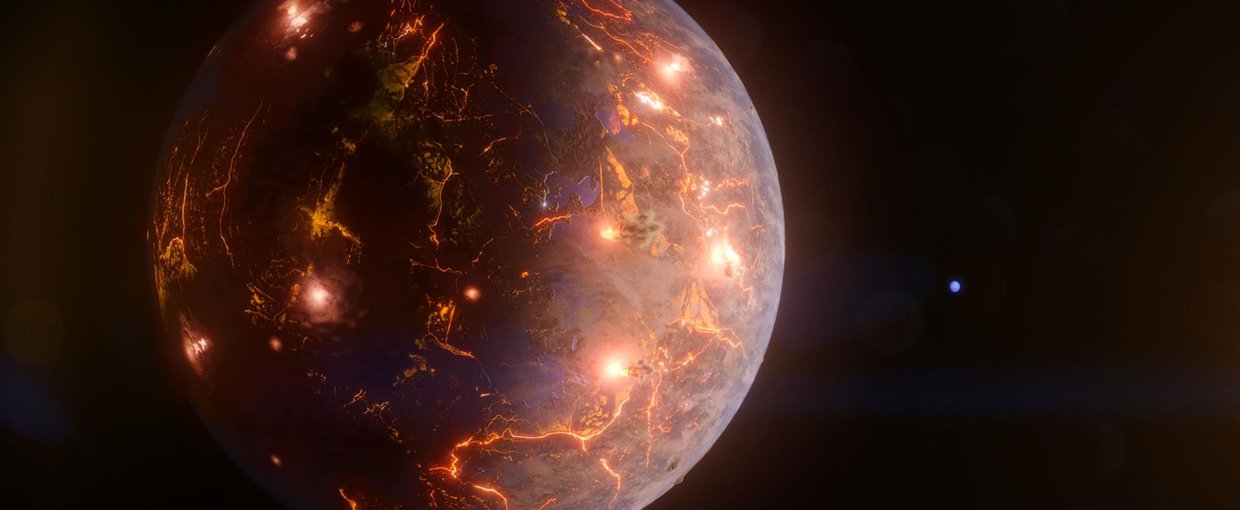
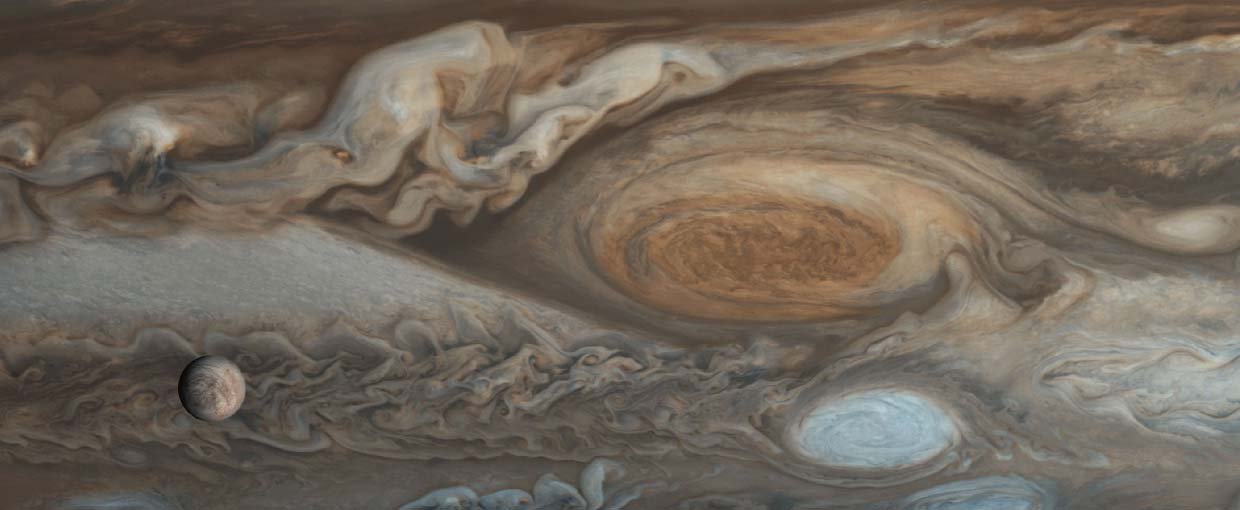
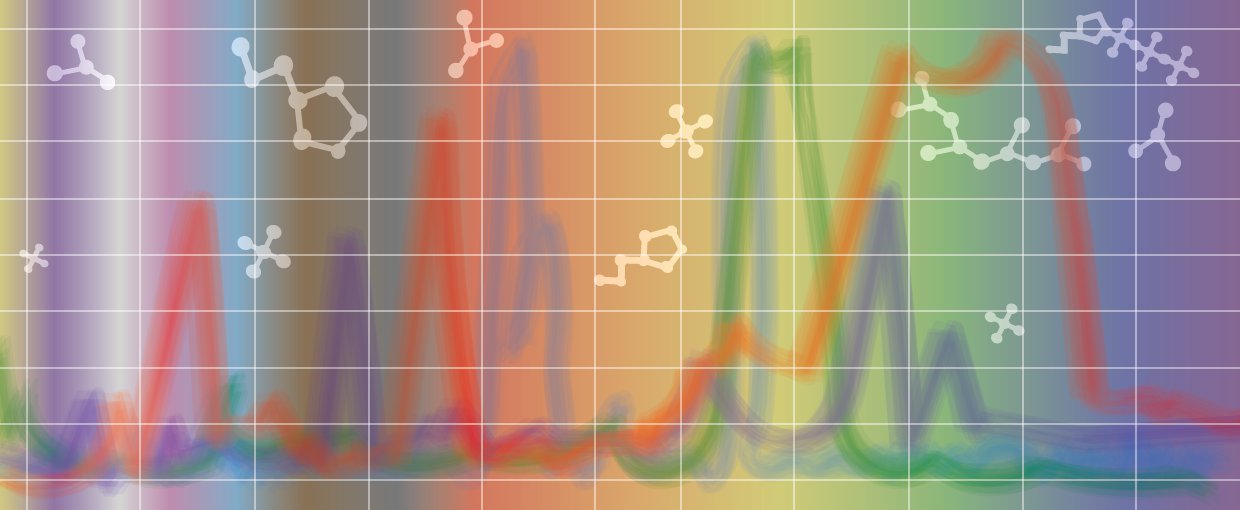
A volcanically active planet is shown in closeup at the left side of the image with glowing eruptions and lines of lava on the surface. To the right and in the distance is a faint blue glowing ball representing the more massive planet in the system.Sixteen frames from Voyager 1's flyby of Jupiter in 1979 were merged to create this image. Jupiter's Great Red Spot is visible in the center. Jupiter's moon Europa can be seen in the foreground at the bottom left of the image.The frame is a horizontal rainbow of color on a grid. Shadows of molecules can be seen through the light as well as the jagged peaks and troughs of spectral lines.
Fizzy Super Earths and Lava Worlds“Fizzy Super-Earths: Impacts of Magma Composition on the Bulk Density and Structure of Lava Worlds.” in The Astrophysical Journal.01/03
Identifying Hydrothermal Activity on Icy Ocean Worlds“Ethene-ethanol ratios as potential indicators of hydrothermal activity at Enceladus, Europa, and other icy ocean worlds.” In Icarus.02/03
NASA Raman Spectroscopic Database"The NASA Raman spectroscopic database: Ramdb version 1.00.” In Icarus.03/03
NextPrevious
Go Explore
October 2009The irradiation of ammonia ice studied by near edge x-ray absorption spectroscopy

Parent, P., Bournel, F., Lasne, J., Lacombe, S., Strazzulla, G., Gardonio, S., … Lizzit, S. (2009). J. Chem. Phys., 131(15), 154308. doi:10.1063/1.3243849

Building the terrestrial planets: Constrained accretion in the inner Solar System

Raymond, S. N., O’Brien, D. P., Morbidelli, A., & Kaib, N. A. (2009). Icarus, 203(2), 644–662. doi:10.1016/j.icarus.2009.05.016

A Late Archean Sulfidic Sea Stimulated by Early Oxidative Weathering of the Continents

Reinhard, C. T., Raiswell, R., Scott, C., Anbar, A. D., & Lyons, T. W. (2009). Science, 326(5953), 713–716. doi:10.1126/science.1176711

Structural Insight into Nascent Polypeptide Chain-Mediated Translational Stalling

Seidelt, B., Innis, C. A., Wilson, D. N., Gartmann, M., Armache, J-P., Villa, E., … Trabuco, L. G. (2009). Science, 326(5958), 1412–1415. doi:10.1126/science.1177662

WATER, METHANE, AND CARBON DIOXIDE PRESENT IN THE DAYSIDE SPECTRUM OF THE EXOPLANET HD 209458b

Swain, M. R., Tinetti, G., Vasisht, G., Deroo, P., Griffith, C., Bouwman, J., … Chen, P. (2009). The Astrophysical Journal, 704(2), 1616–1621. doi:10.1088/0004-637x/704/2/1616

Generation of banded iron formations by internal dynamics and leaching of oceanic crust

Wang, Y., Xu, H., Merino, E., & Konishi, H. (2009). Nature Geosci, 2(11), 781–784. doi:10.1038/ngeo652

Organic matter from comet 81P/Wild 2, IDPs, and carbonaceous meteorites; similarities and differences

Wirick, S., Flynn, G. J., Keller, L. P., Nakamura-Messenger, K., Peltzer, C., Jacobsen, C., … Sandford, S. (2009). Meteoritics & Planetary Science, 44(10), 1611–1626. doi:10.1111/j.1945-5100.2009.tb01194.x

Influence of pH and dissolved Si on Fe isotope fractionation during dissimilatory microbial reduction of hematite

Wu, L., Beard, B. L., Roden, E. E., & Johnson, C. M. (2009). Geochimica et Cosmochimica Acta, 73(19), 5584–5599. doi:10.1016/j.gca.2009.06.026

A major drop in seawater 87Sr/86Sr during the Middle Ordovician (Darriwilian): Links to volcanism and climate?

Young, S. A., Saltzman, M. R., Foland, K. A., Linder, J. S., & Kump, L. R. (2009). Geology, 37(10), 951–954. doi:10.1130/g30152a.1

September 2009Timescales for the evolution of oxygen isotope compositions in the solar nebula

Lyons, J. R., Bergin, E. A., Ciesla, F. J., Davis, A. M., Desch, S. J., Hashizume, K., & Lee, J-E. (2009). Timescales for the evolution of oxygen isotope compositions in the solar nebula. Geochimica et Cosmochimica Acta, 73(17), 4998–5017. doi:10.1016/j.gca.2009.01.041