

This website is currently being migrated. For the most up-to-date astrobiology news, resources, and community announcements, please visit our new home at science.nasa.gov/astrobiology

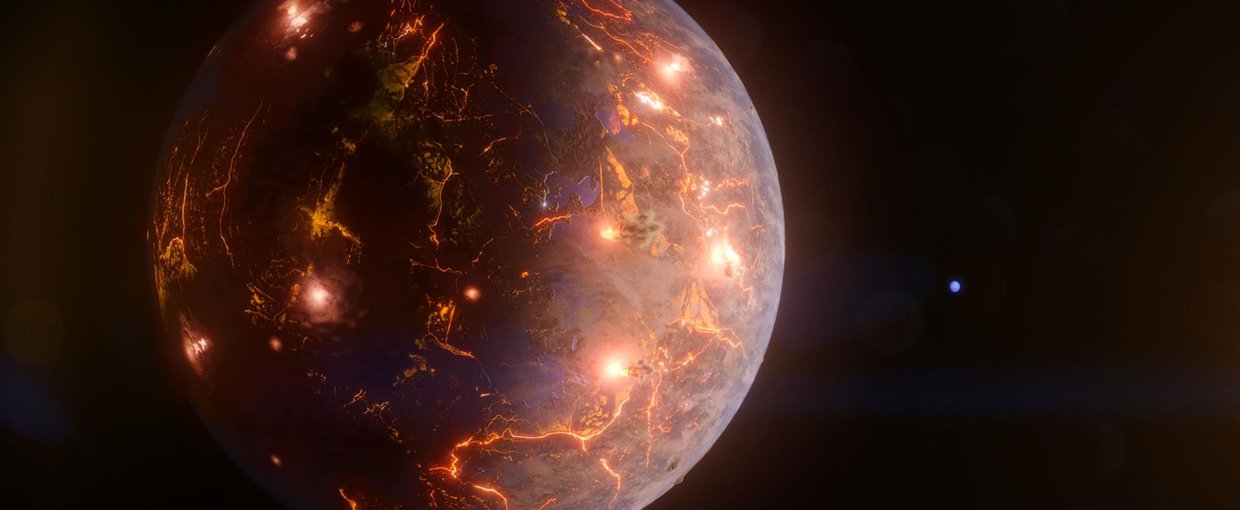
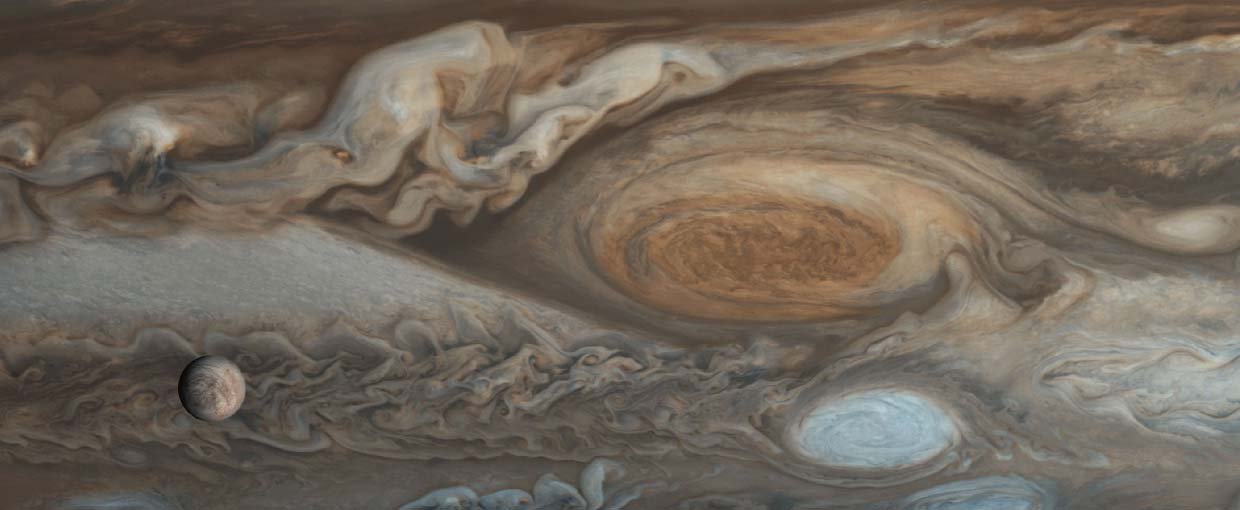
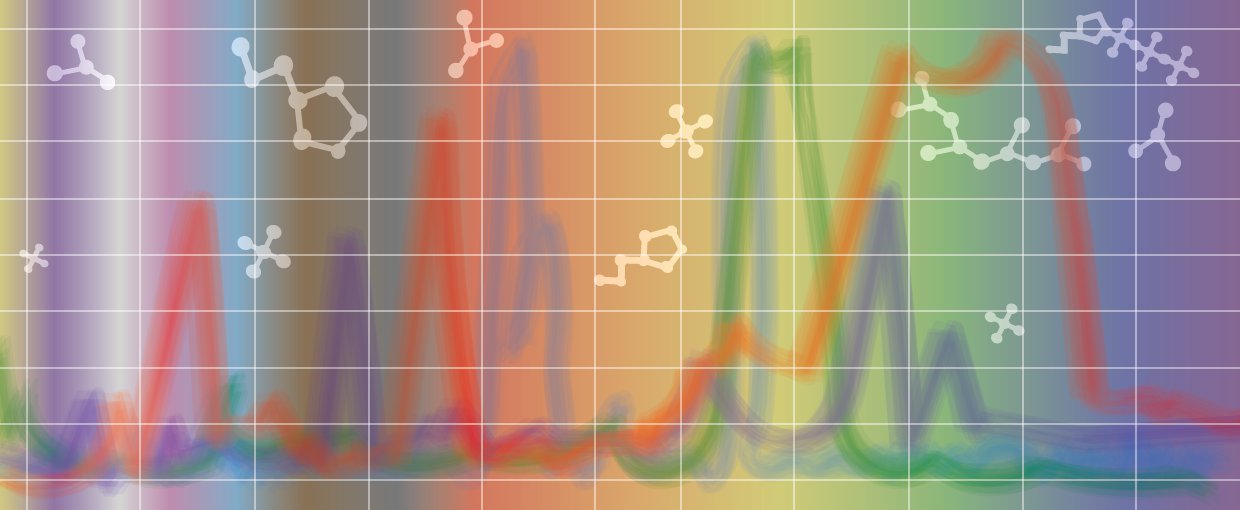
A volcanically active planet is shown in closeup at the left side of the image with glowing eruptions and lines of lava on the surface. To the right and in the distance is a faint blue glowing ball representing the more massive planet in the system.Sixteen frames from Voyager 1's flyby of Jupiter in 1979 were merged to create this image. Jupiter's Great Red Spot is visible in the center. Jupiter's moon Europa can be seen in the foreground at the bottom left of the image.The frame is a horizontal rainbow of color on a grid. Shadows of molecules can be seen through the light as well as the jagged peaks and troughs of spectral lines.
Fizzy Super Earths and Lava Worlds“Fizzy Super-Earths: Impacts of Magma Composition on the Bulk Density and Structure of Lava Worlds.” in The Astrophysical Journal.01/03
Identifying Hydrothermal Activity on Icy Ocean Worlds“Ethene-ethanol ratios as potential indicators of hydrothermal activity at Enceladus, Europa, and other icy ocean worlds.” In Icarus.02/03
NASA Raman Spectroscopic Database"The NASA Raman spectroscopic database: Ramdb version 1.00.” In Icarus.03/03
NextPrevious
Go Explore
November 2009Sulphide survival and diamond genesis during formation and evolution of Archaean subcontinental lithosphere: A comparison between the Slave and Kaapvaal cratons

Aulbach, S., Stachel, T., Creaser, R. A., Heaman, L. M., Shirey, S. B., Muehlenbachs, K., … Eichenberg, D. (2009). Lithos, 112(None), 747–757. doi:10.1016/j.lithos.2009.03.048

Chemotrophic Microbial Mats and Their Potential for Preservation in the Rock Record

Bailey, J. V., Orphan, V. J., Joye, S. B., & Corsetti, F. A. (2009). Astrobiology, 9(9), 843–859. doi:10.1089/ast.2008.0314

Variety--the Splice of Life--in Microbial Communities

Banfield, J. F., & Young, M. (2009). Science, 326(5957), 1198–1199. doi:10.1126/science.1181501

The Carnegie Astrometric Planet Search Program

Boss, A. P., Weinberger, A. J., Anglada-Escudé, G., Thompson, I. B., Burley, G., Birk, C., … Pravdo, S. H. (2009). Publications of the Astronomical Society of the Pacific, 121(885), 1218–1231. doi:10.1086/647960

The evolutionary history of the extinct ratite moa and New Zealand Neogene paleogeography

Bunce, M., Worthy, T. H., Phillips, M. J., Holdaway, R. N., Willerslev, E., Haile, J., … Shapiro, B. (2009). Proceedings of the National Academy of Sciences, 106(49), 20646–20651. doi:10.1073/pnas.0906660106

Evolutionary innovation and stability in animal gene networks

Davidson, E. H., & Erwin, D. H. (2009). J. Exp. Zool., 9999B(None), n/a–n/a. doi:10.1002/jez.b.21329

Toward a paradigm shift in managing future global space exploration endeavors

Ehrenfreund, P., & Peter, N. (2009). Space Policy, 25(4), 244–256. doi:10.1016/j.spacepol.2009.09.004

A call to the custodians of deep time

Erwin, D. (2009). Nature, 462(7271), 282–283. doi:10.1038/462282a

The fate of S-bearing species after ion irradiation of interstellar icy grain mantles

Garozzo, M., Fulvio, D., Kanuchova, Z., Palumbo, M. E., & Strazzulla, G. (2009). A&A, 509(None), A67. doi:10.1051/0004-6361/200913040

Nitrogen-enhanced greenhouse warming on early Earth

Goldblatt, C., Claire, M. W., Lenton, T. M., Matthews, A. J., Watson, A. J., & Zahnle, K. J. (2009). Nature Geosci, 2(12), 891–896. doi:10.1038/ngeo692