

This website is currently being migrated. For the most up-to-date astrobiology news, resources, and community announcements, please visit our new home at science.nasa.gov/astrobiology

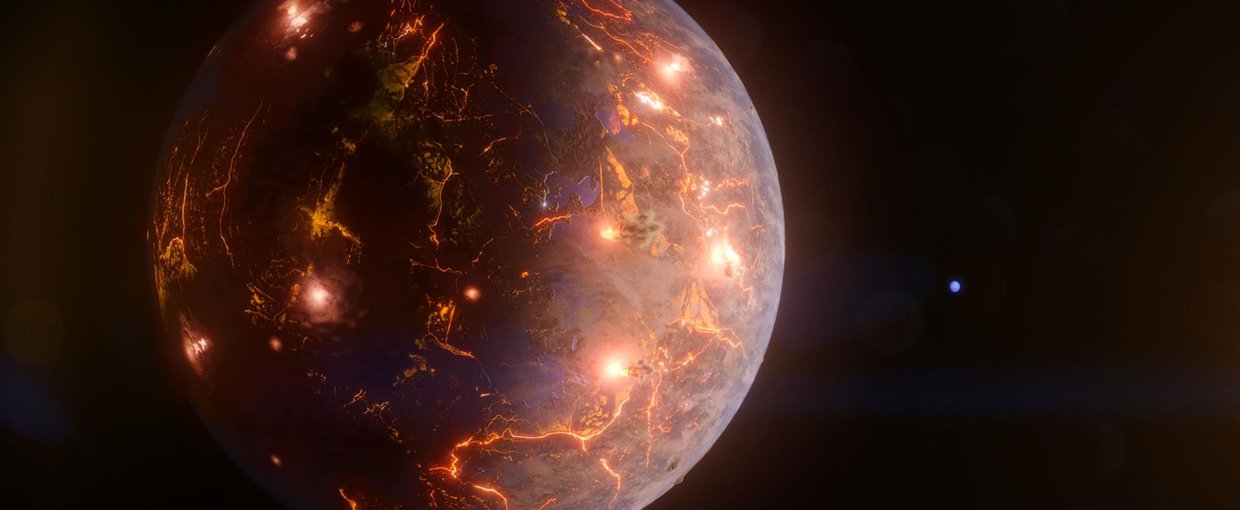
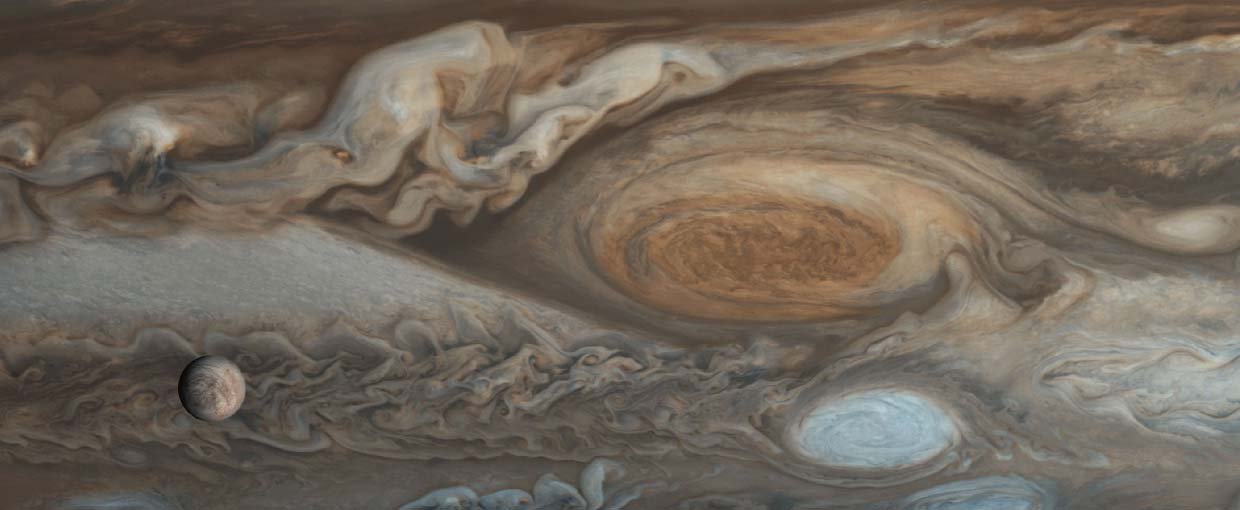
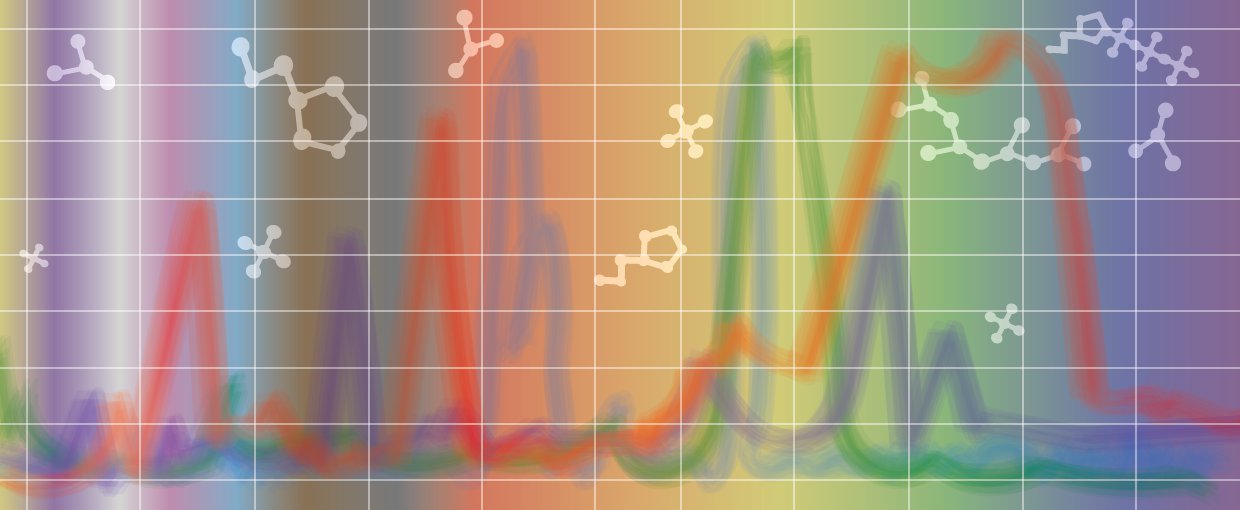
A volcanically active planet is shown in closeup at the left side of the image with glowing eruptions and lines of lava on the surface. To the right and in the distance is a faint blue glowing ball representing the more massive planet in the system.Sixteen frames from Voyager 1's flyby of Jupiter in 1979 were merged to create this image. Jupiter's Great Red Spot is visible in the center. Jupiter's moon Europa can be seen in the foreground at the bottom left of the image.The frame is a horizontal rainbow of color on a grid. Shadows of molecules can be seen through the light as well as the jagged peaks and troughs of spectral lines.
Fizzy Super Earths and Lava Worlds“Fizzy Super-Earths: Impacts of Magma Composition on the Bulk Density and Structure of Lava Worlds.” in The Astrophysical Journal.01/03
Identifying Hydrothermal Activity on Icy Ocean Worlds“Ethene-ethanol ratios as potential indicators of hydrothermal activity at Enceladus, Europa, and other icy ocean worlds.” In Icarus.02/03
NASA Raman Spectroscopic Database"The NASA Raman spectroscopic database: Ramdb version 1.00.” In Icarus.03/03
NextPrevious
Go Explore
March 2010Global Biogeochemical Changes at Both Ends of the Proterozoic: Insights from Phosphorites

Papineau, D. (2010). Astrobiology, 10(2), 165–181. doi:10.1089/ast.2009.0360

Film Bulk Acoustic-Wave Resonator Based Relative Humidity Sensor Using ZnO Films

Qiu, X., Oiler, J., Zhu, J., Wang, Z., Tang, R., Yu, C., & Yu, H. (2010). Electrochem. Solid-State Lett., 13(5), J65. doi:10.1149/1.3332397

THE COLORS OF EXTREME OUTER SOLAR SYSTEM OBJECTS

Sheppard, S. S. (2010). The Astronomical Journal, 139(4), 1394–1405. doi:10.1088/0004-6256/139/4/1394

Microbial production of isotopically light iron(II) in a modern chemically precipitated sediment and implications for isotopic variations in ancient rocks

Tangalos, G. E., Beard, B. L., Johnson, C. M., Alpers, C. N., Shelobolina, E. S., Xu, H., … Konishi, H. (2010). Geobiology, 8(3), 197–208. doi:10.1111/j.1472-4669.2010.00237.x

PROBING THE TERMINATOR REGION ATMOSPHERE OF THE HOT-JUPITER XO-1b WITH TRANSMISSION SPECTROSCOPY

Tinetti, G., Deroo, P., Swain, M. R., Griffith, C. A., Vasisht, G., Brown, L. R., … Burke, C. (2010). The Astrophysical Journal, 712(2), L139–L142. doi:10.1088/2041-8205/712/2/l139

Clay mineralogy, organic carbon burial, and redox evolution in Proterozoic oceans

Tosca, N. J., Johnston, D. T., Mushegian, A., Rothman, D. H., Summons, R. E., & Knoll, A. H. (2010). Geochimica et Cosmochimica Acta, 74(5), 1579–1592. doi:10.1016/j.gca.2009.12.001

A Folding Zone in the Ribosomal Exit Tunnel for Kv1.3 Helix Formation

Tu, L. W., & Deutsch, C. (2010). Journal of Molecular Biology, 396(5), 1346–1360. doi:10.1016/j.jmb.2009.12.059

A physiologically explicit morphospace for tracheid-based water transport in modern and extinct seed plants

Wilson, J. P., & Knoll, A. H. (2010). Paleobiology, 36(2), 335–355. doi:10.1666/08071.1

HRTEM investigation of trilling todorokite and nano-phase Mn-oxides in manganese dendrites

Xu, H., Chen, T., & Konishi, H. (2010). American Mineralogist, 95(4), 556–562. doi:10.2138/am.2010.3211

Formation of the Phenyl Radical [C 6 H 5 (X 2 A 1 )] under Single Collision Conditions: A Crossed Molecular Beam and ab Initio Study

Zhang, F., Jones, B., Maksyutenko, P., Kaiser, R. I., Chin, C., Kislov, V. V., & Mebel, A. M. (2010). Journal of the American Chemical Society, 132(8), 2672–2683. doi:10.1021/ja908559v