


This website is currently being migrated. For the most up-to-date astrobiology news, resources, and community announcements, please visit our new home at science.nasa.gov/astrobiology

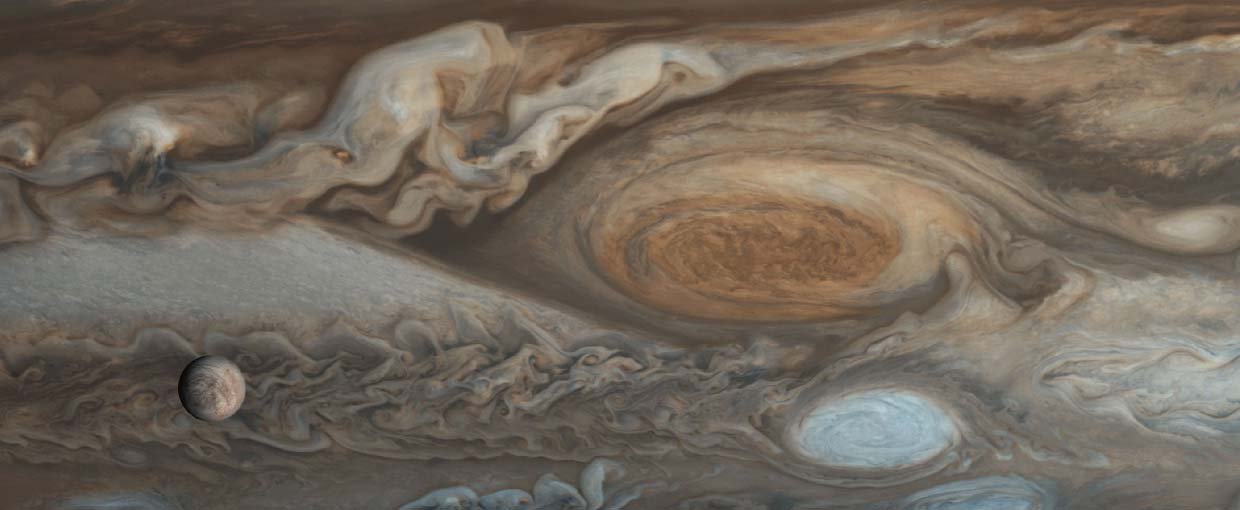
A volcanically active planet is shown in closeup at the left side of the image with glowing eruptions and lines of lava on the surface. To the right and in the distance is a faint blue glowing ball representing the more massive planet in the system.Sixteen frames from Voyager 1's flyby of Jupiter in 1979 were merged to create this image. Jupiter's Great Red Spot is visible in the center. Jupiter's moon Europa can be seen in the foreground at the bottom left of the image.The frame is a horizontal rainbow of color on a grid. Shadows of molecules can be seen through the light as well as the jagged peaks and troughs of spectral lines.
Fizzy Super Earths and Lava Worlds“Fizzy Super-Earths: Impacts of Magma Composition on the Bulk Density and Structure of Lava Worlds.” in The Astrophysical Journal.01/03
Identifying Hydrothermal Activity on Icy Ocean Worlds“Ethene-ethanol ratios as potential indicators of hydrothermal activity at Enceladus, Europa, and other icy ocean worlds.” In Icarus.02/03
NASA Raman Spectroscopic Database"The NASA Raman spectroscopic database: Ramdb version 1.00.” In Icarus.03/03
NextPrevious
Go Explore
September 2010Migration of air bubbles in ice under a temperature gradient, with application to “Snowball Earth”

Dadic, R., Light, B., & Warren, S. G. (2010). Journal of Geophysical Research, 115(D18), None. doi:10.1029/2010jd014148

Devonian rise in atmospheric oxygen correlated to the radiations of terrestrial plants and large predatory fish

Dahl, T. W., Hammarlund, E. U., Anbar, A. D., Bond, D. P. G., Gill, B. C., Gordon, G. W., … Knoll, A. H. (2010). Proceedings of the National Academy of Sciences, 107(42), 17911–17915. doi:10.1073/pnas.1011287107

Methane, ammonia, and their irradiation products at the surface of an intermediate-size KBO?

Delsanti, A., Merlin, F., Guilbert-Lepoutre, A., Bauer, J., Yang, B., & Meech, K. J. (2010). A&A, 520(None), A40. doi:10.1051/0004-6361/201014296

HABITABLE CLIMATES: THE INFLUENCE OF ECCENTRICITY

Dressing, C. D., Spiegel, D. S., Scharf, C. A., Menou, K., & Raymond, S. N. (2010). The Astrophysical Journal, 721(2), 1295–1307. doi:10.1088/0004-637x/721/2/1295

Fullerenes and Cosmic Carbon

Ehrenfreund, P., & Foing, B. H. (2010). Science, 329(5996), 1159–1160. doi:10.1126/science.1194855

Exposure of spectrally distinct material by impact craters on Mercury: Implications for global stratigraphy

Ernst, C. M., Murchie, S. L., Barnouin, O. S., Robinson, M. S., Denevi, B. W., Blewett, D. T., … Head, J. W. (2010). Icarus, 209(1), 210–223. doi:10.1016/j.icarus.2010.05.022

Geological constraints on the origin of oxygenic photosynthesis

Farquhar, J., Zerkle, A. L., & Bekker, A. (2010). Photosynthesis Research, 107(1), 11–36. doi:10.1007/s11120-010-9594-0

In Situ Biological Contamination Studies of the Moon: Implications for Planetary Protection and Life Detection Missions

Glavin, D. P., Dworkin, J. P., Lupisella, M., Williams, D. R., Kminek, G., & Rummel, J. D. (2010). Earth, Moon, and Planets, 107(1), 87–93. doi:10.1007/s11038-010-9361-4

Behavior of planetary dynamos under the influence of external magnetic fields: Application to Mercury and Ganymede

Gómez-Pérez, N., & Wicht, J. (2010). Icarus, 209(1), 53–62. doi:10.1016/j.icarus.2010.04.006

Evaluation of biosynthetic pathways for the unique dithiolate ligand of the FeFe hydrogenase H-cluster

Grigoropoulos, A., & Szilagyi, R. K. (2010). JBIC Journal of Biological Inorganic Chemistry, 15(8), 1177–1182. doi:10.1007/s00775-010-0698-y