

This website is currently being migrated. For the most up-to-date astrobiology news, resources, and community announcements, please visit our new home at science.nasa.gov/astrobiology

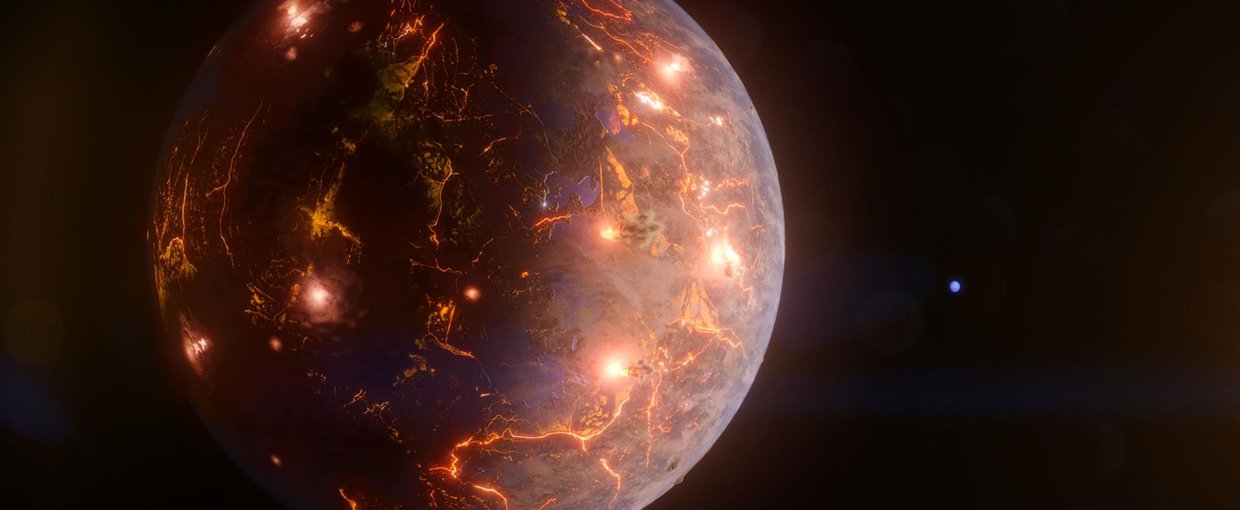
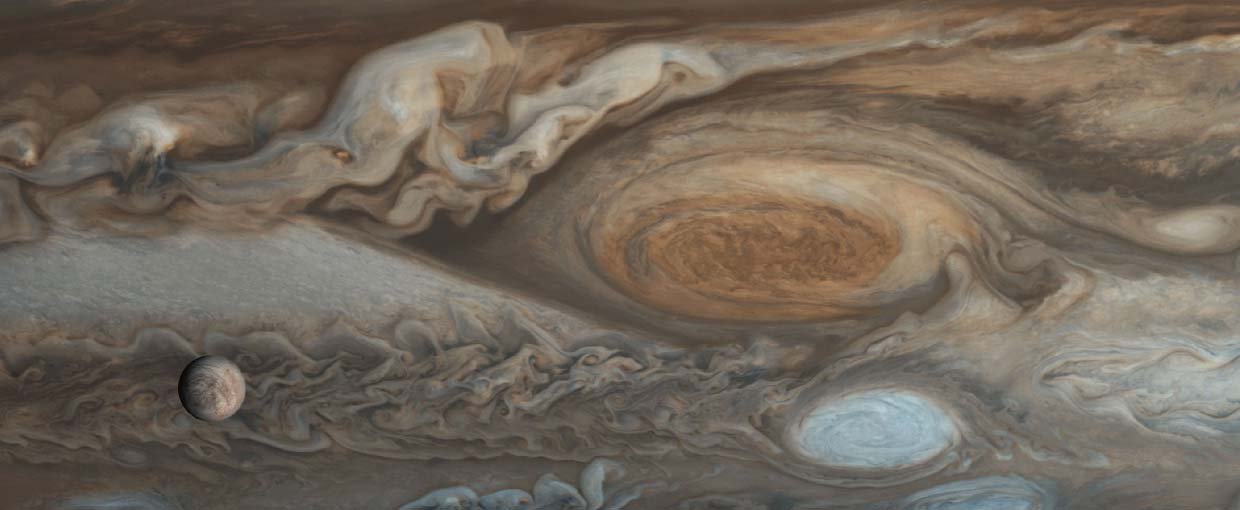
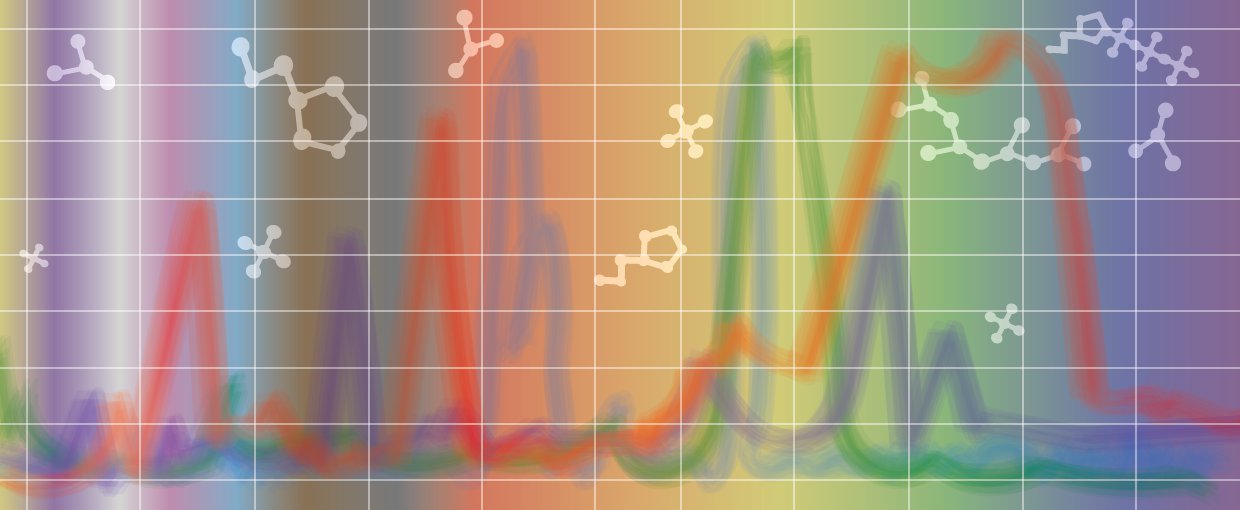
A volcanically active planet is shown in closeup at the left side of the image with glowing eruptions and lines of lava on the surface. To the right and in the distance is a faint blue glowing ball representing the more massive planet in the system.Sixteen frames from Voyager 1's flyby of Jupiter in 1979 were merged to create this image. Jupiter's Great Red Spot is visible in the center. Jupiter's moon Europa can be seen in the foreground at the bottom left of the image.The frame is a horizontal rainbow of color on a grid. Shadows of molecules can be seen through the light as well as the jagged peaks and troughs of spectral lines.
Fizzy Super Earths and Lava Worlds“Fizzy Super-Earths: Impacts of Magma Composition on the Bulk Density and Structure of Lava Worlds.” in The Astrophysical Journal.01/03
Identifying Hydrothermal Activity on Icy Ocean Worlds“Ethene-ethanol ratios as potential indicators of hydrothermal activity at Enceladus, Europa, and other icy ocean worlds.” In Icarus.02/03
NASA Raman Spectroscopic Database"The NASA Raman spectroscopic database: Ramdb version 1.00.” In Icarus.03/03
NextPrevious
Go Explore
September 2011Radioactive Elements on Mercury's Surface from MESSENGER: Implications for the Planet's Formation and Evolution

Peplowski, P. N., Evans, L. G., Hauck, S. A., McCoy, T. J., Boynton, W. V., Gillis-Davis, J. J., … Ebel, D. S. (2011). Science, 333(6051), 1850–1852. doi:10.1126/science.1211576

Two phase, inward-then-outward migration of Jupiter and Saturn in the gaseous solar nebula

Pierens, A., & Raymond, S. N. (2011). A&A, 533(None), A131. doi:10.1051/0004-6361/201117451

Widespread iron-rich conditions in the mid-Proterozoic ocean

Planavsky, N. J., McGoldrick, P., Scott, C. T., Li, C., Reinhard, C. T., Kelly, A. E., … Chu, X. (2011). Nature, 477(7365), 448–451. doi:10.1038/nature10327

Laser ablation-miniature mass spectrometer for elemental and isotopic analysis of rocks

Sinha, M. P., Neidholdt, E. L., Hurowitz, J., Sturhahn, W., Beard, B., & Hecht, M. H. (2011). Review of Scientific Instruments, 82(9), 094102. doi:10.1063/1.3626794

Serpentinite and the dawn of life

Sleep, N. H., Bird, D. K., & Pope, E. C. (2011). Philosophical Transactions of the Royal Society B: Biological Sciences, 366(1580), 2857–2869. doi:10.1098/rstb.2011.0129

Miniature mass spectrometer equipped with electrospray and desorption electrospray ionization for direct analysis of organics from solids and solutions

Sokol, E., Noll, R. J., Cooks, R. G., Beegle, L. W., Kim, H. I., & Kanik, I. (2011). International Journal of Mass Spectrometry, 306(2-3), 187–195. doi:10.1016/j.ijms.2010.10.019

Chemical composition of magnetite in Martian meteorite ALH 84001: Revised appraisal from thermochemistry of phases in Fe–Mg–C–O

Treiman, A. H., & Essene, E. J. (2011). Geochimica et Cosmochimica Acta, 75(18), 5324–5335. doi:10.1016/j.gca.2011.06.038

Diffuse interstellar bands in Upper Scorpius: probing variations in the DIB spectrum due to changing environmental conditions

Vos, D. A. I., Cox, N. L. J., Kaper, L., Spaans, M., & Ehrenfreund, P. (2011). A&A, 533(None), A129. doi:10.1051/0004-6361/200809746

Deep Mantle Cycling of Oceanic Crust: Evidence from Diamonds and Their Mineral Inclusions

Walter, M. J., Kohn, S. C., Araujo, D., Bulanova, G. P., Smith, C. B., Gaillou, E., … Wang, J. (2011). Science, 334(6052), 54–57. doi:10.1126/science.1209300

The molecular mechanism of Mo isotope fractionation during adsorption to birnessite

Wasylenki, L. E., Weeks, C. L., Bargar, J. R., Spiro, T. G., Hein, J. R., & Anbar, A. D. (2011). Geochimica et Cosmochimica Acta, 75(17), 5019–5031. doi:10.1016/j.gca.2011.06.020