


This website is currently being migrated. For the most up-to-date astrobiology news, resources, and community announcements, please visit our new home at science.nasa.gov/astrobiology

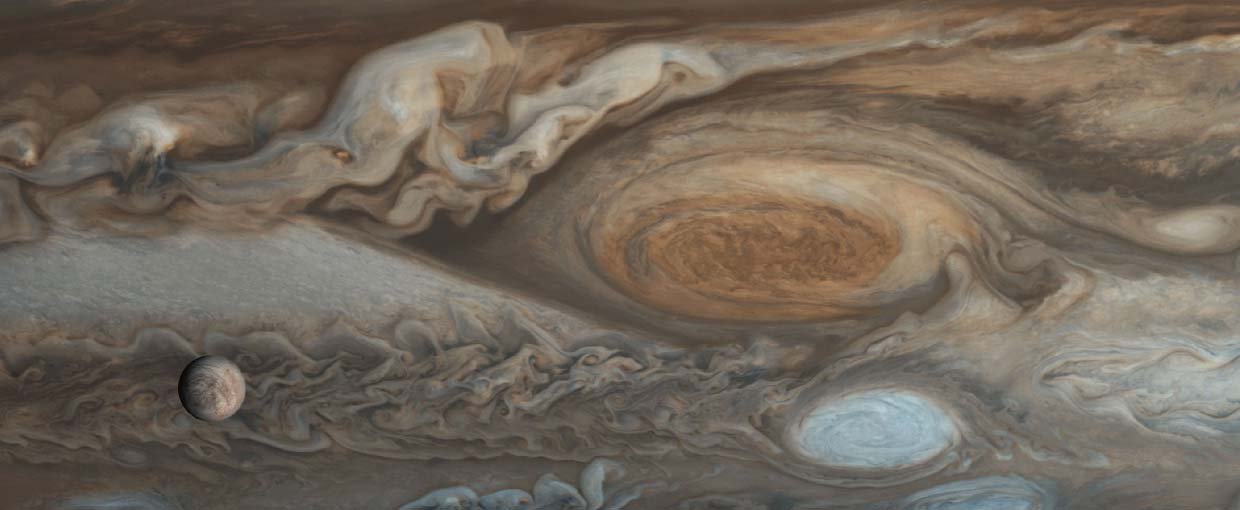
A volcanically active planet is shown in closeup at the left side of the image with glowing eruptions and lines of lava on the surface. To the right and in the distance is a faint blue glowing ball representing the more massive planet in the system.Sixteen frames from Voyager 1's flyby of Jupiter in 1979 were merged to create this image. Jupiter's Great Red Spot is visible in the center. Jupiter's moon Europa can be seen in the foreground at the bottom left of the image.The frame is a horizontal rainbow of color on a grid. Shadows of molecules can be seen through the light as well as the jagged peaks and troughs of spectral lines.
Fizzy Super Earths and Lava Worlds“Fizzy Super-Earths: Impacts of Magma Composition on the Bulk Density and Structure of Lava Worlds.” in The Astrophysical Journal.01/03
Identifying Hydrothermal Activity on Icy Ocean Worlds“Ethene-ethanol ratios as potential indicators of hydrothermal activity at Enceladus, Europa, and other icy ocean worlds.” In Icarus.02/03
NASA Raman Spectroscopic Database"The NASA Raman spectroscopic database: Ramdb version 1.00.” In Icarus.03/03
NextPrevious
Go Explore
October 2024Evaluating the Use of Unoccupied Aircraft Systems (UASs) for Planetary Exploration in Mars Analog Terrain

Carr, B. B., Varnam, M., Hadland, N., Shah, J., Voigt, J. R. C., Gwizd, S., … Hamilton, C. W. (2024). Evaluating the Use of Unoccupied Aircraft Systems (UASs) for Planetary Exploration in Mars Analog Terrain. The Planetary Science Journal, 5(10), 231. doi:10.3847/psj/ad781e

Unoccupied Aerial System Coring Drill Sampler Development for Applications on Earth and Other Planetary Bodies

Chen, C., Bywaters, K., Zacny, K., Traeden, N., & Hamilton, C. W. (2024). Unoccupied Aerial System Coring Drill Sampler Development for Applications on Earth and Other Planetary Bodies. Earth and Space 2024, None, 321–331. doi:10.1061/9780784485736.030

P-Band Antenna Array for NASA's Space Exploration Synthetic Aperture Radar (SESAR) Instrument

Du Toit, C. F., Steigner, P. J., Segal, K. N., & Rincon, R. F. (2024). P-Band Antenna Array for NASA's Space Exploration Synthetic Aperture Radar (SESAR) Instrument. 2024 IEEE International Symposium on Phased Array Systems and Technology (ARRAY), None, 1–5. doi:10.1109/array58370.2024.10880366

Probing Cold-to-temperate Exoplanetary Atmospheres: The Role of Water Condensation on Surface Identification with JWST

Huang 黄, Z. 子., Yu 余, X. 馨., Tsai, S-M., Moses, J. I., Ohno, K., Krissansen-Totton, J., … Fortney, J. J. (2024). Probing Cold-to-temperate Exoplanetary Atmospheres: The Role of Water Condensation on Surface Identification with JWST. The Astrophysical Journal, 975(1), 146. doi:10.3847/1538-4357/ad76ac

Robotic exploration of Martian caves: Evaluating operational concepts through analog experiments in lava tubes

Morrell, B. J., Saboia Da Silva, M., Kaufmann, M., Moon, S., Kim, T., Lei, X., … Blank, J. G. (2024). Robotic exploration of Martian caves: Evaluating operational concepts through analog experiments in lava tubes. Acta Astronautica, 223, 741–758. doi:10.1016/j.actaastro.2024.07.041

Permafrost and ground-ice conditions in the Untersee Oasis, Queen Maud Land, East Antarctica

Lacelle, D., Verret, M., Faucher, B., Fisher, D., Gaudreau, A., Pellerin, A., … Andersen, D. T. (2024). Permafrost and ground-ice conditions in the Untersee Oasis, Queen Maud Land, East Antarctica. Antarctic Science, 36(5), 361–378. doi:10.1017/s0954102024000233

Data report: the DNA event horizon in the Guaymas Basin subsurface biosphere: technical advances and redefined limits in bulk extractions of nucleic acids from deep marine sediments, IODP Expedition 385

Ramírez, G. A., Mara, P., Beaudoin, D., Bojanova, D., Hinkle, J. E., Kingham, B., … Teske, A. (2024). Data report: the DNA event horizon in the Guaymas Basin subsurface biosphere: technical advances and redefined limits in bulk extractions of nucleic acids from deep marine sediments, IODP Expedition 385. Guaymas Basin Tectonics and Biosphere. doi:10.14379/iodp.proc.385.204.2024

Radial transport and nebular thermal processing of millimeter‐sized solids in the Solar protoplanetary disk inferred from Cr‐Ti‐O isotope systematics of chondrules

Fukuda, K., Hibiya, Y., Kastelle, C. R., Suzuki, K., Iizuka, T., Yamashita, K., … Kita, N. T. (2024). Radial transport and nebular thermal processing of millimeter‐sized solids in the Solar protoplanetary disk inferred from Cr‐Ti‐O isotope systematics of chondrules. Meteoritics & Planetary Science. doi:10.1111/maps.14276

Annotation-free prediction of microbial dioxygen utilization

Flamholz, A. I., Goldford, J. E., Richter, P. A., Larsson, E. M., Jinich, A., Fischer, W. W., & Newman, D. K. (2024). Annotation-free prediction of microbial dioxygen utilization. mSystems, 9(10), None. doi:10.1128/msystems.00763-24

Genome sequence of an extremely halophilic archaeon isolated from Permian Period halite, Salado Formation in New Mexico, USA: Halobacterium sp. strain NMX12-1

Soto, L., DasSarma, P., Anton, B. P., Vincze, T., Verma, I., Eralp, B., Powers, D. W., Dozier, B. L., Roberts, R. J., DasSarma, S. (2024). Genome sequence of an extremely halophilic archaeon isolated from Permian Period halite, Salado Formation in New Mexico, USA: Halobacterium sp. strain NMX12-1. Microbiology Resource Announcements. doi: 10.1128/mra.00778-24