

This website is currently being migrated. For the most up-to-date astrobiology news, resources, and community announcements, please visit our new home at science.nasa.gov/astrobiology

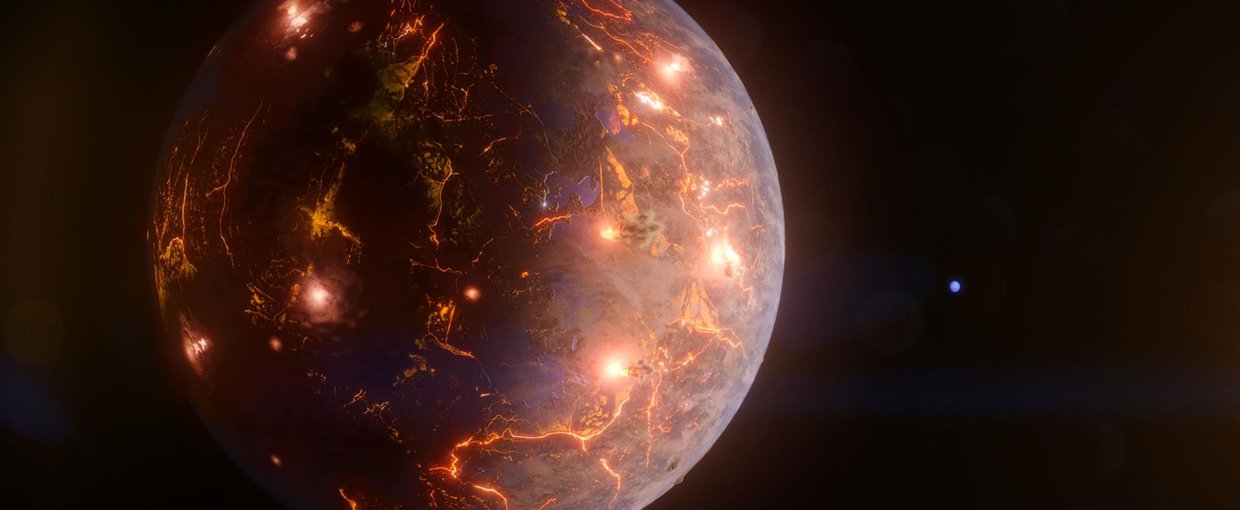
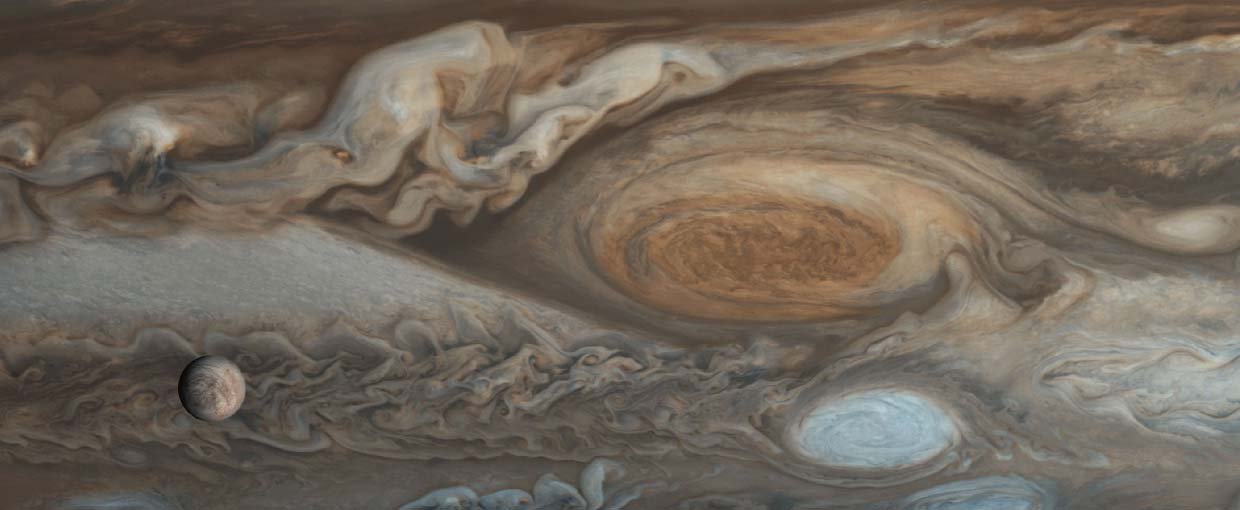
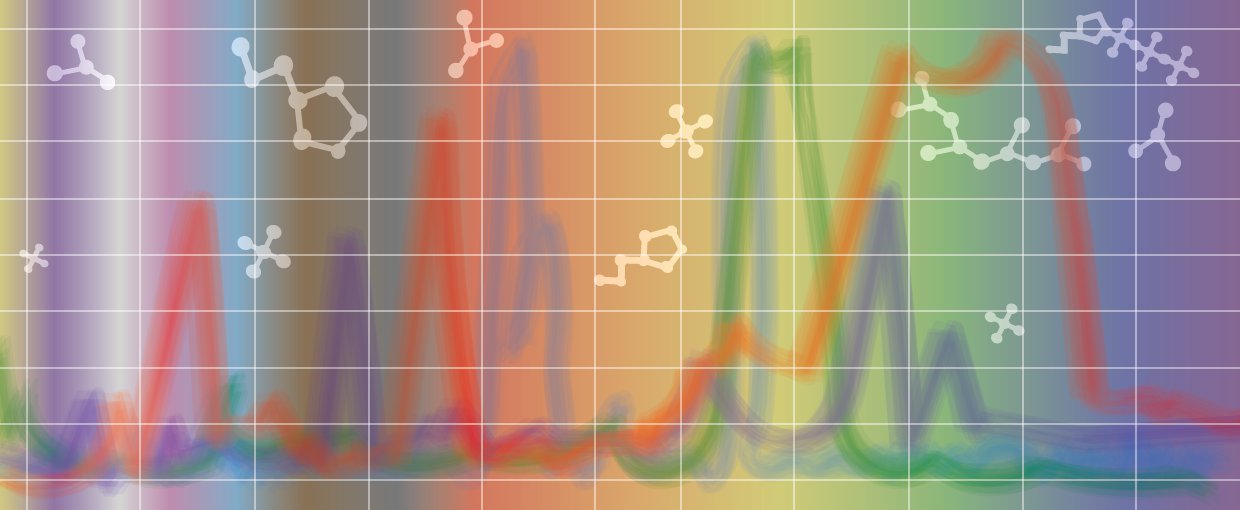
A volcanically active planet is shown in closeup at the left side of the image with glowing eruptions and lines of lava on the surface. To the right and in the distance is a faint blue glowing ball representing the more massive planet in the system.Sixteen frames from Voyager 1's flyby of Jupiter in 1979 were merged to create this image. Jupiter's Great Red Spot is visible in the center. Jupiter's moon Europa can be seen in the foreground at the bottom left of the image.The frame is a horizontal rainbow of color on a grid. Shadows of molecules can be seen through the light as well as the jagged peaks and troughs of spectral lines.
Fizzy Super Earths and Lava Worlds“Fizzy Super-Earths: Impacts of Magma Composition on the Bulk Density and Structure of Lava Worlds.” in The Astrophysical Journal.01/03
Identifying Hydrothermal Activity on Icy Ocean Worlds“Ethene-ethanol ratios as potential indicators of hydrothermal activity at Enceladus, Europa, and other icy ocean worlds.” In Icarus.02/03
NASA Raman Spectroscopic Database"The NASA Raman spectroscopic database: Ramdb version 1.00.” In Icarus.03/03
NextPrevious
Go Explore
February 2014Carbon and hydrogen stable isotope microanalysis and data correction for rare carbonate minerals: Case studies for stichtite (Mg6Cr2[(OH)16|CO3]∙H2O) and malachite (Cu2CO3(OH)2)

Melchiorre, E. B., Huss, G. R., & Lopez, A. (2014). Chemical Geology, 367(None), 63–69. doi:10.1016/j.chemgeo.2013.11.010

Unsupervised classification and visualization of unstructured text for the support of interdisciplinary collaboration

Miller, L. J., Gazan, R., & Still, S. (2014). Proceedings of the 17th ACM conference on Computer supported cooperative work & social computing - CSCW '14. doi:10.1145/2531602.2531666

Using Dimers to Measure Biosignatures and Atmospheric Pressure for Terrestrial Exoplanets

Misra, A., Meadows, V., Claire, M., & Crisp, D. (2014). Astrobiology, 14(2), 67–86. doi:10.1089/ast.2013.0990

Diffusive fractionation of carbon isotopes in γ-Fe: Experiment, models and implications for early solar system processes

Mueller, T., Watson, E. B., Trail, D., Wiedenbeck, M., Van Orman, J., & Hauri, E. H. (2014). Geochimica et Cosmochimica Acta, 127(None), 57–66. doi:10.1016/j.gca.2013.11.014

Science Applications of a Multispectral Microscopic Imager for the Astrobiological Exploration of Mars

Núñez, J. I., Farmer, J. D., Sellar, R. G., Swayze, G. A., & Blaney, D. L. (2014). Astrobiology, 14(2), 132–169. doi:10.1089/ast.2013.1079

Secondary Structures of rRNAs from All Three Domains of Life

Petrov, A. S., Bernier, C. R., Gulen, B., Waterbury, C. C., Hershkovits, E., Hsiao, C., … Harvey, S. C. (2014). PLoS ONE, 9(2), e88222. doi:10.1371/journal.pone.0088222

No universal minimum-mass extrasolar nebula: evidence against in situ accretion of systems of hot super-Earths

Raymond, S. N., & Cossou, C. (2014). Monthly Notices of the Royal Astronomical Society: Letters, 440(1), L11–L15. doi:10.1093/mnrasl/slu011

Photosynthesis and Photo-Stability of Nucleic Acids in Prebiotic Extraterrestrial Environments

Sandford, S. A., Bera, P. P., Lee, T. J., Materese, C. K., & Nuevo, M. (2014). Topics in Current Chemistry, None(None), 123–164. doi:10.1007/128_2013_499

The Effects of Impacts on the Climates of Terrestrial Planets

Segura, T. L., Zahnle, K., Toon, O. B., & McKay, C. P. (2013). Comparative Climatology of Terrestrial Planets. doi:10.2458/azu_uapress_9780816530595-ch17

Hadean age for a post-magma-ocean zircon confirmed by atom-probe tomography

Valley, J. W., Cavosie, A. J., Ushikubo, T., Reinhard, D. A., Lawrence, D. F., Larson, D. J., … Clifton, P. H. (2014). Nature Geosci, 7(3), 219–223. doi:10.1038/ngeo2075