

This website is currently being migrated. For the most up-to-date astrobiology news, resources, and community announcements, please visit our new home at science.nasa.gov/astrobiology

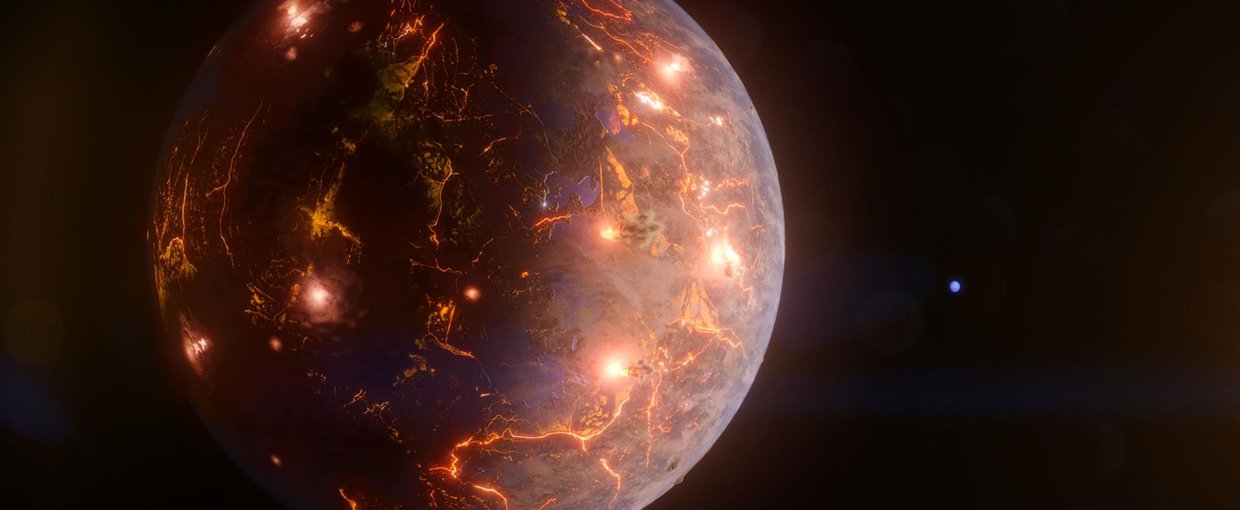
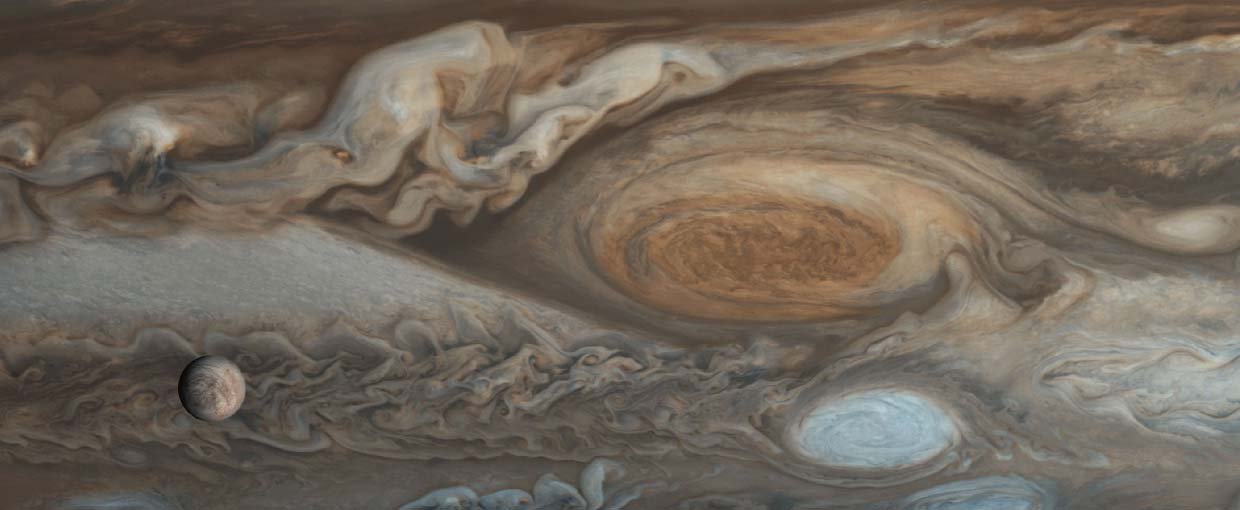
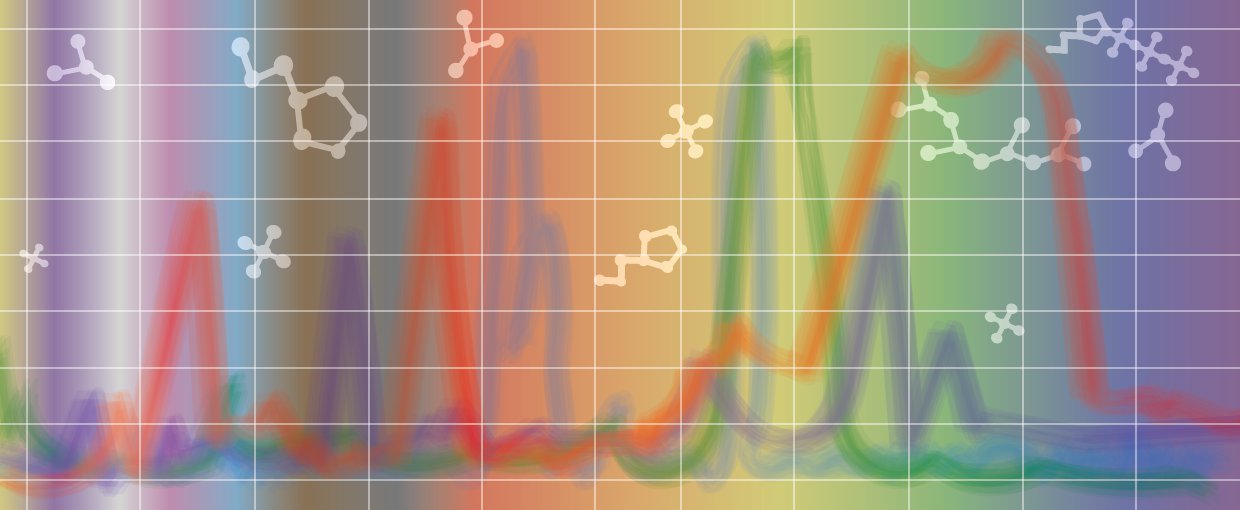
A volcanically active planet is shown in closeup at the left side of the image with glowing eruptions and lines of lava on the surface. To the right and in the distance is a faint blue glowing ball representing the more massive planet in the system.Sixteen frames from Voyager 1's flyby of Jupiter in 1979 were merged to create this image. Jupiter's Great Red Spot is visible in the center. Jupiter's moon Europa can be seen in the foreground at the bottom left of the image.The frame is a horizontal rainbow of color on a grid. Shadows of molecules can be seen through the light as well as the jagged peaks and troughs of spectral lines.
Fizzy Super Earths and Lava Worlds“Fizzy Super-Earths: Impacts of Magma Composition on the Bulk Density and Structure of Lava Worlds.” in The Astrophysical Journal.01/03
Identifying Hydrothermal Activity on Icy Ocean Worlds“Ethene-ethanol ratios as potential indicators of hydrothermal activity at Enceladus, Europa, and other icy ocean worlds.” In Icarus.02/03
NASA Raman Spectroscopic Database"The NASA Raman spectroscopic database: Ramdb version 1.00.” In Icarus.03/03
NextPrevious
Go Explore
September 2015Tidal Heating of Earth-like Exoplanets around M Stars: Thermal, Magnetic, and Orbital Evolutions

Driscoll, P. E., & Barnes, R. (2015). Astrobiology, 15(9), 739–760. doi:10.1089/ast.2015.1325

Meta-omic signatures of microbial metal and nitrogen cycling in marine oxygen minimum zones

Glass, J. B., Kretz, C. B., Ganesh, S., Ranjan, P., Seston, S. L., Buck, K. N., … Landing, W. M. (2015). Frontiers in Microbiology, 6(None), None. doi:10.3389/fmicb.2015.00998

Laboratory Studies Towards Understanding Comets

Gudipati, M. S., Abou Mrad, N., Blum, J., Charnley, S. B., Chiavassa, T., Cordiner, M. A., … Mousis, O. (2015). Space Sci Rev, 197(1-4), 101–150. doi:10.1007/s11214-015-0192-5

Terrestrial planet formation constrained by Mars and the structure of the asteroid belt

Izidoro, A., Raymond, S. N., Morbidelli, A., & Winter, O. C. (2015). Monthly Notices of the Royal Astronomical Society, 453(4), 3620–3635. doi:10.1093/mnras/stv1835

The Phanerozoic diversification of silica-cycling testate amoebae and its possible links to changes in terrestrial ecosystems

Lahr, D. J. G., Bosak, T., Lara, E., & Mitchell, E. A. D. (2015). PeerJ, 3(None), e1234. doi:10.7717/peerj.1234

The Phanerozoic diversification of silica-cycling testate amoebae and its possible links to changes in terrestrial ecosystems

Lahr, D. J. G., Bosak, T., Lara, E., & Mitchell, E. A. D. (2015). PeerJ, 3(None), e1234. doi:10.7717/peerj.1234

The molecular record of Cryogenian sponges - a response to Antcliffe (2013)

Love, G. D., & Summons, R. E. (2015). Palaeontology, 58(6), 1131–1136. doi:10.1111/pala.12196

Single cell activity reveals direct electron transfer in methanotrophic consortia

McGlynn, S. E., Chadwick, G. L., Kempes, C. P., & Orphan, V. J. (2015). Nature, 526(7574), 531–535. doi:10.1038/nature15512

Martian outflow channels: How did their source aquifers form, and why did they drain so rapidly?

Rodriguez, J. A. P., Kargel, J. S., Baker, V. R., Gulick, V. C., Berman, D. C., Fairén, A. G., … Linares, R. (2015). Scientific Reports, 5(None), 13404. doi:10.1038/srep13404

Investigation of the Role of Polysaccharide in the Dolomite Growth at Low Temperature by Using Atomistic Simulations

Shen, Z., Szlufarska, I., Brown, P. E., & Xu, H. (2015). Langmuir, 31(38), 10435–10442. doi:10.1021/acs.langmuir.5b02025