

This website is currently being migrated. For the most up-to-date astrobiology news, resources, and community announcements, please visit our new home at science.nasa.gov/astrobiology

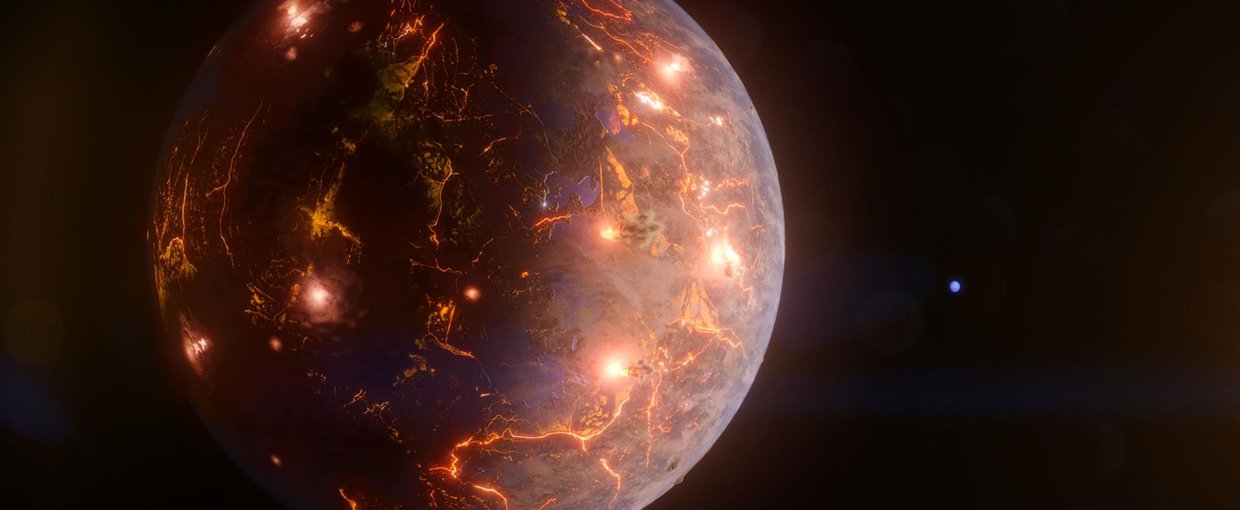
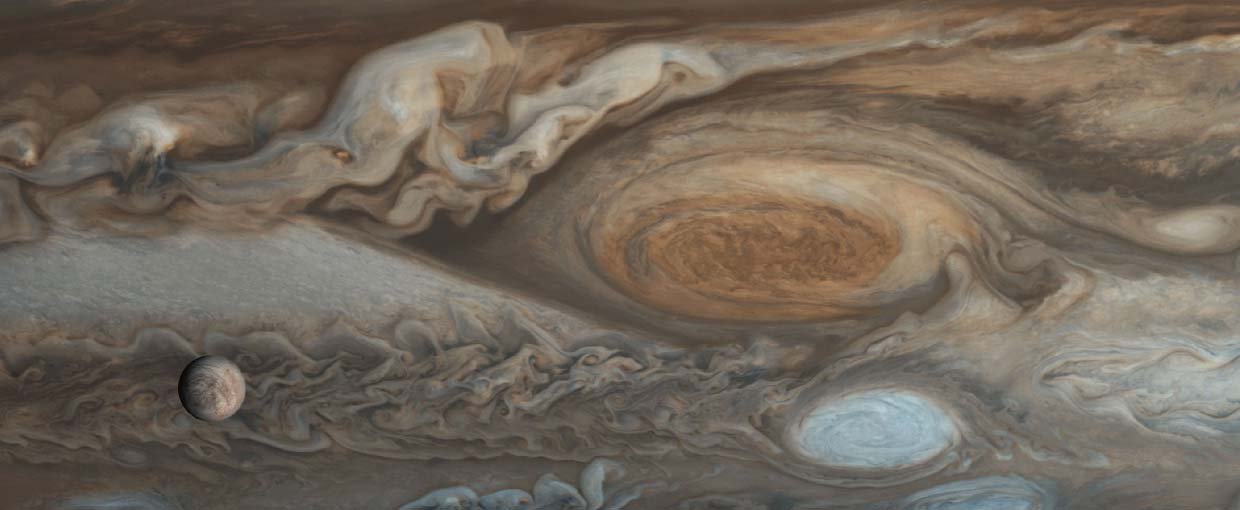
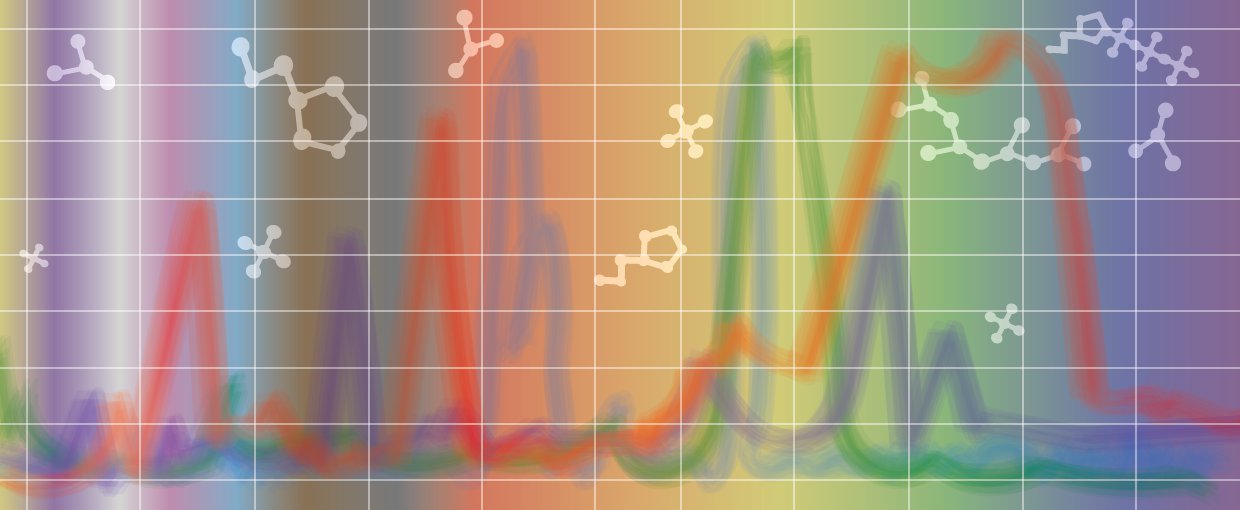
A volcanically active planet is shown in closeup at the left side of the image with glowing eruptions and lines of lava on the surface. To the right and in the distance is a faint blue glowing ball representing the more massive planet in the system.Sixteen frames from Voyager 1's flyby of Jupiter in 1979 were merged to create this image. Jupiter's Great Red Spot is visible in the center. Jupiter's moon Europa can be seen in the foreground at the bottom left of the image.The frame is a horizontal rainbow of color on a grid. Shadows of molecules can be seen through the light as well as the jagged peaks and troughs of spectral lines.
Fizzy Super Earths and Lava Worlds“Fizzy Super-Earths: Impacts of Magma Composition on the Bulk Density and Structure of Lava Worlds.” in The Astrophysical Journal.01/03
Identifying Hydrothermal Activity on Icy Ocean Worlds“Ethene-ethanol ratios as potential indicators of hydrothermal activity at Enceladus, Europa, and other icy ocean worlds.” In Icarus.02/03
NASA Raman Spectroscopic Database"The NASA Raman spectroscopic database: Ramdb version 1.00.” In Icarus.03/03
NextPrevious
Go Explore
October 2015Response: “Comment on Record solar UV irradiance in the tropical Andes, by Cabrol et al.”

Häder, D-P., Feister, U., & Cabrol, N. A. (2015). Frontiers in Environmental Science, 3(None), None. doi:10.3389/fenvs.2015.00068

ABIOTIC O 2 LEVELS ON PLANETS AROUND F, G, K, AND M STARS: POSSIBLE FALSE POSITIVES FOR LIFE?

Harman, C. E., Schwieterman, E. W., Schottelkotte, J. C., & Kasting, J. F. (2015). The Astrophysical Journal, 812(2), 137. doi:10.1088/0004-637x/812/2/137

Noise-Induced Mechanism for Biological Homochirality of Early Life Self-Replicators

Jafarpour, F., Biancalani, T., & Goldenfeld, N. (2015). Physical Review Letters, 115(15), None. doi:10.1103/physrevlett.115.158101

Roles of Nucleoid-Associated Proteins in Stress-Induced Mutagenic Break Repair in Starving Escherichia coli

Moore, J. M., Magnan, D., Mojica, A. K., Nunez, M. A. B., Bates, D., Rosenberg, S. M., & Hastings, P. J. (2015). Genetics, 201(4), 1349–1362. doi:10.1534/genetics.115.178970

Rock comminution as a source of hydrogen for subglacial ecosystems

Telling, J., Boyd, E. S., Bone, N., Jones, E. L., Tranter, M., MacFarlane, J. W., … Martin, P. G. (2015). Nature Geosci, 8(11), 851–855. doi:10.1038/ngeo2533

Effect of depth and vent fluid composition on the carbon sources at two neighboring deep-sea hydrothermal vent fields (Mid-Cayman Rise)

Bennett, S. A., Dover, C. V., Breier, J. A., & Coleman, M. (2015). Deep Sea Research Part I: Oceanographic Research Papers, 104(None), 122–133. doi:10.1016/j.dsr.2015.06.005

Ethyl alcohol and sugar in comet C/2014 Q2 (Lovejoy)

Biver, N., Bockelee-Morvan, D., Moreno, R., Crovisier, J., Colom, P., Lis, D. C., … Sandqvist, A. (2015). Science Advances, 1(9), e1500863–e1500863. doi:10.1126/sciadv.1500863

The Cambrian explosion

Briggs, D. E. G. (2015). Current Biology, 25(19), R864–R868. doi:10.1016/j.cub.2015.04.047

Tracing Biosignature Preservation of Geothermally Silicified Microbial Textures into the Geological Record

Campbell, K. A., Lynne, B. Y., Handley, K. M., Jordan, S., Farmer, J. D., Guido, D. M., … Foucher, F. (2015). Astrobiology, 15(10), 858–882. doi:10.1089/ast.2015.1307

3D MODELING OF GJ1214B’S ATMOSPHERE: VERTICAL MIXING DRIVEN BY AN ANTI-HADLEY CIRCULATION

Charnay, B., Meadows, V., & Leconte, J. (2015). The Astrophysical Journal, 813(1), 15. doi:10.1088/0004-637x/813/1/15