


This website is currently being migrated. For the most up-to-date astrobiology news, resources, and community announcements, please visit our new home at science.nasa.gov/astrobiology

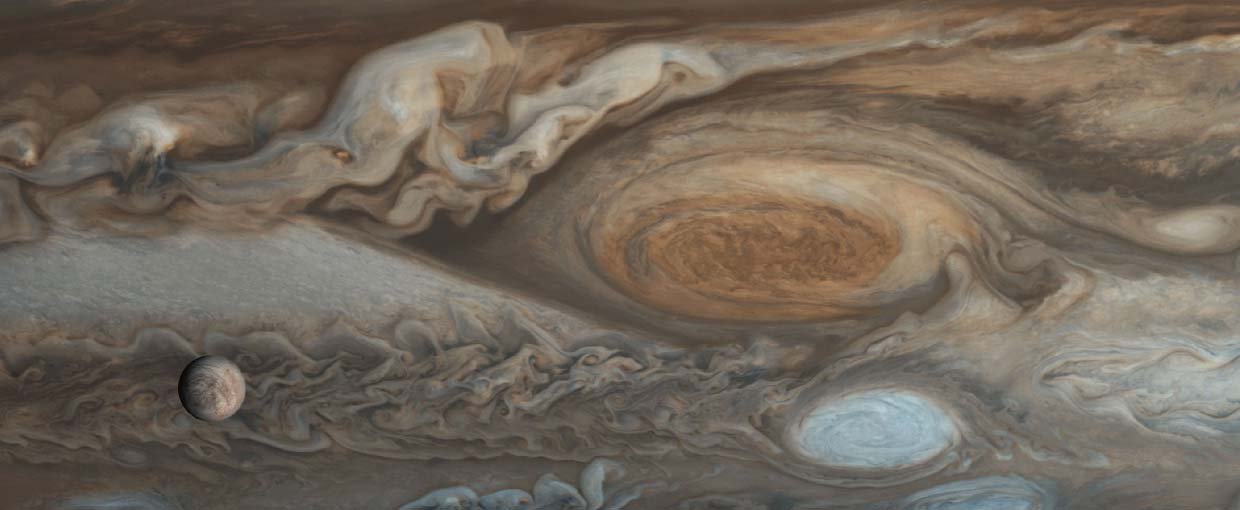
A volcanically active planet is shown in closeup at the left side of the image with glowing eruptions and lines of lava on the surface. To the right and in the distance is a faint blue glowing ball representing the more massive planet in the system.Sixteen frames from Voyager 1's flyby of Jupiter in 1979 were merged to create this image. Jupiter's Great Red Spot is visible in the center. Jupiter's moon Europa can be seen in the foreground at the bottom left of the image.The frame is a horizontal rainbow of color on a grid. Shadows of molecules can be seen through the light as well as the jagged peaks and troughs of spectral lines.
Fizzy Super Earths and Lava Worlds“Fizzy Super-Earths: Impacts of Magma Composition on the Bulk Density and Structure of Lava Worlds.” in The Astrophysical Journal.01/03
Identifying Hydrothermal Activity on Icy Ocean Worlds“Ethene-ethanol ratios as potential indicators of hydrothermal activity at Enceladus, Europa, and other icy ocean worlds.” In Icarus.02/03
NASA Raman Spectroscopic Database"The NASA Raman spectroscopic database: Ramdb version 1.00.” In Icarus.03/03
NextPrevious
Go Explore
February 2017Association between geographic range and initial survival of Mesozoic marine animal genera: circumventing the confounding effects of temporal and taxonomic heterogeneity

Ritterbush, K. A., & Foote, M. (2017). Association between geographic range and initial survival of Mesozoic marine animal genera: circumventing the confounding effects of temporal and taxonomic heterogeneity. Paleobiology, 43(02), 209–223. doi:10.1017/pab.2016.25

January 2017Metagenomic identification of active methanogens and methanotrophs in serpentinite springs of the Voltri Massif, Italy

Brazelton, W. J., Thornton, C. N., Hyer, A., Twing, K. I., Longino, A. A., Lang, S. Q., … Schrenk, M. O. (2017). Metagenomic identification of active methanogens and methanotrophs in serpentinite springs of the Voltri Massif, Italy. PeerJ, 5, e2945. doi:10.7717/peerj.2945

Microstructural constraints on the mechanisms of the transformation to reidite in naturally shocked zircon

Erickson, T. M., Pearce, M. A., Reddy, S. M., Timms, N. E., Cavosie, A. J., Bourdet, J., … Nemchin, A. A. (2017). Microstructural constraints on the mechanisms of the transformation to reidite in naturally shocked zircon. Contributions to Mineralogy and Petrology, 172(1), None. doi:10.1007/s00410-016-1322-0

RelA Mutant Enterococcus faecium with Multiantibiotic Tolerance Arising in an Immunocompromised Host

Honsa, E. S., Cooper, V. S., Mhaissen, M. N., Frank, M., Shaker, J., Iverson, A., … Rosch, J. W. (2017). RelA Mutant Enterococcus faecium with Multiantibiotic Tolerance Arising in an Immunocompromised Host . mBio, 8(1), e02124–16. doi:10.1128/mbio.02124-16

Reply to “Methane origin in the Samail ophiolite: Comment on ‘Modern water/rock reactions in Oman hyperalkaline peridotite aquifers and implications for microbial habitability’” [Geochim. Cosmochim. Acta 179 (2016) 217–241]

Miller, H. M., Matter, J. M., Kelemen, P., Ellison, E. T., Conrad, M., Fierer, N., … Templeton, A. S. (2017). Reply to “Methane origin in the Samail ophiolite: Comment on ‘Modern water/rock reactions in Oman hyperalkaline peridotite aquifers and implications for microbial habitability’” [Geochim. Cosmochim. Acta 179 (2016) 217–241]. Geochimica et Cosmochimica Acta, 197, 471–473. doi:10.1016/j.gca.2016.11.011

Exceptional preservation of soft-bodied Ediacara Biota promoted by silica-rich oceans: REPLY

Tarhan, L. G., Hood, A. v. S., Droser, M. L., Gehling, J. G., & Briggs, D. E. G. (2017). Exceptional preservation of soft-bodied Ediacara Biota promoted by silica-rich oceans: REPLY. Geology, 45(2), e408–e408. doi:10.1130/g38858y.1

Numerically modelling tidal dissipation with bottom drag in the oceans of Titan and Enceladus

Hay, H. C. F. C., & Matsuyama, I. (2017). Numerically modelling tidal dissipation with bottom drag in the oceans of Titan and Enceladus. Icarus, 281, 342–356. doi:10.1016/j.icarus.2016.09.022

Investigating controls on boron isotope ratios in shallow marine carbonates

Zhang, S., Henehan, M. J., Hull, P. M., Reid, R. P., Hardisty, D. S., Hood, A. v. S., & Planavsky, N. J. (2017). Investigating controls on boron isotope ratios in shallow marine carbonates. Earth and Planetary Science Letters, 458, 380–393. doi:10.1016/j.epsl.2016.10.059

Xeropreservation of functionalized lipid biomarkers in hyperarid soils in the Atacama Desert

Wilhelm, M. B., Davila, A. F., Eigenbrode, J. L., Parenteau, M. N., Jahnke, L. L., Liu, X-L., … Williams, A. (2017). Xeropreservation of functionalized lipid biomarkers in hyperarid soils in the Atacama Desert. Organic Geochemistry, 103, 97–104. doi:10.1016/j.orggeochem.2016.10.015

The Adult Body Plan of Indirect Developing Hemichordates Develops by Adding a Hox-Patterned Trunk to an Anterior Larval Territory

Gonzalez, P., Uhlinger, K. R., & Lowe, C. J. (2017). The Adult Body Plan of Indirect Developing Hemichordates Develops by Adding a Hox-Patterned Trunk to an Anterior Larval Territory. Current Biology, 27(1), 87–95. doi:10.1016/j.cub.2016.10.047