

This website is currently being migrated. For the most up-to-date astrobiology news, resources, and community announcements, please visit our new home at science.nasa.gov/astrobiology

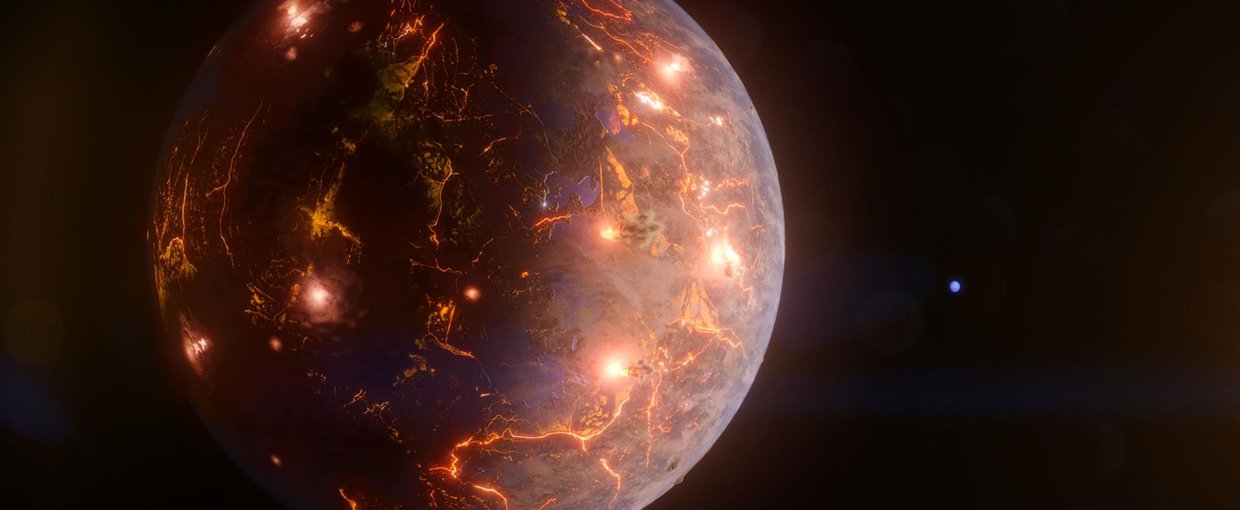
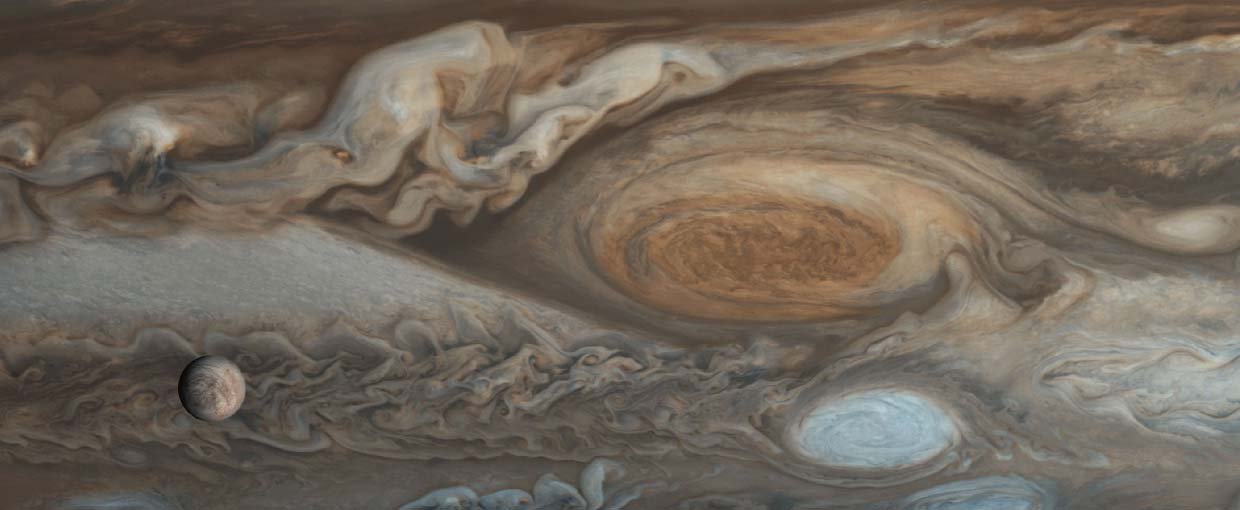
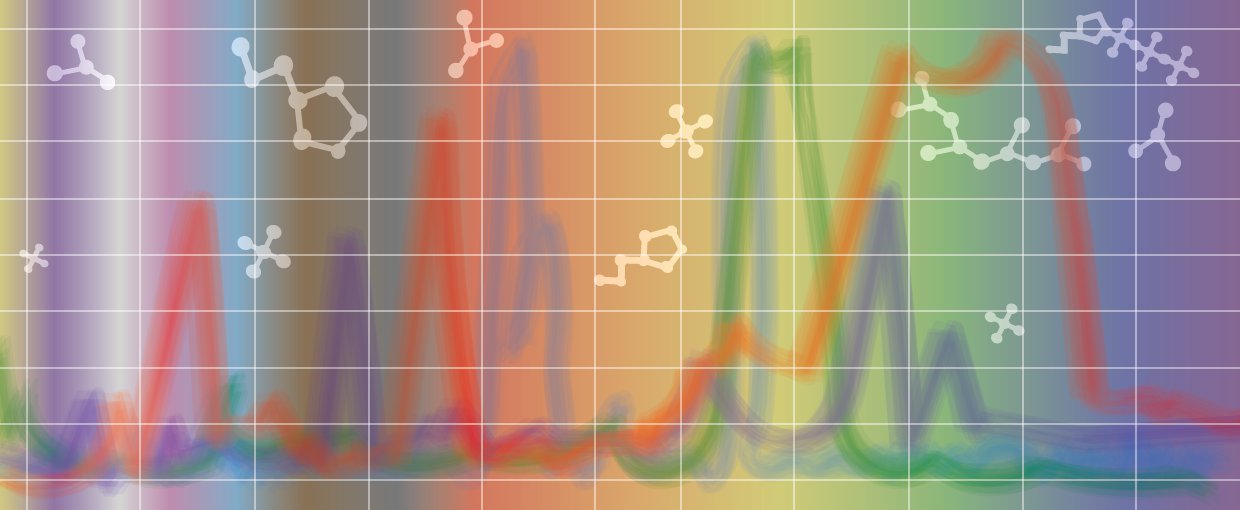
A volcanically active planet is shown in closeup at the left side of the image with glowing eruptions and lines of lava on the surface. To the right and in the distance is a faint blue glowing ball representing the more massive planet in the system.Sixteen frames from Voyager 1's flyby of Jupiter in 1979 were merged to create this image. Jupiter's Great Red Spot is visible in the center. Jupiter's moon Europa can be seen in the foreground at the bottom left of the image.The frame is a horizontal rainbow of color on a grid. Shadows of molecules can be seen through the light as well as the jagged peaks and troughs of spectral lines.
Fizzy Super Earths and Lava Worlds“Fizzy Super-Earths: Impacts of Magma Composition on the Bulk Density and Structure of Lava Worlds.” in The Astrophysical Journal.01/03
Identifying Hydrothermal Activity on Icy Ocean Worlds“Ethene-ethanol ratios as potential indicators of hydrothermal activity at Enceladus, Europa, and other icy ocean worlds.” In Icarus.02/03
NASA Raman Spectroscopic Database"The NASA Raman spectroscopic database: Ramdb version 1.00.” In Icarus.03/03
NextPrevious
Go Explore
September 2017Piecing together the puzzle of the Ediacara Biota: Excavation and reconstruction at the Ediacara National Heritage site Nilpena (South Australia)

Droser, M. L., Gehling, J. G., Tarhan, L. G., Evans, S. D., Hall, C. M. S., Hughes, I. V., … Rice, D. (2017). Piecing together the puzzle of the Ediacara Biota: Excavation and reconstruction at the Ediacara National Heritage site Nilpena (South Australia). Palaeogeography, Palaeoclimatology, Palaeoecology. doi:10.1016/j.palaeo.2017.09.007

Comparison of two bioinformatics tools used to characterize the microbial diversity and predictive functional attributes of microbial mats from Lake Obersee, Antarctica

Koo, H., Hakim, J. A., Morrow, C. D., Eipers, P. G., Davila, A., Andersen, D. T., & Bej, A. K. (2017). Comparison of two bioinformatics tools used to characterize the microbial diversity and predictive functional attributes of microbial mats from Lake Obersee, Antarctica. Journal of Microbiological Methods, 140, 15–22. doi:10.1016/j.mimet.2017.06.017

The ruthenium isotopic composition of the oceanic mantle

Bermingham, K. R., & Walker, R. J. (2017). The ruthenium isotopic composition of the oceanic mantle. Earth and Planetary Science Letters, 474, 466–473. doi:10.1016/j.epsl.2017.06.052

A warm or a cold early Earth? New insights from a 3-D climate-carbon model

Charnay, B., Le Hir, G., Fluteau, F., Forget, F., & Catling, D. C. (2017). A warm or a cold early Earth? New insights from a 3-D climate-carbon model. Earth and Planetary Science Letters, 474, 97–109. doi:10.1016/j.epsl.2017.06.029

Adaptive Sample Selection for Hypothesis Falsification

Furlong, P.. "Adaptive Sample Selection for Hypothesis Falsification" AAAI Workshops (2017): n. pag. Web. 6 Sep. 2017

Comparison of two bioinformatics tools used to characterize the microbial diversity and predictive functional attributes of microbial mats from Lake Obersee, Antarctica

Koo, H., Hakim, J. A., Morrow, C. D., Eipers, P. G., Davila, A., Andersen, D. T., & Bej, A. K. (2017). Comparison of two bioinformatics tools used to characterize the microbial diversity and predictive functional attributes of microbial mats from Lake Obersee, Antarctica. Journal of Microbiological Methods, 140, 15–22. doi:10.1016/j.mimet.2017.06.017

Beyond the stony veil: Reconstructing the Earth’s earliest large animal traces via computed tomography X-ray imaging

Meyer, M., Polys, N., Yaqoob, H., Hinnov, L., & Xiao, S. (2017). Beyond the stony veil: Reconstructing the Earth’s earliest large animal traces via computed tomography X-ray imaging. Precambrian Research, 298, 341–350. doi:10.1016/j.precamres.2017.05.010

Angrite meteorites record the onset and flux of water to the inner solar system

Sarafian, A. R., Nielsen, S. G., Marschall, H. R., Gaetani, G. A., Hauri, E. H., Righter, K., & Sarafian, E. (2017). Angrite meteorites record the onset and flux of water to the inner solar system. Geochimica et Cosmochimica Acta, 212, 156–166. doi:10.1016/j.gca.2017.06.001

Raman geothermometry of carbonaceous material in the basal Ediacaran Doushantuo cap dolostone: The thermal history of extremely negative δ 13 C signatures in the aftermath of the terminal Cryogenian snowball Earth glaciation

Wang, Z., Wang, J., Kouketsu, Y., Bodnar, R. J., Gill, B. C., & Xiao, S. (2017). Raman geothermometry of carbonaceous material in the basal Ediacaran Doushantuo cap dolostone: The thermal history of extremely negative δ 13 C signatures in the aftermath of the terminal Cryogenian snowball Earth glaciation. Precambrian Research, 298, 174–186. doi:10.1016/j.precamres.2017.06.013

Detecting Darwinism from Molecules in the Enceladus Plumes, Jupiter's Moons, and Other Planetary Water Lagoons

Benner, S. A. (2017). Detecting Darwinism from Molecules in the Enceladus Plumes, Jupiter's Moons, and Other Planetary Water Lagoons. Astrobiology, 17(9), 840–851. doi:10.1089/ast.2016.1611