


This website is currently being migrated. For the most up-to-date astrobiology news, resources, and community announcements, please visit our new home at science.nasa.gov/astrobiology

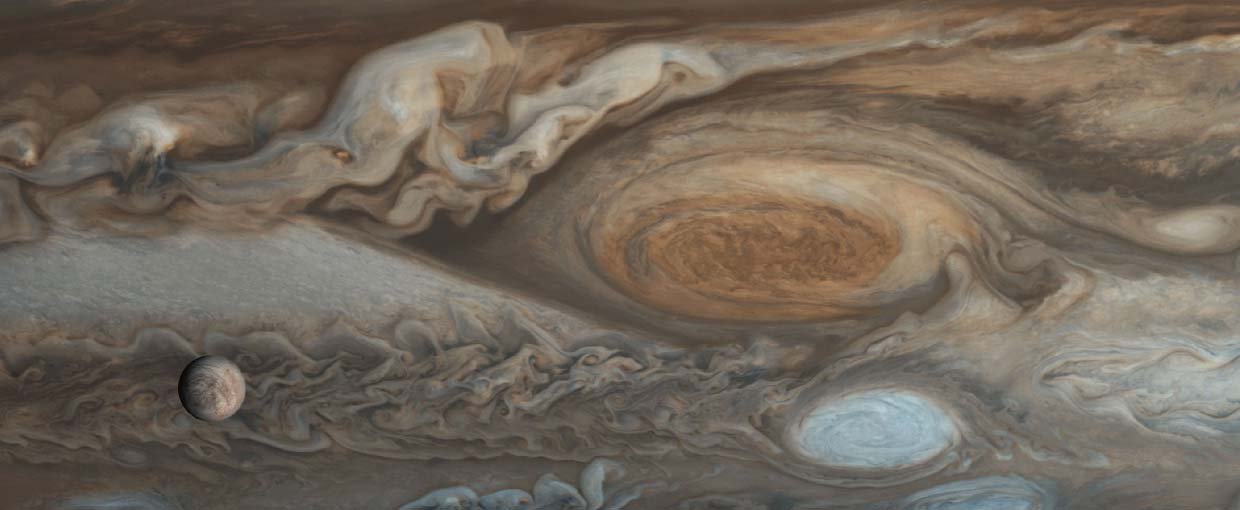
A volcanically active planet is shown in closeup at the left side of the image with glowing eruptions and lines of lava on the surface. To the right and in the distance is a faint blue glowing ball representing the more massive planet in the system.Sixteen frames from Voyager 1's flyby of Jupiter in 1979 were merged to create this image. Jupiter's Great Red Spot is visible in the center. Jupiter's moon Europa can be seen in the foreground at the bottom left of the image.The frame is a horizontal rainbow of color on a grid. Shadows of molecules can be seen through the light as well as the jagged peaks and troughs of spectral lines.
Fizzy Super Earths and Lava Worlds“Fizzy Super-Earths: Impacts of Magma Composition on the Bulk Density and Structure of Lava Worlds.” in The Astrophysical Journal.01/03
Identifying Hydrothermal Activity on Icy Ocean Worlds“Ethene-ethanol ratios as potential indicators of hydrothermal activity at Enceladus, Europa, and other icy ocean worlds.” In Icarus.02/03
NASA Raman Spectroscopic Database"The NASA Raman spectroscopic database: Ramdb version 1.00.” In Icarus.03/03
NextPrevious
Go Explore
November 2017Key amino acid residues conferring enhanced enzyme activity at cold temperatures in an Antarctic polyextremophilic β-galactosidase

Laye, V. J., Karan, R., Kim, J-M., Pecher, W. T., DasSarma, P., & DasSarma, S. (2017). Key amino acid residues conferring enhanced enzyme activity at cold temperatures in an Antarctic polyextremophilic β-galactosidase. Proceedings of the National Academy of Sciences, 114(47), 12530–12535. doi:10.1073/pnas.1711542114

Phosphorylation on the early earth

Pasek, M. A., Gull, M., & Herschy, B. (2017). Phosphorylation on the early earth. Chemical Geology. doi:10.1016/j.chemgeo.2017.11.008

Space-saving tips to lower stress

Gordon, V. D. (2017). Space-saving tips to lower stress. Nature Physics. doi:10.1038/s41567-017-0012-9

Editorial: Deep Carbon in Earth: Early Career Scientist Contributions to the Deep Carbon Observatory

Giovannelli, D., Black, B. A., Cox, A. D., & Sheik, C. S. (2017). Editorial: Deep Carbon in Earth: Early Career Scientist Contributions to the Deep Carbon Observatory. Frontiers in Earth Science, 5, None. doi:10.3389/feart.2017.00089

Hydrogen isotope composition of Thermoanaerobacterium saccharolyticum lipids: Comparing wild type with a nfn- transhydrogenase mutant

Leavitt, W. D., Murphy, S-L., Lynd, L. R., & Bradley, A. S. (2017). Hydrogen isotope composition of Thermoanaerobacterium saccharolyticum lipids: Comparing wild type with a nfn- transhydrogenase mutant. Organic Geochemistry, 113, 239–241. doi:10.1016/j.orggeochem.2017.06.020

Morphological signatures of microbial activity across sediment and light microenvironments of Lake Vanda, Antarctica

Mackey, T. J., Sumner, D. Y., Hawes, I., & Jungblut, A. D. (2017). Morphological signatures of microbial activity across sediment and light microenvironments of Lake Vanda, Antarctica. Sedimentary Geology, 361, 82–92. doi:10.1016/j.sedgeo.2017.09.013

The late-stage “ferruginization” of the Ediacara Member (Rawnsley Quartzite, South Australia): Insights from uranium isotopes

Tarhan, L. G., Planavsky, N. J., Wang, X., Bellefroid, E. J., Droser, M. L., & Gehling, J. G. (2017). The late-stage “ferruginization” of the Ediacara Member (Rawnsley Quartzite, South Australia): Insights from uranium isotopes. Geobiology. doi:10.1111/gbi.12262

Stable carbon isotopes of sedimentary kerogens and carbonaceous macrofossils from the Ediacaran Miaohe Member in South China: Implications for stratigraphic correlation and sources of sedimentary organic carbon

Xiao, S., Bykova, N., Kovalick, A., & Gill, B. C. (2017). Stable carbon isotopes of sedimentary kerogens and carbonaceous macrofossils from the Ediacaran Miaohe Member in South China: Implications for stratigraphic correlation and sources of sedimentary organic carbon. Precambrian Research, 302, 171–179. doi:10.1016/j.precamres.2017.10.006

Preliminary analysis of newly recovered Apollo 17 seismic data

Dimech, J-L., Knapmeyer-Endrun, B., Phillips, D., & Weber, R. C. (2017). Preliminary analysis of newly recovered Apollo 17 seismic data. Results in Physics, 7, 4457–4458. doi:10.1016/j.rinp.2017.11.029

Elongation of Model Prebiotic Proto-Peptides by Continuous Monomer Feeding

Yu, S-S., Solano, M. D., Blanchard, M. K., Soper-Hopper, M. T., Krishnamurthy, R., Fernández, F. M., … Grover, M. A. (2017). Elongation of Model Prebiotic Proto-Peptides by Continuous Monomer Feeding. Macromolecules, 50(23), 9286–9294. doi:10.1021/acs.macromol.7b01569