

This website is currently being migrated. For the most up-to-date astrobiology news, resources, and community announcements, please visit our new home at science.nasa.gov/astrobiology

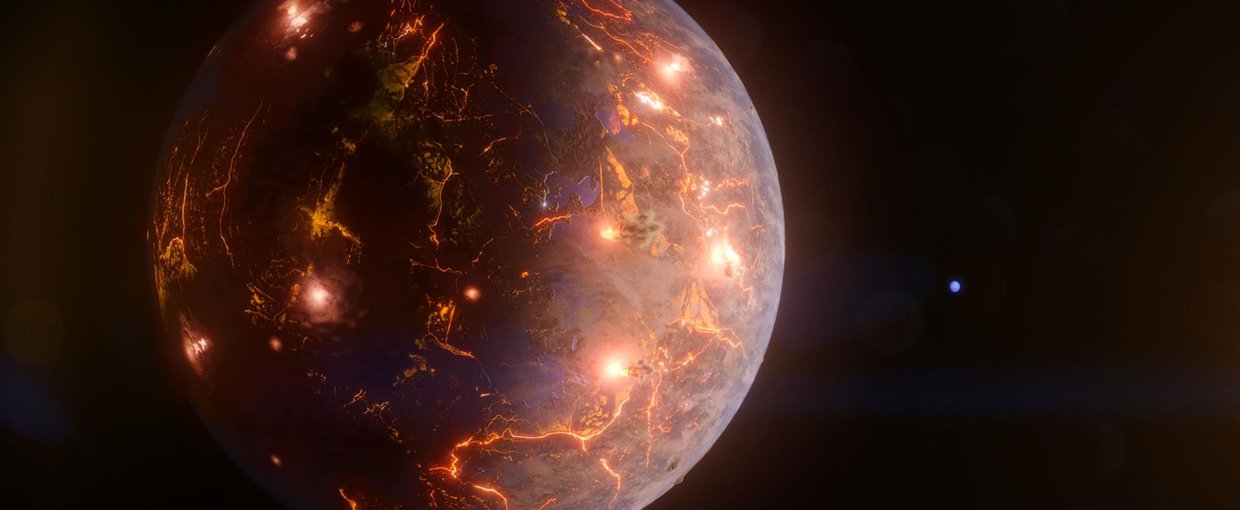
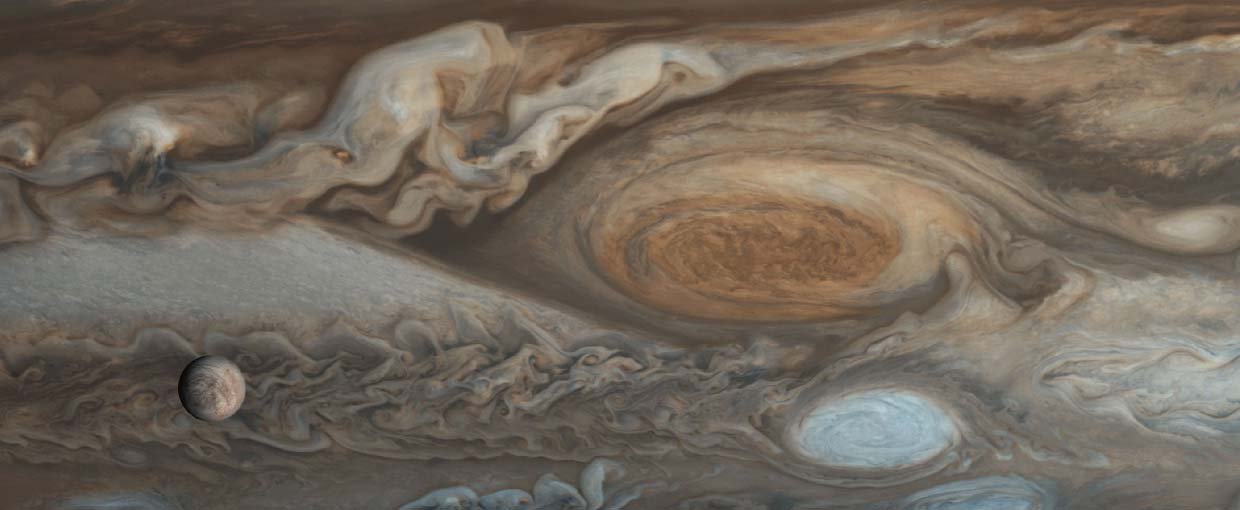
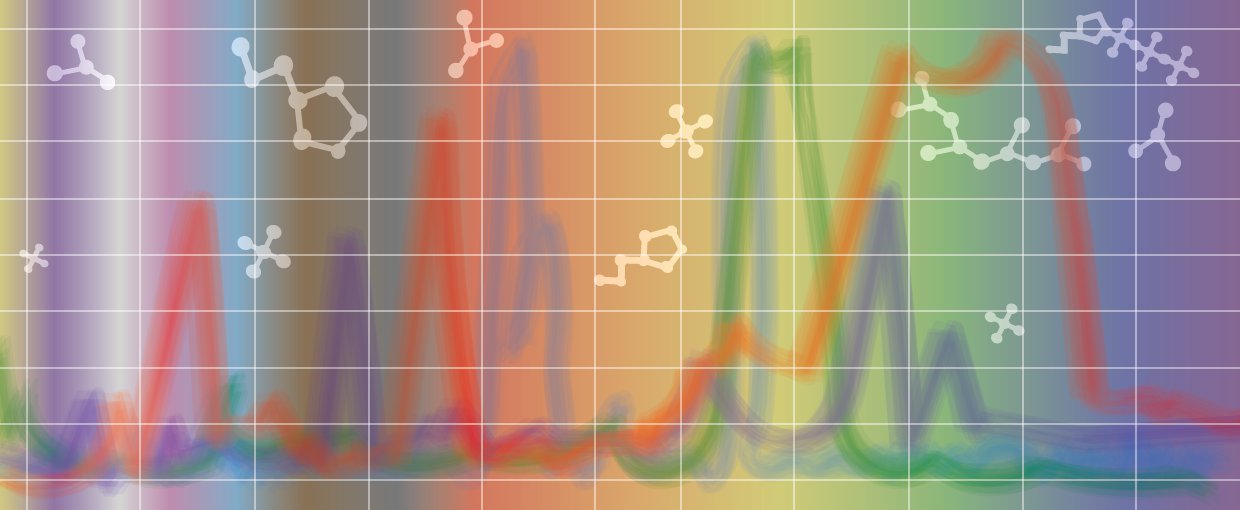
A volcanically active planet is shown in closeup at the left side of the image with glowing eruptions and lines of lava on the surface. To the right and in the distance is a faint blue glowing ball representing the more massive planet in the system.Sixteen frames from Voyager 1's flyby of Jupiter in 1979 were merged to create this image. Jupiter's Great Red Spot is visible in the center. Jupiter's moon Europa can be seen in the foreground at the bottom left of the image.The frame is a horizontal rainbow of color on a grid. Shadows of molecules can be seen through the light as well as the jagged peaks and troughs of spectral lines.
Fizzy Super Earths and Lava Worlds“Fizzy Super-Earths: Impacts of Magma Composition on the Bulk Density and Structure of Lava Worlds.” in The Astrophysical Journal.01/03
Identifying Hydrothermal Activity on Icy Ocean Worlds“Ethene-ethanol ratios as potential indicators of hydrothermal activity at Enceladus, Europa, and other icy ocean worlds.” In Icarus.02/03
NASA Raman Spectroscopic Database"The NASA Raman spectroscopic database: Ramdb version 1.00.” In Icarus.03/03
NextPrevious
Go Explore
April 2018New insights into Mo and Ru isotope variation in the nebula and terrestrial planet accretionary genetics

Bermingham, K. R., Worsham, E. A., & Walker, R. J. (2018). New insights into Mo and Ru isotope variation in the nebula and terrestrial planet accretionary genetics. Earth and Planetary Science Letters, 487, 221–229. doi:10.1016/j.epsl.2018.01.017

Detecting Kerogen as a Biosignature Using Colocated UV Time-Gated Raman and Fluorescence Spectroscopy

Shkolyar, S., Eshelman, E. J., Farmer, J. D., Hamilton, D., Daly, M. G., & Youngbull, C. (2018). Detecting Kerogen as a Biosignature Using Colocated UV Time-Gated Raman and Fluorescence Spectroscopy. Astrobiology, 18(4), 431–453. doi:10.1089/ast.2017.1716

Highly heterogeneous “poikiloredox” conditions in the early Ediacaran Yangtze Sea

Jin, C., Li, C., Algeo, T. J., O'Connell, B., Cheng, M., Shi, W., … Planavsky, N. J. (2018). Highly heterogeneous “poikiloredox” conditions in the early Ediacaran Yangtze Sea. Precambrian Research. doi:10.1016/j.precamres.2018.04.012

Evidence for episodic oxygenation in a weakly redox-buffered deep mid-Proterozoic ocean

Planavsky, N. J., Slack, J. F., Cannon, W. F., O'Connell, B., Isson, T. T., Asael, D., … Bekker, A. (2018). Evidence for episodic oxygenation in a weakly redox-buffered deep mid-Proterozoic ocean. Chemical Geology, 483, 581–594. doi:10.1016/j.chemgeo.2018.03.028

A model for the oceanic mass balance of rhenium and implications for the extent of Proterozoic ocean anoxia

Sheen, A. I., Kendall, B., Reinhard, C. T., Creaser, R. A., Lyons, T. W., Bekker, A., … Anbar, A. D. (2018). A model for the oceanic mass balance of rhenium and implications for the extent of Proterozoic ocean anoxia. Geochimica et Cosmochimica Acta, 227, 75–95. doi:10.1016/j.gca.2018.01.036

Diversity of Chlorophototrophic Bacteria Revealed in the Omics Era

Thiel, V., Tank, M., & Bryant, D. A. (2018). Diversity of Chlorophototrophic Bacteria Revealed in the Omics Era. Annual Review of Plant Biology, 69(1), 21–49. doi:10.1146/annurev-arplant-042817-040500

MapX: 2D XRF for Planetary Exploration - Image Formation and Optic Characterization

Sarrazin, P., Blake, D., Gailhanou, M., Marchis, F., Chalumeau, C., Webb, S., … Bristow, T. (2018). MapX: 2D XRF for Planetary Exploration - Image Formation and Optic Characterization. Journal of Instrumentation, 13(04), C04023–C04023. doi:10.1088/1748-0221/13/04/c04023

Simultaneous In Situ Analysis of Carbon and Nitrogen Isotope Ratios in Organic Matter by Secondary Ion Mass Spectrometry

Simultaneous In Situ Analysis of Carbon and Nitrogen Isotope Ratios in Organic Matter by Secondary Ion Mass Spectrometry (2018). Geostandards and Geoanalytical Research, None(None), None. doi:10.1111/ggr.12209

A Decade of MWC 758 Disk Images: Where Are the Spiral-arm-driving Planets?

Ren, B., Dong, R., Esposito, T. M., Pueyo, L., Debes, J. H., Poteet, C. A., … Soummer, R. (2018). A Decade of MWC 758 Disk Images: Where Are the Spiral-arm-driving Planets? The Astrophysical Journal, 857(1), L9. doi:10.3847/2041-8213/aab7f5

Hyperactivity and Dust Composition of Comet 103P/Hartley 2 During the EPOXI Encounter

Harker, D. E., Woodward, C. E., Kelley, M. S. P., & Wooden, D. H. (2018). Hyperactivity and Dust Composition of Comet 103P/Hartley 2 During the EPOXI Encounter. The Astronomical Journal, 155(5), 199. doi:10.3847/1538-3881/aab778