


This website is currently being migrated. For the most up-to-date astrobiology news, resources, and community announcements, please visit our new home at science.nasa.gov/astrobiology

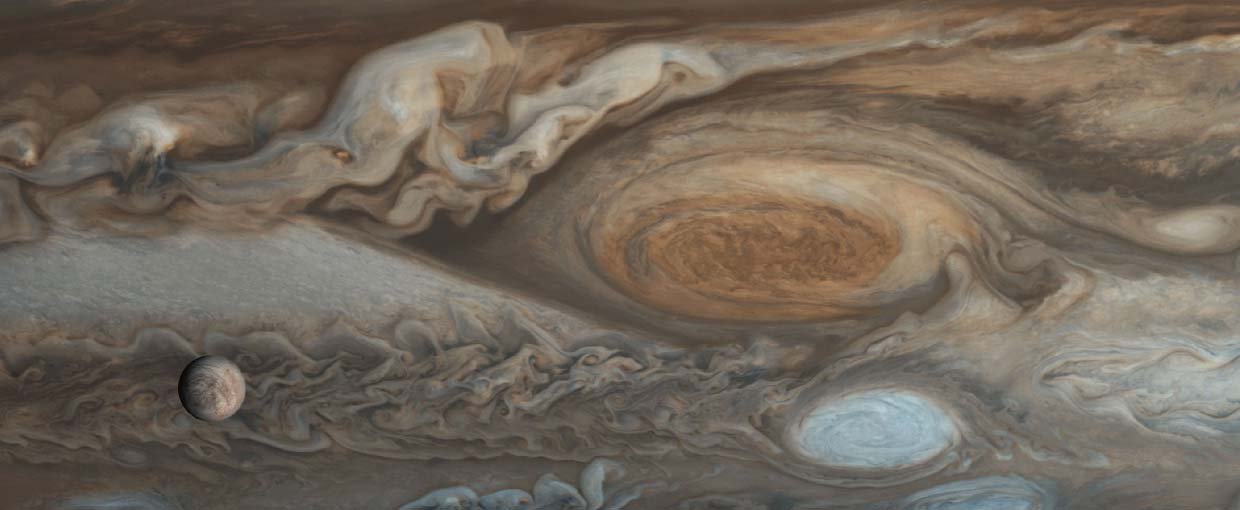
A volcanically active planet is shown in closeup at the left side of the image with glowing eruptions and lines of lava on the surface. To the right and in the distance is a faint blue glowing ball representing the more massive planet in the system.Sixteen frames from Voyager 1's flyby of Jupiter in 1979 were merged to create this image. Jupiter's Great Red Spot is visible in the center. Jupiter's moon Europa can be seen in the foreground at the bottom left of the image.The frame is a horizontal rainbow of color on a grid. Shadows of molecules can be seen through the light as well as the jagged peaks and troughs of spectral lines.
Fizzy Super Earths and Lava Worlds“Fizzy Super-Earths: Impacts of Magma Composition on the Bulk Density and Structure of Lava Worlds.” in The Astrophysical Journal.01/03
Identifying Hydrothermal Activity on Icy Ocean Worlds“Ethene-ethanol ratios as potential indicators of hydrothermal activity at Enceladus, Europa, and other icy ocean worlds.” In Icarus.02/03
NASA Raman Spectroscopic Database"The NASA Raman spectroscopic database: Ramdb version 1.00.” In Icarus.03/03
NextPrevious
Go Explore
September 2018A Framework for Prioritizing the TESS Planetary Candidates Most Amenable to Atmospheric Characterization

Kempton, E-R., Bean, J. L., Louie, D. R., Deming, D., Koll, D. D. B., Mansfield, M., … Essen, C. v. (2018). A Framework for Prioritizing the TESS Planetary Candidates Most Amenable to Atmospheric Characterization. Publications of the Astronomical Society of the Pacific, 130(993), 114401. doi:10.1088/1538-3873/aadf6f

The Vegetation Red Edge Biosignature Through Time on Earth and Exoplanets

O'Malley-James, J. T., & Kaltenegger, L. (2018). The Vegetation Red Edge Biosignature Through Time on Earth and Exoplanets. Astrobiology, 18(9), 1123–1136. doi:10.1089/ast.2017.1798

The Effect of Jupiter's Formation on the Distribution of Refractory Elements and Inclusions in Meteorites

Desch, S. J., Kalyaan, A., & Alexander, C. M. O. D. (2018). The Effect of Jupiter's Formation on the Distribution of Refractory Elements and Inclusions in Meteorites. The Astrophysical Journal Supplement Series, 238(1), 11. doi:10.3847/1538-4365/aad95f

Retrieval analysis of 38 WFC3 transmission spectra and resolution of the normalization degeneracy

Fisher, C., & Heng, K. (2018). Retrieval analysis of 38 WFC3 transmission spectra and resolution of the normalization degeneracy. Monthly Notices of the Royal Astronomical Society, 481(4), 4698–4727. doi:10.1093/mnras/sty2550

Habitability in the Omega Centauri Cluster

Kane, S. R., & Deveny, S. J. (2018). Habitability in the Omega Centauri Cluster. The Astrophysical Journal, 864(2), 115. doi:10.3847/1538-4357/aad802

Theoretical and experimental evidence of conformational transformation in stereoisomers of nucleoside analogues

Hernández-Hernández, L. A., Yi, R., Cleaves, H. J., Fuentes-Cabrera, M., Sumpter, B. G., Hernández-Hernández, A., … Vallejo, E. (2018). Theoretical and experimental evidence of conformational transformation in stereoisomers of nucleoside analogues. International Journal of Quantum Chemistry, None, e25714. doi:10.1002/qua.25714

Ocean tidal heating in icy satellites with solid shells

Matsuyama, I., Beuthe, M., Hay, H. C. F. C., Nimmo, F., & Kamata, S. (2018). Ocean tidal heating in icy satellites with solid shells. Icarus, 312, 208–230. doi:10.1016/j.icarus.2018.04.013

Ediacaran scavenging as a prelude to predation

Gehling, J. G., & Droser, M. L. (2018). Ediacaran scavenging as a prelude to predation. Emerging Topics in Life Sciences, 2(2), 213–222. doi:10.1042/etls20170166

Chlorate brines on Mars: Implications for the occurrence of liquid water and deliquescence

Toner, J. D., & Catling, D. C. (2018). Chlorate brines on Mars: Implications for the occurrence of liquid water and deliquescence. Earth and Planetary Science Letters, 497, 161–168. doi:10.1016/j.epsl.2018.06.011

August 2018Biological effects on uranium isotope fractionation (238U/235U) in primary biogenic carbonates

Chen, X., Romaniello, S. J., Herrmann, A. D., Samankassou, E., & Anbar, A. D. (2018). Biological effects on uranium isotope fractionation (238U/235U) in primary biogenic carbonates. Geochimica et Cosmochimica Acta. doi:10.1016/j.gca.2018.08.028