


This website is currently being migrated. For the most up-to-date astrobiology news, resources, and community announcements, please visit our new home at science.nasa.gov/astrobiology

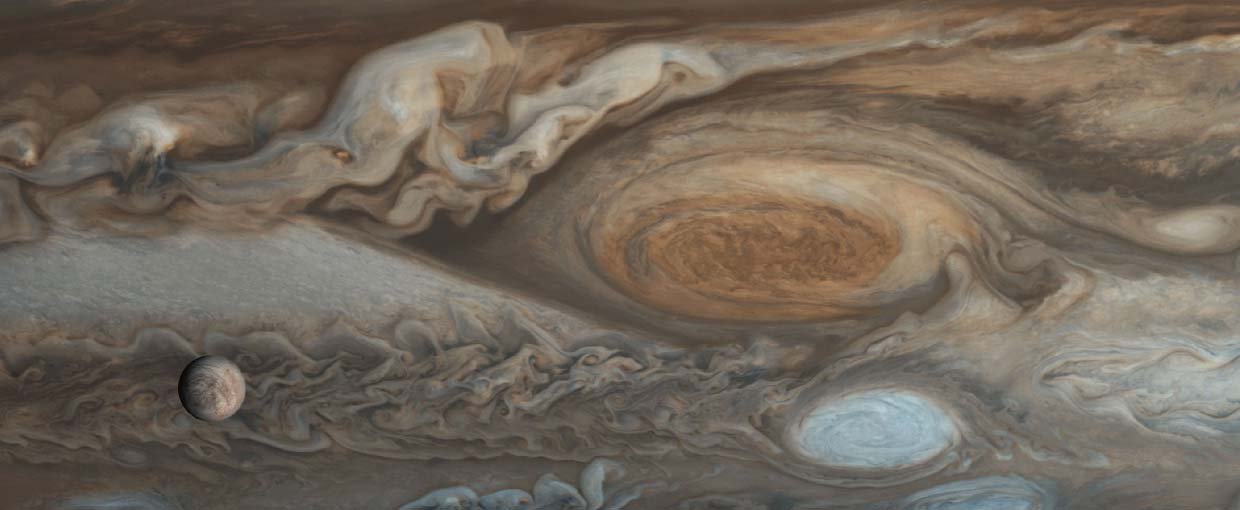
A volcanically active planet is shown in closeup at the left side of the image with glowing eruptions and lines of lava on the surface. To the right and in the distance is a faint blue glowing ball representing the more massive planet in the system.Sixteen frames from Voyager 1's flyby of Jupiter in 1979 were merged to create this image. Jupiter's Great Red Spot is visible in the center. Jupiter's moon Europa can be seen in the foreground at the bottom left of the image.The frame is a horizontal rainbow of color on a grid. Shadows of molecules can be seen through the light as well as the jagged peaks and troughs of spectral lines.
Fizzy Super Earths and Lava Worlds“Fizzy Super-Earths: Impacts of Magma Composition on the Bulk Density and Structure of Lava Worlds.” in The Astrophysical Journal.01/03
Identifying Hydrothermal Activity on Icy Ocean Worlds“Ethene-ethanol ratios as potential indicators of hydrothermal activity at Enceladus, Europa, and other icy ocean worlds.” In Icarus.02/03
NASA Raman Spectroscopic Database"The NASA Raman spectroscopic database: Ramdb version 1.00.” In Icarus.03/03
NextPrevious
Go Explore
February 2019The Physical and Chemical Sedimentology of Two High-Altitude Acid Salars in Chile: Sedimentary Processes In An Extreme Environment

Benison, K. C. (2019). The Physical and Chemical Sedimentology of Two High-Altitude Acid Salars in Chile: Sedimentary Processes In An Extreme Environment. Journal of Sedimentary Research, 89(2), 147–167. doi:10.2110/jsr.2019.9

Local frustration around enzyme active sites

Freiberger, M. I., Guzovsky, A. B., Wolynes, P. G., Parra, R. G., & Ferreiro, D. U. (2019). Local frustration around enzyme active sites. Proceedings of the National Academy of Sciences, 116(10), 4037–4043. doi:10.1073/pnas.1819859116

Computational analysis of vibrational modes in tetra-sulfur using dimensionally reduced potential energy surface

Gayday, I., Teplukhin, A., & Babikov, D. (2019). Computational analysis of vibrational modes in tetra-sulfur using dimensionally reduced potential energy surface. Molecular Physics, None, 1–13. doi:10.1080/00268976.2019.1574038

Evolutionary dynamics ofde novomutations and mutant lineages arising in a simple, constant environment

Kinnersley, M., Schwartz, K., Boswell, J., Yang, D-D., Sherlock, G., & Rosenzweig, F. (2019). Evolutionary dynamics ofde novomutations and mutant lineages arising in a simple, constant environment. None. doi:10.1101/540625

The case for a deep search for Earth’s Trojan asteroids

Malhotra, R. (2019). The case for a deep search for Earth’s Trojan asteroids. Nature Astronomy. doi:10.1038/s41550-019-0697-z

Copper oxide nanoparticles promote the evolution of multicellularity in yeast

Tan, J., He, Q., Pentz, J. T., Peng, C., Yang, X., Tsai, M-H., … Jiang, L. (2019). Copper oxide nanoparticles promote the evolution of multicellularity in yeast. Nanotoxicology, 13(5), 597–605. doi:10.1080/17435390.2018.1553253

NADH Dehydrogenases in Pseudomonas aeruginosa Growth and Virulence

Torres, A., Kasturiarachi, N., DuPont, M., Cooper, V. S., Bomberger, J., & Zemke, A. (2019). NADH Dehydrogenases in Pseudomonas aeruginosa Growth and Virulence. Frontiers in Microbiology, 10, None. doi:10.3389/fmicb.2019.00075

Structural basis of DSF recognition by its receptor RpfR and its regulatory interaction with the DSF synthase RpfF

Waldron, E. J., Snyder, D., Fernandez, N. L., Sileo, E., Inoyama, D., Freundlich, J. S., … Neiditch, M. B. (2019). Structural basis of DSF recognition by its receptor RpfR and its regulatory interaction with the DSF synthase RpfF. PLOS Biology, 17(2), e3000123. doi:10.1371/journal.pbio.3000123

Nonlinear tidal dissipation in the subsurface oceans of Enceladus and other icy satellites

Hay, H. C. F. C., & Matsuyama, I. (2019). Nonlinear tidal dissipation in the subsurface oceans of Enceladus and other icy satellites. Icarus, 319, 68–85. doi:10.1016/j.icarus.2018.09.019

Terrestrial sources as the primary delivery mechanism of mercury to the oceans across the Toarcian Oceanic Anoxic Event (Early Jurassic)

Them, T. R., Jagoe, C. H., Caruthers, A. H., Gill, B. C., Grasby, S. E., Gröcke, D. R., … Owens, J. D. (2019). Terrestrial sources as the primary delivery mechanism of mercury to the oceans across the Toarcian Oceanic Anoxic Event (Early Jurassic). Earth and Planetary Science Letters, 507, 62–72. doi:10.1016/j.epsl.2018.11.029