

This website is currently being migrated. For the most up-to-date astrobiology news, resources, and community announcements, please visit our new home at science.nasa.gov/astrobiology

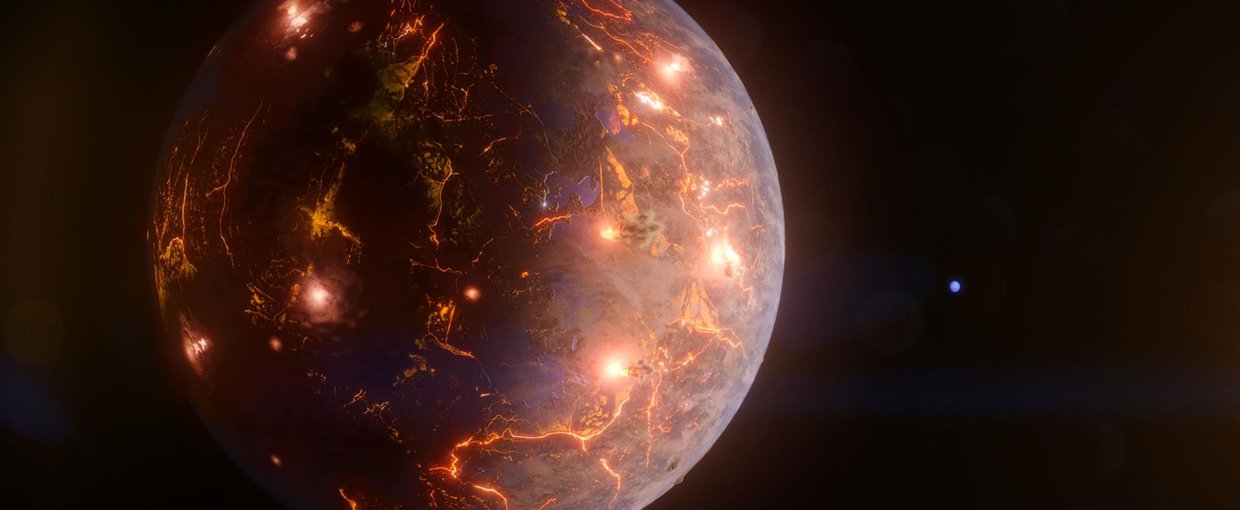
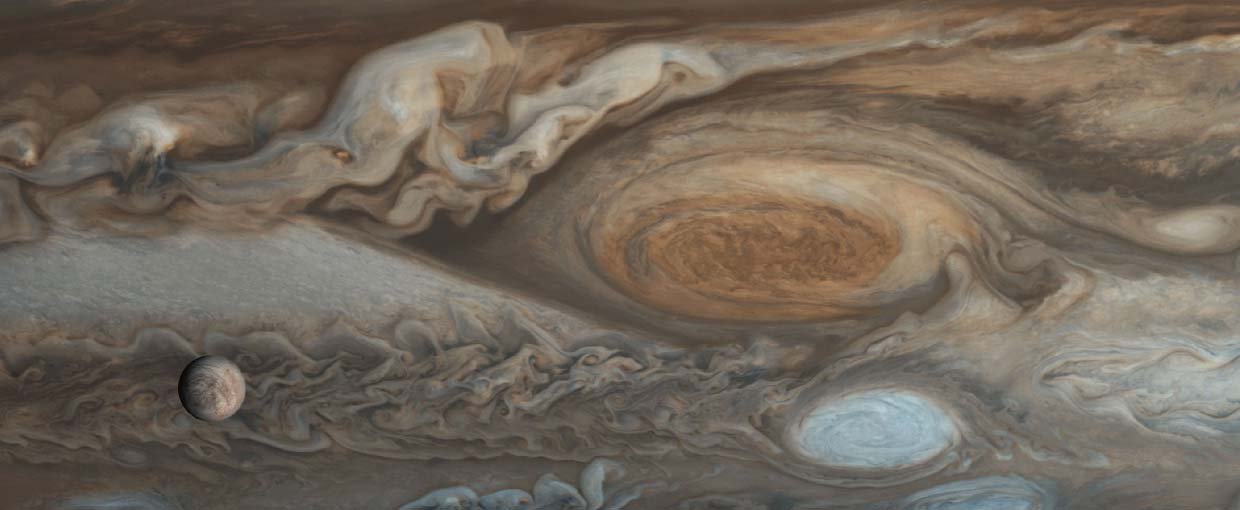
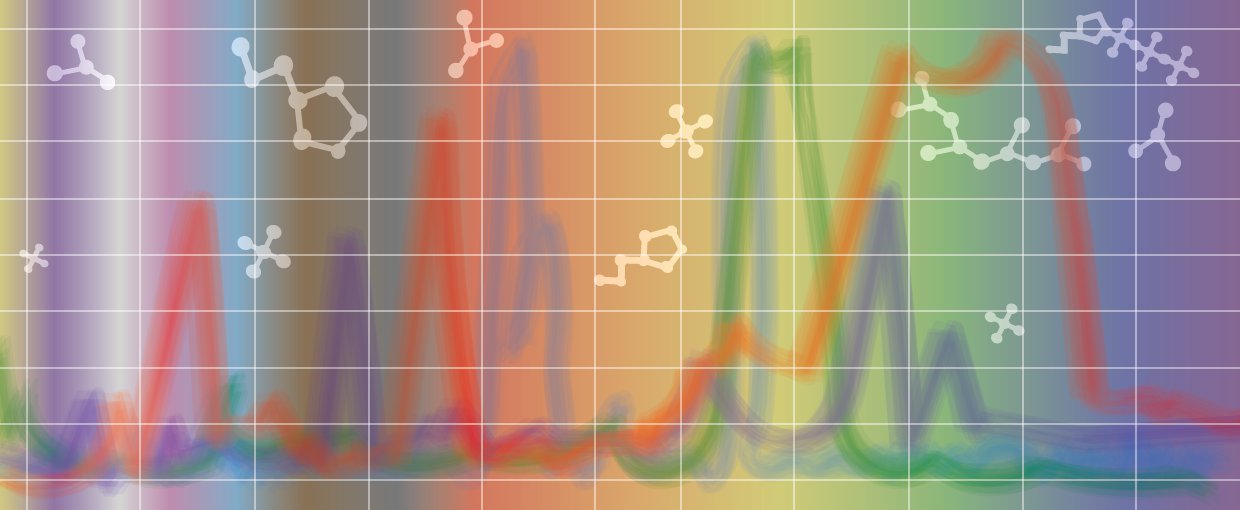
A volcanically active planet is shown in closeup at the left side of the image with glowing eruptions and lines of lava on the surface. To the right and in the distance is a faint blue glowing ball representing the more massive planet in the system.Sixteen frames from Voyager 1's flyby of Jupiter in 1979 were merged to create this image. Jupiter's Great Red Spot is visible in the center. Jupiter's moon Europa can be seen in the foreground at the bottom left of the image.The frame is a horizontal rainbow of color on a grid. Shadows of molecules can be seen through the light as well as the jagged peaks and troughs of spectral lines.
Fizzy Super Earths and Lava Worlds“Fizzy Super-Earths: Impacts of Magma Composition on the Bulk Density and Structure of Lava Worlds.” in The Astrophysical Journal.01/03
Identifying Hydrothermal Activity on Icy Ocean Worlds“Ethene-ethanol ratios as potential indicators of hydrothermal activity at Enceladus, Europa, and other icy ocean worlds.” In Icarus.02/03
NASA Raman Spectroscopic Database"The NASA Raman spectroscopic database: Ramdb version 1.00.” In Icarus.03/03
NextPrevious
Go Explore
October 2019Binary survival in the outer solar system

Nesvorný, D., & Vokrouhlický, D. (2019). Binary survival in the outer solar system. Icarus, 331, 49–61. doi:10.1016/j.icarus.2019.04.030

The evolution of CNO isotopes: the impact of massive stellar rotators

Romano, D., Matteucci, F., Zhang, Z-Y., Ivison, R. J., & Ventura, P. (2019). The evolution of CNO isotopes: the impact of massive stellar rotators. Monthly Notices of the Royal Astronomical Society. doi:10.1093/mnras/stz2741

The origin of blue coloration in a fulgurite from Marquette, Michigan

Feng, T., Lang, C., & Pasek, M. A. (2019). The origin of blue coloration in a fulgurite from Marquette, Michigan. Lithos, 342-343, 288–294. doi:10.1016/j.lithos.2019.06.003

The first samples from Almahata Sitta showing contacts between ureilitic and chondritic lithologies: Implications for the structure and composition of asteroid 2008 TC 3

Goodrich, C. A., Zolensky, M. E., Fioretti, A. M., Shaddad, M. H., Downes, H., Hiroi, T., … Jenniskens, P. (2019). The first samples from Almahata Sitta showing contacts between ureilitic and chondritic lithologies: Implications for the structure and composition of asteroid 2008 TC 3. Meteoritics & Planetary Science, 54(11), 2769–2813. doi:10.1111/maps.13390

Collapse of the General Circulation in Shortwave-absorbing Atmospheres: An Idealized Model Study

Kang, W., & Wordsworth, R. (2019). Collapse of the General Circulation in Shortwave-absorbing Atmospheres: An Idealized Model Study. The Astrophysical Journal, 885(1), L18. doi:10.3847/2041-8213/ab4c43

Meridional flows in the disk around a young star

Teague, R., Bae, J., & Bergin, E. A. (2019). Meridional flows in the disk around a young star. Nature, 574(7778), 378–381. doi:10.1038/s41586-019-1642-0

Benchtop NMR Spectroscopy of Prebiotically-Relevant Peptide Reactions Enabled by Salt-Induced Chemical Shift Dispersion

Febrian, R., Ona, W. J., Araneda, J. F., Riegel, S. D., & Bracher, P. J. (2019). Benchtop NMR Spectroscopy of Prebiotically-Relevant Peptide Reactions Enabled by Salt-Induced Chemical Shift Dispersion. ACS Earth and Space Chemistry. doi:10.1021/acsearthspacechem.9b00221

In the Presence of a Wrecking Ball: Orbital Stability in the HR 5183 System

Kane, S. R., & Blunt, S. (2019). In the Presence of a Wrecking Ball: Orbital Stability in the HR 5183 System. The Astronomical Journal, 158(5), 209. doi:10.3847/1538-3881/ab4c3e

Prebiotic condensation through wet–dry cycling regulated by deliquescence

Campbell, T. D., Febrian, R., McCarthy, J. T., Kleinschmidt, H. E., Forsythe, J. G., & Bracher, P. J. (2019). Prebiotic condensation through wet–dry cycling regulated by deliquescence. Nature Communications, 10(1), None. doi:10.1038/s41467-019-11834-1

Enhanced Habitability on High Obliquity Bodies near the Outer Edge of the Habitable Zone of Sun-like Stars

Colose, C. M., Del Genio, A. D., & Way, M. J. (2019). Enhanced Habitability on High Obliquity Bodies near the Outer Edge of the Habitable Zone of Sun-like Stars. The Astrophysical Journal, 884(2), 138. doi:10.3847/1538-4357/ab4131