

This website is currently being migrated. For the most up-to-date astrobiology news, resources, and community announcements, please visit our new home at science.nasa.gov/astrobiology

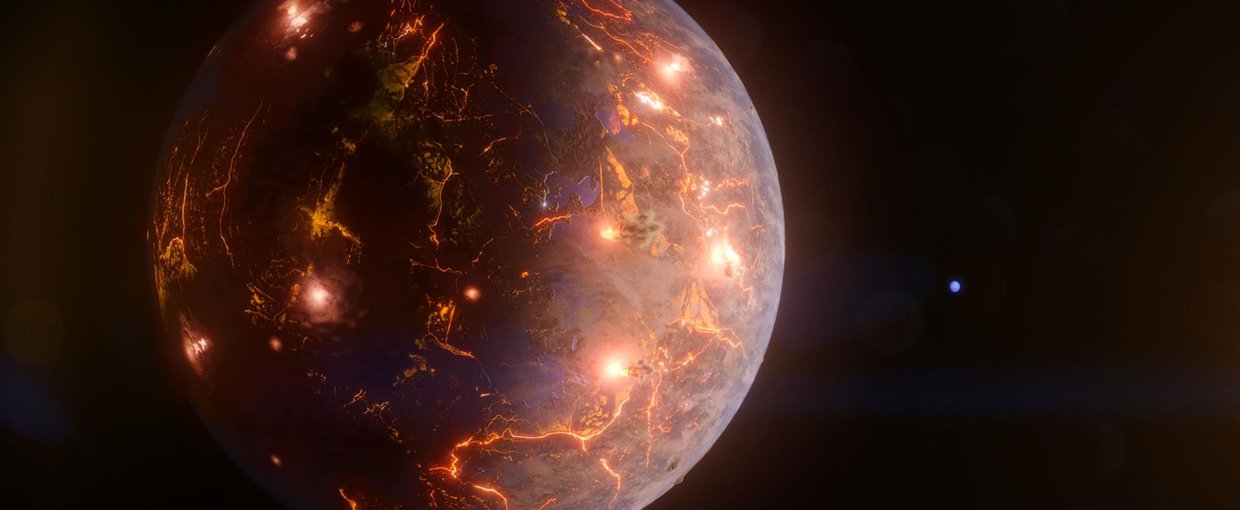
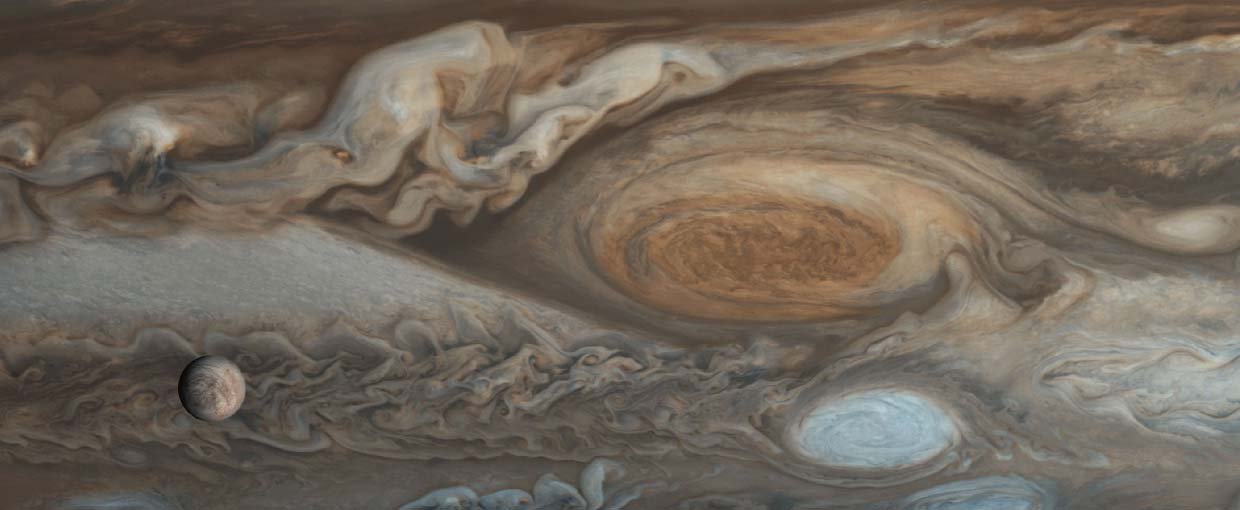
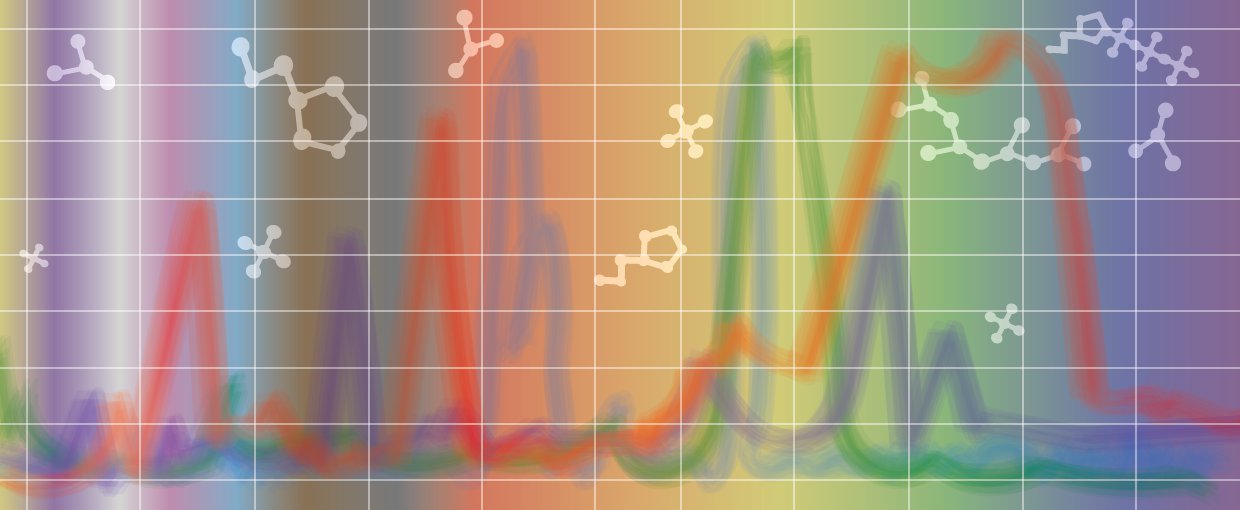
A volcanically active planet is shown in closeup at the left side of the image with glowing eruptions and lines of lava on the surface. To the right and in the distance is a faint blue glowing ball representing the more massive planet in the system.Sixteen frames from Voyager 1's flyby of Jupiter in 1979 were merged to create this image. Jupiter's Great Red Spot is visible in the center. Jupiter's moon Europa can be seen in the foreground at the bottom left of the image.The frame is a horizontal rainbow of color on a grid. Shadows of molecules can be seen through the light as well as the jagged peaks and troughs of spectral lines.
Fizzy Super Earths and Lava Worlds“Fizzy Super-Earths: Impacts of Magma Composition on the Bulk Density and Structure of Lava Worlds.” in The Astrophysical Journal.01/03
Identifying Hydrothermal Activity on Icy Ocean Worlds“Ethene-ethanol ratios as potential indicators of hydrothermal activity at Enceladus, Europa, and other icy ocean worlds.” In Icarus.02/03
NASA Raman Spectroscopic Database"The NASA Raman spectroscopic database: Ramdb version 1.00.” In Icarus.03/03
NextPrevious
Go Explore
July 2020Report Series: Committee on Astrobiology and Planetary Science

, ., , ., , ., & , . (2020). Report Series: Committee on Astrobiology and Planetary Science. None. doi:10.17226/25868

Detectability of Molecular Signatures on TRAPPIST-1e through Transmission Spectroscopy Simulated for Future Space-based Observatories

Pidhorodetska, D., Fauchez, T. J., Villanueva, G. L., Domagal-Goldman, S. D., & Kopparapu, R. K. (2020). Detectability of Molecular Signatures on TRAPPIST-1e through Transmission Spectroscopy Simulated for Future Space-based Observatories. The Astrophysical Journal Letters, 898(2), L33. doi:10.3847/2041-8213/aba4a1

The origins of nearly coplanar, non-resonant systems of close-in super-Earths

Esteves, L., Izidoro, A., Raymond, S. N., & Bitsch, B. (2020). The origins of nearly coplanar, non-resonant systems of close-in super-Earths. Monthly Notices of the Royal Astronomical Society, 497(2), 2493–2500. doi:10.1093/mnras/staa2112

The speciation of carbon, nitrogen, and water in magma oceans and its effect on volatile partitioning between major reservoirs of the Solar System rocky bodies

Grewal, D. S., Dasgupta, R., & Farnell, A. (2020). The speciation of carbon, nitrogen, and water in magma oceans and its effect on volatile partitioning between major reservoirs of the Solar System rocky bodies. Geochimica et Cosmochimica Acta, 280, 281–301. doi:10.1016/j.gca.2020.04.023

June 2020An evolutionary system of mineralogy, part II: Interstellar and solar nebula primary condensation mineralogy (> 4.565 Ga)

An evolutionary system of mineralogy, part II: Interstellar and solar nebula primary condensation mineralogy (> 4.565 Ga) (2020). American Mineralogist, None(None), None. doi:10.2138/am-2020-7447

Amino acid encoding for deep learning applications

ElAbd, H., Bromberg, Y., Hoarfrost, A., Lenz, T., Franke, A., & Wendorff, M. (2020). Amino acid encoding for deep learning applications. BMC Bioinformatics, 21(1), None. doi:10.1186/s12859-020-03546-x

New implications for the origin of the IAB main group iron meteorites and the isotopic evolution of the noncarbonaceous (NC) reservoir

Hilton, C. D., & Walker, R. J. (2020). New implications for the origin of the IAB main group iron meteorites and the isotopic evolution of the noncarbonaceous (NC) reservoir. Earth and Planetary Science Letters, 540, 116248. doi:10.1016/j.epsl.2020.116248

Mutually stabilizing interactions between proto-peptides and RNA

Frenkel-Pinter, M., Haynes, J. W., Mohyeldin, A. M., C, M., Sargon, A. B., Petrov, A. S., … Leman, L. J. (2020). Mutually stabilizing interactions between proto-peptides and RNA. Nature Communications, 11(1), None. doi:10.1038/s41467-020-16891-5

The root of anomalously specular reflections from solid surfaces on Saturn’s moon Titan

Hofgartner, J. D., Hayes, A. G., Campbell, D. B., Lunine, J. I., Black, G. J., MacKenzie, S. M., … Wall, S. D. (2020). The root of anomalously specular reflections from solid surfaces on Saturn’s moon Titan. Nature Communications, 11(1), None. doi:10.1038/s41467-020-16663-1

Aluminosilicate haloes preserve complex life approximately 800 million years ago

Anderson, R. P., Tosca, N. J., Cinque, G., Frogley, M. D., Lekkas, I., Akey, A., … Briggs, D. E. G. (2020). Aluminosilicate haloes preserve complex life approximately 800 million years ago. Interface Focus, 10(4), 20200011. doi:10.1098/rsfs.2020.0011