

This website is currently being migrated. For the most up-to-date astrobiology news, resources, and community announcements, please visit our new home at science.nasa.gov/astrobiology

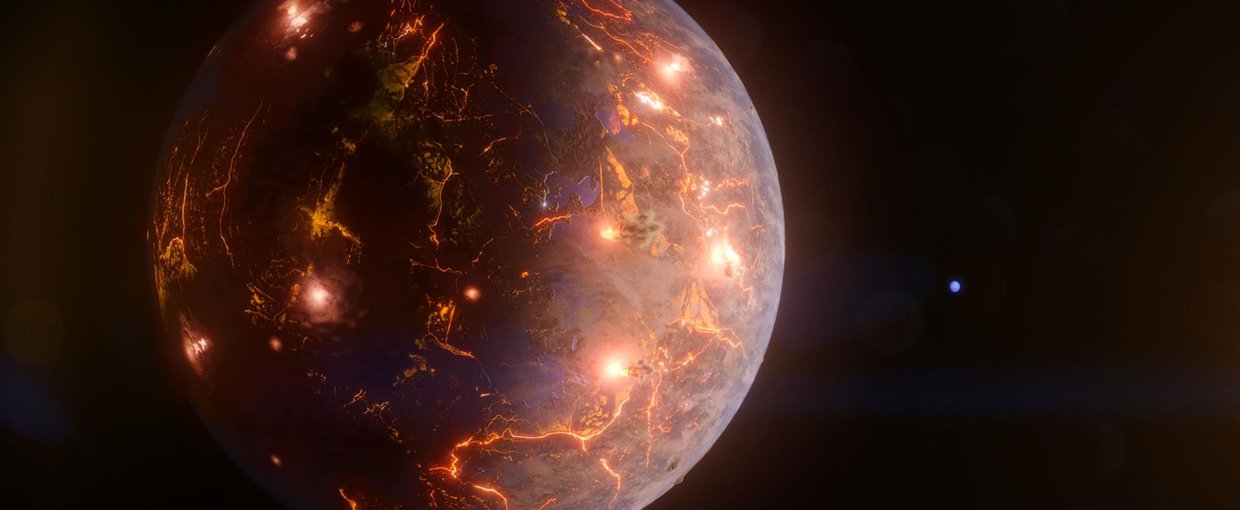
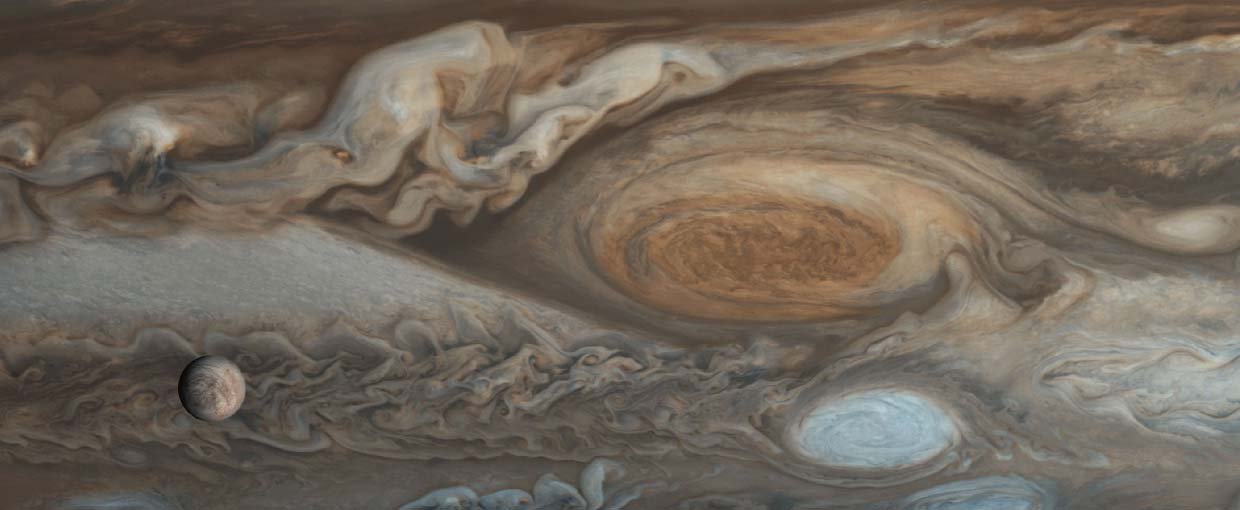
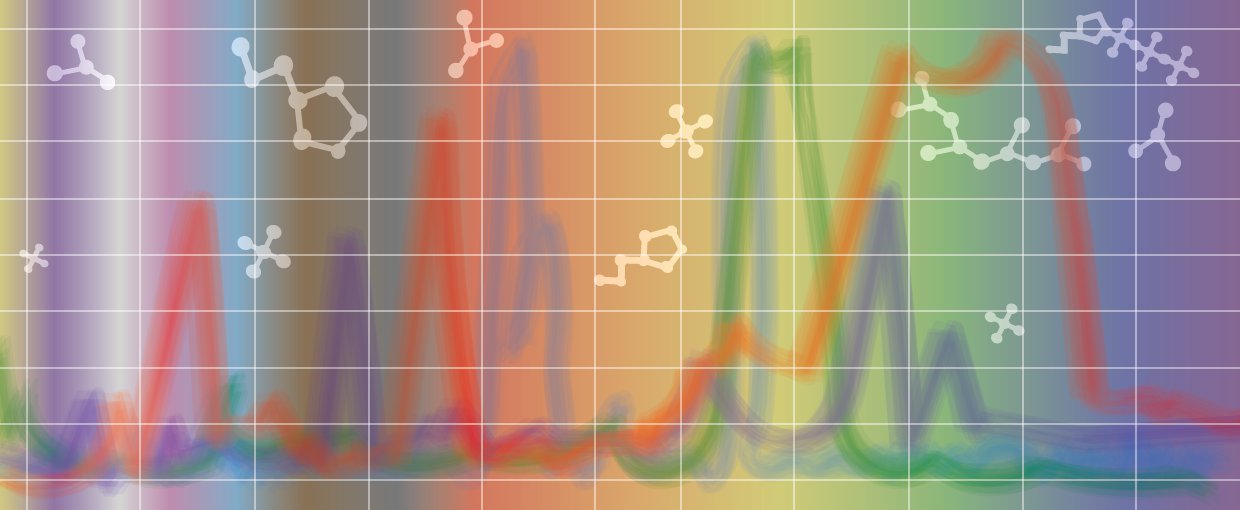
A volcanically active planet is shown in closeup at the left side of the image with glowing eruptions and lines of lava on the surface. To the right and in the distance is a faint blue glowing ball representing the more massive planet in the system.Sixteen frames from Voyager 1's flyby of Jupiter in 1979 were merged to create this image. Jupiter's Great Red Spot is visible in the center. Jupiter's moon Europa can be seen in the foreground at the bottom left of the image.The frame is a horizontal rainbow of color on a grid. Shadows of molecules can be seen through the light as well as the jagged peaks and troughs of spectral lines.
Fizzy Super Earths and Lava Worlds“Fizzy Super-Earths: Impacts of Magma Composition on the Bulk Density and Structure of Lava Worlds.” in The Astrophysical Journal.01/03
Identifying Hydrothermal Activity on Icy Ocean Worlds“Ethene-ethanol ratios as potential indicators of hydrothermal activity at Enceladus, Europa, and other icy ocean worlds.” In Icarus.02/03
NASA Raman Spectroscopic Database"The NASA Raman spectroscopic database: Ramdb version 1.00.” In Icarus.03/03
NextPrevious
Go Explore
August 2020A tale of three taphonomic modes: The Ediacaran fossil Flabellophyton preserved in limestone, black shale, and sandstone

Wan, B., Chen, Z., Yuan, X., Pang, K., Tang, Q., Guan, C., … Xiao, S. (2020). A tale of three taphonomic modes: The Ediacaran fossil Flabellophyton preserved in limestone, black shale, and sandstone. Gondwana Research, 84, 296–314. doi:10.1016/j.gr.2020.04.003

Abiotic redox reactions in hydrothermal mixing zones: Decreased energy availability for the subsurface biosphere

McDermott, J. M., Sylva, S. P., Ono, S., German, C. R., & Seewald, J. S. (2020). Abiotic redox reactions in hydrothermal mixing zones: Decreased energy availability for the subsurface biosphere. Proceedings of the National Academy of Sciences, None, 202003108. doi:10.1073/pnas.2003108117

Low-Temperature Biosurfactants from Polar Microbes

Trudgeon, B., Dieser, M., Balasubramanian, N., Messmer, M., & Foreman, C. M. (2020). Low-Temperature Biosurfactants from Polar Microbes. Microorganisms, 8(8), 1183. doi:10.3390/microorganisms8081183

Evidence for Multiple Diagenetic Episodes in Ancient Fluvial‐Lacustrine Sedimentary Rocks in Gale Crater, Mars

Achilles, C. N., Rampe, E. B., Downs, R. T., Bristow, T. F., Ming, D. W., Morris, R. V., … Morookian, J. M. (2020). Evidence for Multiple Diagenetic Episodes in Ancient Fluvial‐Lacustrine Sedimentary Rocks in Gale Crater, Mars. Journal of Geophysical Research: Planets, 125(8), None. doi:10.1029/2019je006295

One gene, multiple ecological strategies: A biofilm regulator is a capacitor for sustainable diversity

Mhatre, E., Snyder, D. J., Sileo, E., Turner, C. B., Buskirk, S. W., Fernandez, N. L., … Cooper, V. S. (2020). One gene, multiple ecological strategies: A biofilm regulator is a capacitor for sustainable diversity. Proceedings of the National Academy of Sciences, 117(35), 21647–21657. doi:10.1073/pnas.2008540117

Thallium isotope ratios in shales from South China and northwestern Canada suggest widespread O2 accumulation in marine bottom waters was an uncommon occurrence during the Ediacaran Period

Ostrander, C. M., Owens, J. D., Nielsen, S. G., Lyons, T. W., Shu, Y., Chen, X., … Anbar, A. D. (2020). Thallium isotope ratios in shales from South China and northwestern Canada suggest widespread O2 accumulation in marine bottom waters was an uncommon occurrence during the Ediacaran Period. Chemical Geology, None, 119856. doi:10.1016/j.chemgeo.2020.119856

Constraining Ancient Magmatic Evolution on Mars Using Crystal Chemistry of Detrital Igneous Minerals in the Sedimentary Bradbury Group, Gale Crater, Mars

Payré, V., Siebach, K. L., Dasgupta, R., Udry, A., Rampe, E. B., & Morrison, S. M. (2020). Constraining Ancient Magmatic Evolution on Mars Using Crystal Chemistry of Detrital Igneous Minerals in the Sedimentary Bradbury Group, Gale Crater, Mars. Journal of Geophysical Research: Planets, 125(8), None. doi:10.1029/2020je006467

Iron phosphate in the Ediacaran Doushantuo Formation of South China: A previously undocumented marine phosphate sink

Schwid, M. F., Xiao, S., Hiatt, E. E., Fang, Y., & Nolan, M. R. (2020). Iron phosphate in the Ediacaran Doushantuo Formation of South China: A previously undocumented marine phosphate sink. Palaeogeography, Palaeoclimatology, Palaeoecology, None, 109993. doi:10.1016/j.palaeo.2020.109993

Probable benthic macroalgae from the Ediacara Member, South Australia

Xiao, S., Gehling, J. G., Evans, S. D., Hughes, I. V., & Droser, M. L. (2020). Probable benthic macroalgae from the Ediacara Member, South Australia. Precambrian Research, None, 105903. doi:10.1016/j.precamres.2020.105903

July 2020Seaweeds through time: Morphological and ecological analysis of Proterozoic and early Paleozoic benthic macroalgae

Bykova, N., LoDuca, S. T., Ye, Q., Marusin, V., Grazhdankin, D., & Xiao, S. (2020). Seaweeds through time: Morphological and ecological analysis of Proterozoic and early Paleozoic benthic macroalgae. Precambrian Research, None, 105875. doi:10.1016/j.precamres.2020.105875