

This website is currently being migrated. For the most up-to-date astrobiology news, resources, and community announcements, please visit our new home at science.nasa.gov/astrobiology

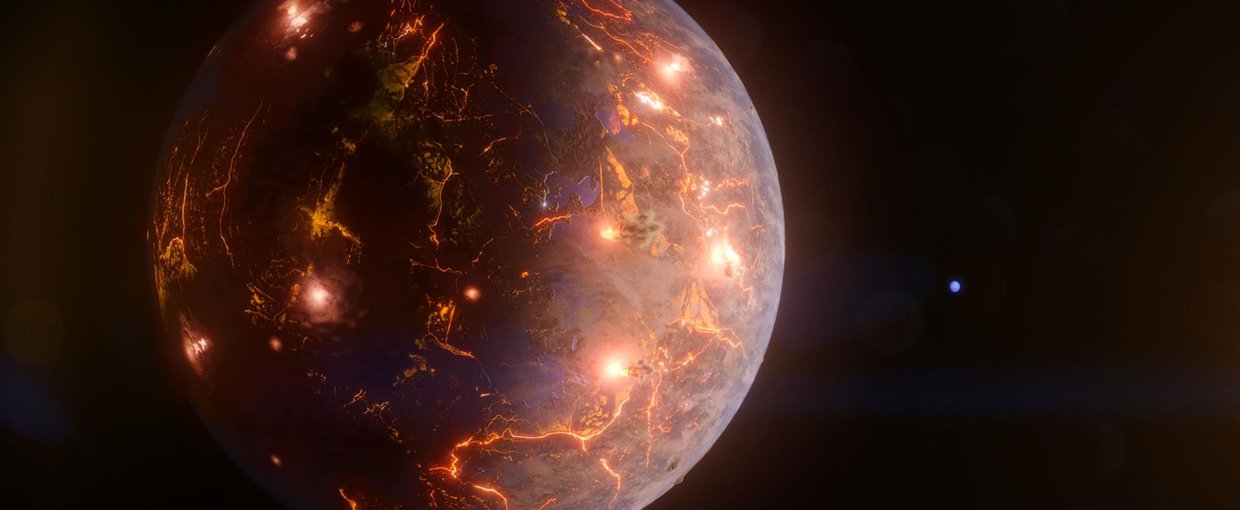
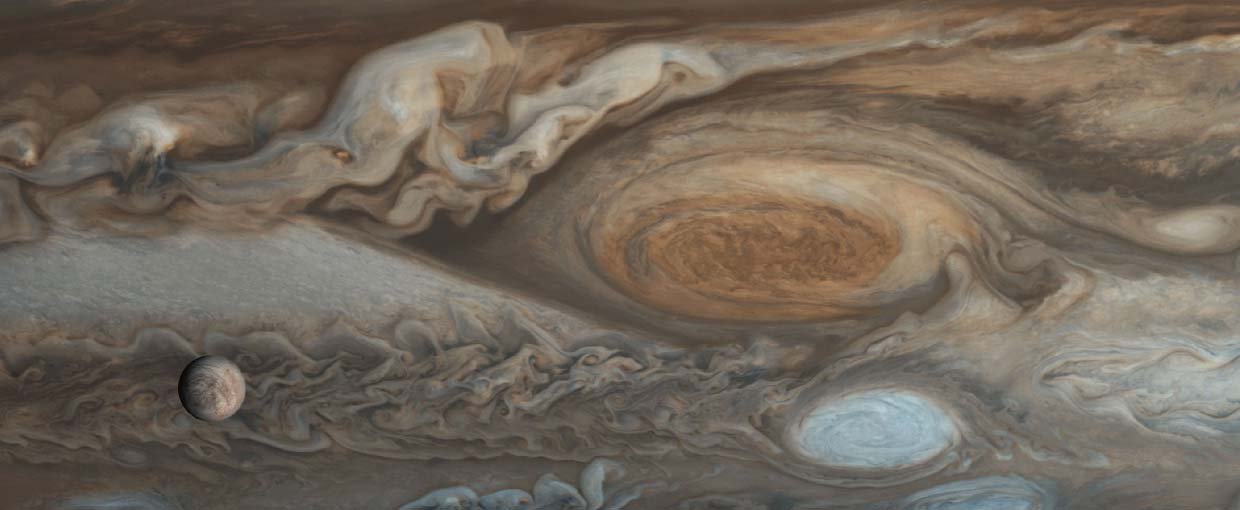
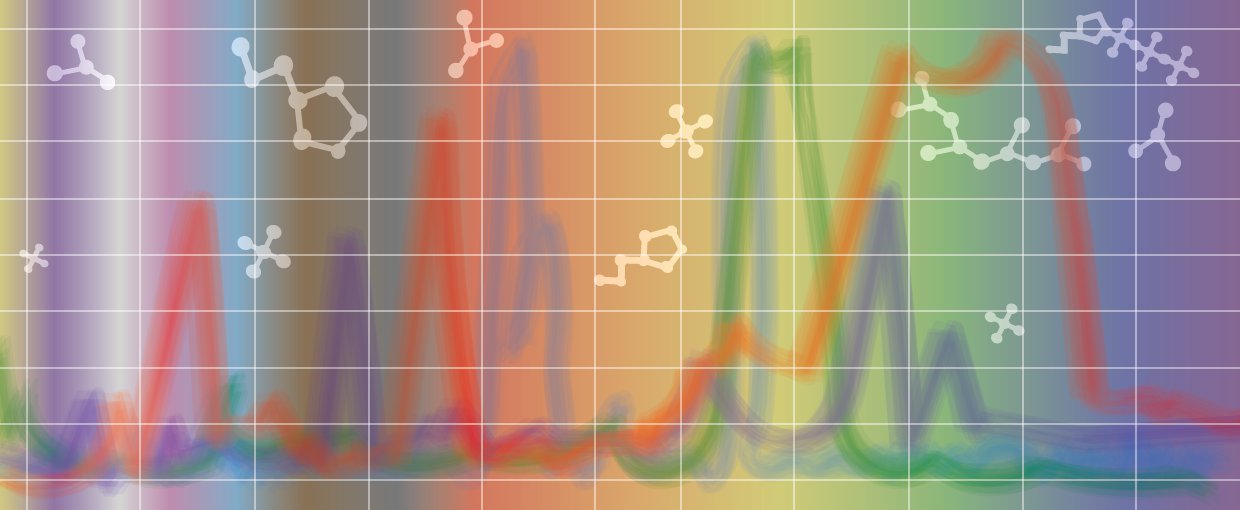
A volcanically active planet is shown in closeup at the left side of the image with glowing eruptions and lines of lava on the surface. To the right and in the distance is a faint blue glowing ball representing the more massive planet in the system.Sixteen frames from Voyager 1's flyby of Jupiter in 1979 were merged to create this image. Jupiter's Great Red Spot is visible in the center. Jupiter's moon Europa can be seen in the foreground at the bottom left of the image.The frame is a horizontal rainbow of color on a grid. Shadows of molecules can be seen through the light as well as the jagged peaks and troughs of spectral lines.
Fizzy Super Earths and Lava Worlds“Fizzy Super-Earths: Impacts of Magma Composition on the Bulk Density and Structure of Lava Worlds.” in The Astrophysical Journal.01/03
Identifying Hydrothermal Activity on Icy Ocean Worlds“Ethene-ethanol ratios as potential indicators of hydrothermal activity at Enceladus, Europa, and other icy ocean worlds.” In Icarus.02/03
NASA Raman Spectroscopic Database"The NASA Raman spectroscopic database: Ramdb version 1.00.” In Icarus.03/03
NextPrevious
Go Explore
December 2020First Detection of Orbital Motion for HD 106906 b: A Wide-separation Exoplanet on a Planet Nine–like Orbit

Nguyen, M. M., De Rosa, R. J., & Kalas, P. (2020). First Detection of Orbital Motion for HD 106906 b: A Wide-separation Exoplanet on a Planet Nine–like Orbit. The Astronomical Journal, 161(1), 22. doi:10.3847/1538-3881/abc012

Simple kinetics, assay, and trends for soil microbial catalases

Chabot, M., Morales, E., Cummings, J., Rios, N., Giatpaiboon, S., & Mogul, R. (2020). Simple kinetics, assay, and trends for soil microbial catalases. Analytical Biochemistry, 610, 113901. doi:10.1016/j.ab.2020.113901

GPI 2.0: upgrading the Gemini Planet Imager

Chilcote, J. K., Konopacky, Q. M., De Rosa, R. J., Hamper, R., Macintosh, B. A., Marois, C., … Thomas, C. (2020). GPI 2.0: upgrading the Gemini Planet Imager. Ground-based and Airborne Instrumentation for Astronomy VIII. doi:10.1117/12.2562578

Gemini Planet Imager observational calibrations XV: instrument calibrations after six years on sky

De Rosa, R. J., Esposito, T. M., Gibbs, A., Bailey, V., Fitzgerald, M., Chilcote, J. K., … Wang, J. J. (2020). Gemini Planet Imager observational calibrations XV: instrument calibrations after six years on sky. Ground-based and Airborne Instrumentation for Astronomy VIII. doi:10.1117/12.2561071

Development of high technology readiness level, all-reflective spatial heterodyne spectrometers for high resolving power/etendue remote sensing of extended emissions in the NUV to EUV

Harris, W. M. (2020). Development of high technology readiness level, all-reflective spatial heterodyne spectrometers for high resolving power/etendue remote sensing of extended emissions in the NUV to EUV. Space Telescopes and Instrumentation 2020: Ultraviolet to Gamma Ray. doi:10.1117/12.2563045

The proto-Nucleic Acid Builder: a software tool for constructing nucleic acid analogs

Alenaizan, A., Barnett, J. L., Hud, N. V., Sherrill, C. D., & Petrov, A. S. (2020). The proto-Nucleic Acid Builder: a software tool for constructing nucleic acid analogs. Nucleic Acids Research. doi:10.1093/nar/gkaa1159

Extraterrestrial hexamethylenetetramine in meteorites—a precursor of prebiotic chemistry in the inner solar system

Oba, Y., Takano, Y., Naraoka, H., Furukawa, Y., Glavin, D. P., Dworkin, J. P., & Tachibana, S. (2020). Extraterrestrial hexamethylenetetramine in meteorites—a precursor of prebiotic chemistry in the inner solar system. Nature Communications, 11(1), None. doi:10.1038/s41467-020-20038-x

Influence of Neptune’s Migration Parameters on the Inclination Distribution of Kuiper Belt Objects (KBOs)

Nesvorný, D. (2020). Influence of Neptune’s Migration Parameters on the Inclination Distribution of Kuiper Belt Objects (KBOs). Research Notes of the AAS, 4(12), 212. doi:10.3847/2515-5172/abceb0

How the first life on Earth survived its biggest threat — water

Marshall, M. (2020). How the first life on Earth survived its biggest threat — water. Nature, 588(7837), 210–213. doi:10.1038/d41586-020-03461-4

Conodont calcium isotopic evidence for multiple shelf acidification events during the early Triassic

Song, H., Song, H., Tong, J., Gordon, G. W., Wignall, P. B., Tian, L., … Anbar, A. D. (2020). Conodont calcium isotopic evidence for multiple shelf acidification events during the early Triassic. Chemical Geology, None, 120038. doi:10.1016/j.chemgeo.2020.120038