

Steele, A., Benning, L. G., Wirth, R., Siljeström, S., Fries, M. D., Hauri, E., … Blanco, J. D. R. (2018). Organic synthesis on Mars by electrochemical reduction of CO2. Science Advances, 4(10), eaat5118. doi:10.1126/sciadv.aat5118
Karunakaran, S. C., Cafferty, B. J., Peláez-Fernández, M., Neselu, K., Schmidt-Krey, I., Fernandez-Nieves, A., … Hud, N. V. (2018). Exquisite regulation of supramolecular equilibrium polymers in water: chain stoppers control length, polydispersity and viscoelasticity. Polymer Chemistry, 9(43), 5268–5277. doi:10.1039/c8py01146j
Price, R. E., & Giovannelli, D. (2019). Marine Shallow-Water Hydrothermal Vents: Geochemistry. Encyclopedia of Ocean Sciences, None, 346–352. doi:10.1016/b978-0-12-409548-9.11015-2
Sleep, N. H. (2018). Geological and Geochemical Constraints on the Origin and Evolution of Life. Astrobiology, 18(9), 1199–1219. doi:10.1089/ast.2017.1778
Turjanski, P., & Ferreiro, D. U. (2018). On the Natural Structure of Amino Acid Patterns in Families of Protein Sequences. The Journal of Physical Chemistry B, 122(49), 11295–11301. doi:10.1021/acs.jpcb.8b07206
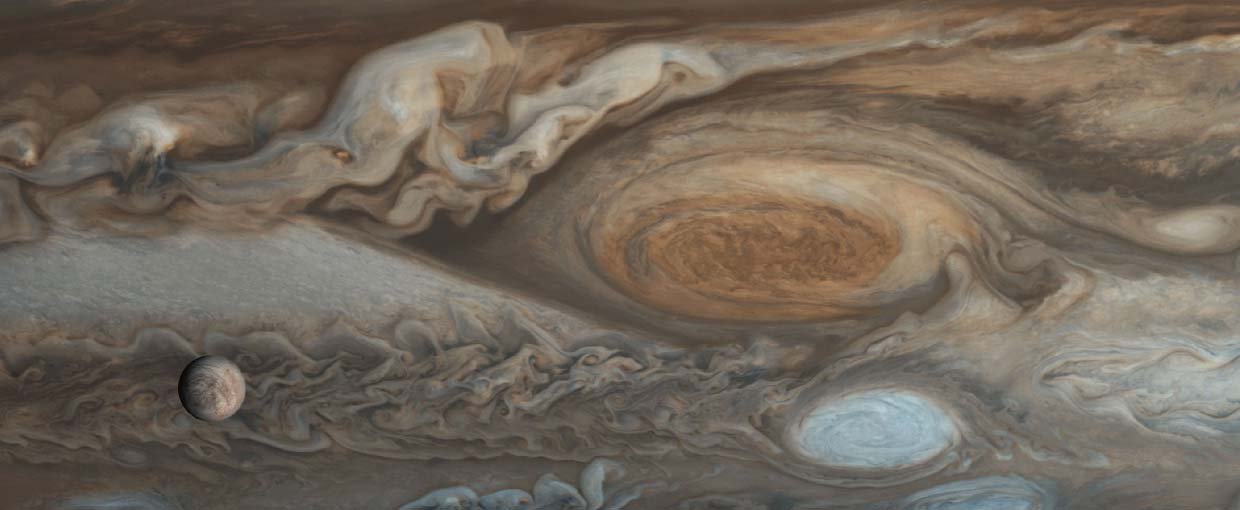
Li, L., Jiang, X., West, R. A., Gierasch, P. J., Perez-Hoyos, S., Sanchez-Lavega, A., … Schmude, R. W. (2018). Less absorbed solar energy and more internal heat for Jupiter. Nature Communications, 9(1), None. doi:10.1038/s41467-018-06107-2
Stebbins, A., Algeo, T. J., Krystyn, L., Rowe, H., Brookfield, M., Williams, J., … Hannigan, R. (2018). Marine sulfur cycle evidence for upwelling and eutrophic stresses during early triassic cooling events. Earth-Science Reviews. doi:10.1016/j.earscirev.2018.09.007
Talens, G. J. J., Deul, E. R., Stuik, R., Burggraaff, O., Lesage, A-L., Spronck, J. F. P., … Snellen, I. A. G. (2018). Data calibration for the MASCARA and bRing instruments.. Astronomy & Astrophysics. doi:10.1051/0004-6361/201834070
Kempton, E-R., Bean, J. L., Louie, D. R., Deming, D., Koll, D. D. B., Mansfield, M., … Essen, C. v. (2018). A Framework for Prioritizing the TESS Planetary Candidates Most Amenable to Atmospheric Characterization. Publications of the Astronomical Society of the Pacific, 130(993), 114401. doi:10.1088/1538-3873/aadf6f
O'Malley-James, J. T., & Kaltenegger, L. (2018). The Vegetation Red Edge Biosignature Through Time on Earth and Exoplanets. Astrobiology, 18(9), 1123–1136. doi:10.1089/ast.2017.1798