

This website is currently being migrated. For the most up-to-date astrobiology news, resources, and community announcements, please visit our new home at science.nasa.gov/astrobiology

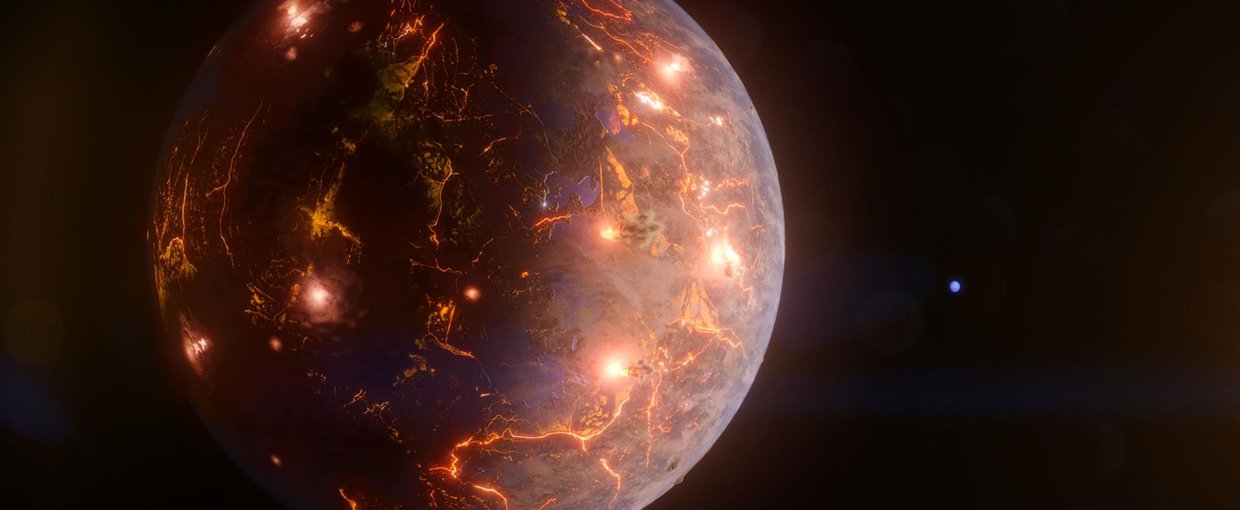
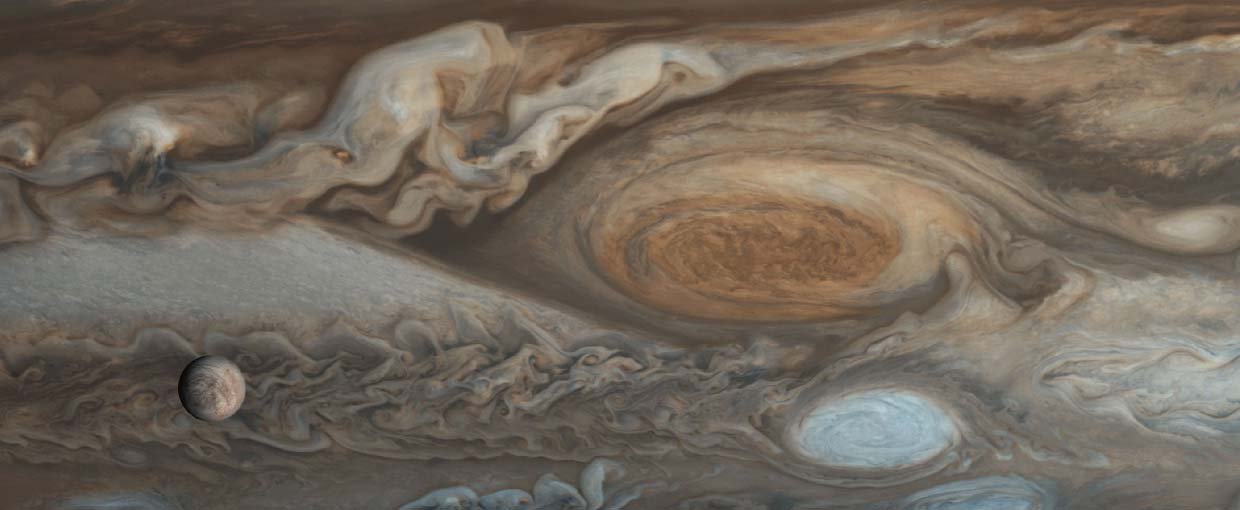
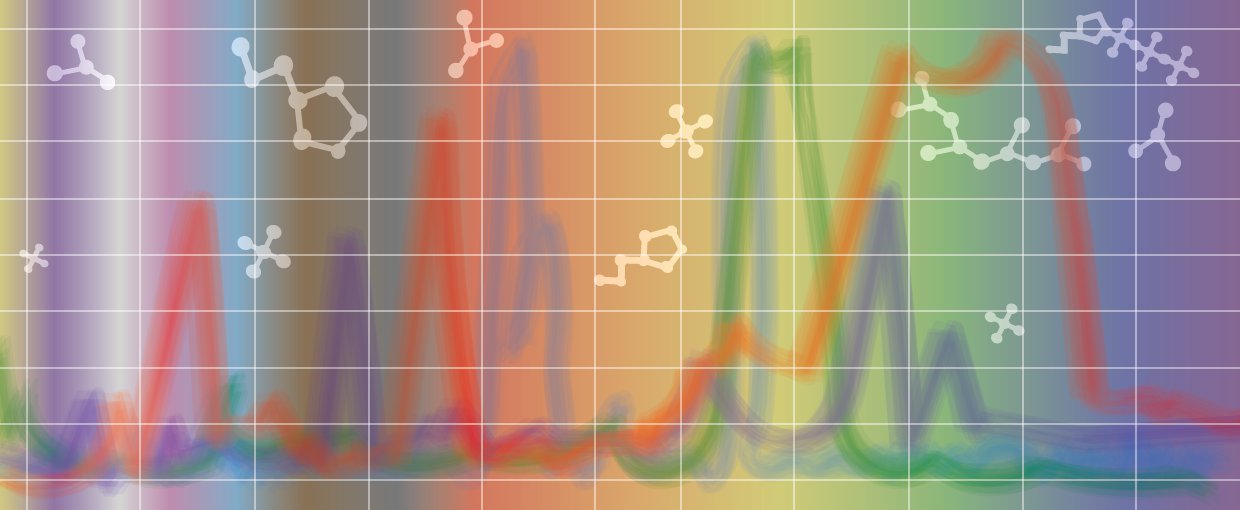
A volcanically active planet is shown in closeup at the left side of the image with glowing eruptions and lines of lava on the surface. To the right and in the distance is a faint blue glowing ball representing the more massive planet in the system.Sixteen frames from Voyager 1's flyby of Jupiter in 1979 were merged to create this image. Jupiter's Great Red Spot is visible in the center. Jupiter's moon Europa can be seen in the foreground at the bottom left of the image.The frame is a horizontal rainbow of color on a grid. Shadows of molecules can be seen through the light as well as the jagged peaks and troughs of spectral lines.
Fizzy Super Earths and Lava Worlds“Fizzy Super-Earths: Impacts of Magma Composition on the Bulk Density and Structure of Lava Worlds.” in The Astrophysical Journal.01/03
Identifying Hydrothermal Activity on Icy Ocean Worlds“Ethene-ethanol ratios as potential indicators of hydrothermal activity at Enceladus, Europa, and other icy ocean worlds.” In Icarus.02/03
NASA Raman Spectroscopic Database"The NASA Raman spectroscopic database: Ramdb version 1.00.” In Icarus.03/03
NextPrevious
Go Explore
May 2025A Complex Systems Approach to Exoplanet Atmospheric Chemistry: New Prospects for Ruling Out the Possibility of Alien Life As We Know It

Fisher, T., Janin, E., & Walker, S. I. (2025). A Complex Systems Approach to Exoplanet Atmospheric Chemistry: New Prospects for Ruling Out the Possibility of Alien Life As We Know It. The Planetary Science Journal, 6(5), 116. doi:10.3847/psj/adcc27

January 2025Photolysis and Sublimation Chemistry of Ammonium Cyanide with Relevance to Cometary Environments

Wilkins, O. H., Yocum, K. M., Esposito, V. J., Harel, E., Milam, S. N., & Gerakines, P. A. (2025). Photolysis and Sublimation Chemistry of Ammonium Cyanide with Relevance to Cometary Environments. The Planetary Science Journal, 6(1), 10. doi:10.3847/psj/ad9a67

July 2024Reply to “Comment on “Biostratinomy of the enigmatic tubular organism Aulozoon soliorum, the Rawnsley Quartzite, South Australia” by Surprenant et al. (2023)”

Surprenant, R. L., Gehling, J. G., Hughes, E. B., & Droser, M. L. (2024). Reply to “Comment on “Biostratinomy of the enigmatic tubular organism Aulozoon soliorum, the Rawnsley Quartzite, South Australia” by Surprenant et al. (2023)”. Gondwana Research, 131, 69–74. doi:10.1016/j.gr.2024.02.010

April 2024Measurements of Titan’s Stratospheric Winds during the 2009 Equinox with the eSMA

Light, S., Gurwell, M., Thelen, A., Lombardo, N. A., & Nixon, C. (2024). Measurements of Titan’s Stratospheric Winds during the 2009 Equinox with the eSMA. The Planetary Science Journal, 5(4), 98. doi:10.3847/psj/ad3355

March 2024Chapter 2: What Is Life?

Colón-Santos, S., Vázquez-Salazar, A., Adams, A., Campillo-Balderas, J. A., Hernández-Morales, R., Jácome, R., … Trubl, G. (2024). Chapter 2: What Is Life? Astrobiology, 24(S1), S–40–S–56. doi:10.1089/ast.2021.0116

Chapter 9: Life as We Don't Know It

Grefenstette, N., Chou, L., Colón-Santos, S., Fisher, T. M., Mierzejewski, V., Nural, C., … Weng, M. M. (2024). Chapter 9: Life as We Don't Know It. Astrobiology, 24(S1), S–186–S–201. doi:10.1089/ast.2021.0103

Chapter 1: The Astrobiology Primer 3.0

Schaible, M. J., Szeinbaum, N., Bozdag, G. O., Chou, L., Grefenstette, N., Colón-Santos, S., … Young, A. (2024). Chapter 1: The Astrobiology Primer 3.0. Astrobiology, 24(S1), S–4–S–39. doi:10.1089/ast.2021.0129

Astrobiological applications of μ-mapping X-ray fluorescence spectrometry

Blake, D. F., Walroth, R. C., Bristow, T. F., Sarrazin, P., Gailhanou, M., Thompson, K., … Lafuente, B. (2024). Astrobiological applications of μ-mapping X-ray fluorescence spectrometry. International Journal of Astrobiology, 23, None. doi:10.1017/s147355042400003x

TOI-4438 b: a transiting mini-Neptune amenable to atmospheric characterization

Goffo, E., Chaturvedi, P., Murgas, F., Morello, G., Orell-Miquel, J., AcuñA, L., … Zechmeister, M. (2024). TOI-4438 b: a transiting mini-Neptune amenable to atmospheric characterization. Astronomy & Astrophysics. doi:10.1051/0004-6361/202349133

February 2024Searching for Life: End-to-End Automated Detection and Characterization of Ediacaran Biosignatures

Jonnalagedda, P., Surprenant, R. L., Droser, M. L., & Bhanu, B. (2024). Searching for Life: End-to-End Automated Detection and Characterization of Ediacaran Biosignatures. IEEE Transactions on Geoscience and Remote Sensing, 62, 1–18. doi:10.1109/tgrs.2024.3367632

PREV
1/2/3/4/5/6...412
NEXT