


This website is currently being migrated. For the most up-to-date astrobiology news, resources, and community announcements, please visit our new home at science.nasa.gov/astrobiology

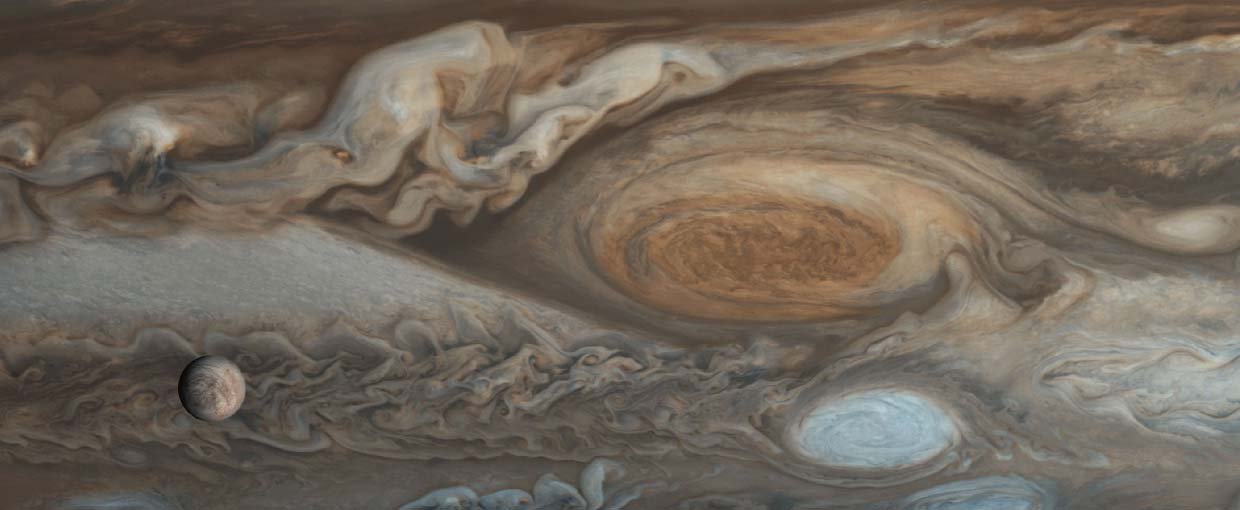
A volcanically active planet is shown in closeup at the left side of the image with glowing eruptions and lines of lava on the surface. To the right and in the distance is a faint blue glowing ball representing the more massive planet in the system.Sixteen frames from Voyager 1's flyby of Jupiter in 1979 were merged to create this image. Jupiter's Great Red Spot is visible in the center. Jupiter's moon Europa can be seen in the foreground at the bottom left of the image.The frame is a horizontal rainbow of color on a grid. Shadows of molecules can be seen through the light as well as the jagged peaks and troughs of spectral lines.
Fizzy Super Earths and Lava Worlds“Fizzy Super-Earths: Impacts of Magma Composition on the Bulk Density and Structure of Lava Worlds.” in The Astrophysical Journal.01/03
Identifying Hydrothermal Activity on Icy Ocean Worlds“Ethene-ethanol ratios as potential indicators of hydrothermal activity at Enceladus, Europa, and other icy ocean worlds.” In Icarus.02/03
NASA Raman Spectroscopic Database"The NASA Raman spectroscopic database: Ramdb version 1.00.” In Icarus.03/03
NextPrevious
Go Explore
October 2018Catalytic abiotic synthesis of uracil from cysteine and urea: Theoretical studies

Mirchi, A., Sizochenko, N., Wang, J., & Leszczynski, J. (2018). Catalytic abiotic synthesis of uracil from cysteine and urea: Theoretical studies. Chemical Physics Letters, 710, 16–25. doi:10.1016/j.cplett.2018.08.057

Anharmonicity and the infrared emission spectrum of highly excited polycyclic aromatic hydrocarbons

Chen, T., Mackie, C., Candian, A., Lee, T. J., & Tielens, A. G. G. M. (2018). Anharmonicity and the infrared emission spectrum of highly excited polycyclic aromatic hydrocarbons. Astronomy & Astrophysics, 618, A49. doi:10.1051/0004-6361/201833731

Stepwise oxygenation of the Paleozoic atmosphere

Krause, A. J., Mills, B. J. W., Zhang, S., Planavsky, N. J., Lenton, T. M., & Poulton, S. W. (2018). Stepwise oxygenation of the Paleozoic atmosphere. Nature Communications, 9(1), None. doi:10.1038/s41467-018-06383-y

Clostridioides difficile: a potential source of NpmA in the clinical environment

Marsh, J. W., Pacey, M. P., Ezeonwuka, C., Ohm, S. L., Snyder, D., Cooper, V. S., … Mustapha, M. M. (2018). Clostridioides difficile: a potential source of NpmA in the clinical environment. Journal of Antimicrobial Chemotherapy, 74(2), 521–523. doi:10.1093/jac/dky420

Distant worlds beckon

Schwieterman, E. W. (2018). Distant worlds beckon. Nature Astronomy, 2(11), 849–850. doi:10.1038/s41550-018-0624-8

Dalangtan Saline Playa in a Hyperarid Region of Tibet Plateau: III. Correlated Multiscale Surface Mineralogy and Geochemistry Survey

Sobron, P., Wang, A., Mayer, D. P., Bentz, J., Kong, F., & Zheng, M. (2018). Dalangtan Saline Playa in a Hyperarid Region of Tibet Plateau: III. Correlated Multiscale Surface Mineralogy and Geochemistry Survey. Astrobiology, 18(10), 1277–1304. doi:10.1089/ast.2017.1777

Methane on Mars and Habitability: Challenges and Responses

Yung, Y. L., Chen, P., Nealson, K., Atreya, S., Beckett, P., Blank, J. G., … Worden, J. (2018). Methane on Mars and Habitability: Challenges and Responses. Astrobiology, 18(10), 1221–1242. doi:10.1089/ast.2018.1917

Demosponge steroid biomarker 26-methylstigmastane provides evidence for Neoproterozoic animals

Zumberge, J. A., Love, G. D., Cárdenas, P., Sperling, E. A., Gunasekera, S., Rohrssen, M., … Summons, R. E. (2018). Demosponge steroid biomarker 26-methylstigmastane provides evidence for Neoproterozoic animals. Nature Ecology & Evolution, 2(11), 1709–1714. doi:10.1038/s41559-018-0676-2

Evolutionary and biogeographical shifts in response to the Late Ordovician mass extinction

Congreve, C. R., Krug, A. Z., & Patzkowsky, M. E. (2018). Evolutionary and biogeographical shifts in response to the Late Ordovician mass extinction. Palaeontology. doi:10.1111/pala.12397

Phytoplankton (acritarch) community changes during the Permian-Triassic transition in South China

Lei, Y., Shen, J., Algeo, T. J., Servais, T., Feng, Q., & Yu, J. (2018). Phytoplankton (acritarch) community changes during the Permian-Triassic transition in South China. Palaeogeography, Palaeoclimatology, Palaeoecology. doi:10.1016/j.palaeo.2018.09.033