

This website is currently being migrated. For the most up-to-date astrobiology news, resources, and community announcements, please visit our new home at science.nasa.gov/astrobiology

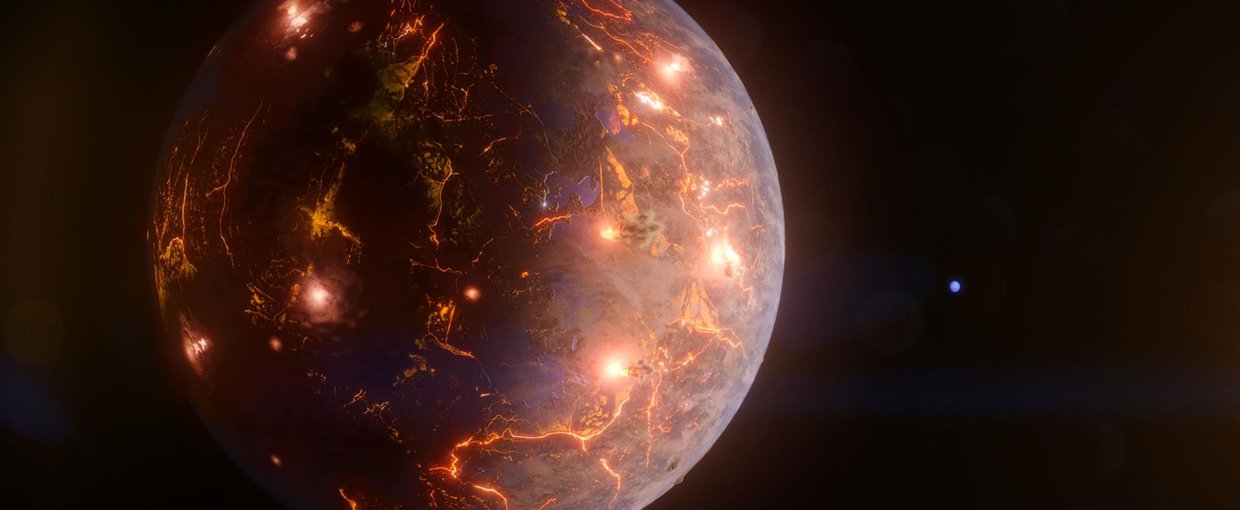
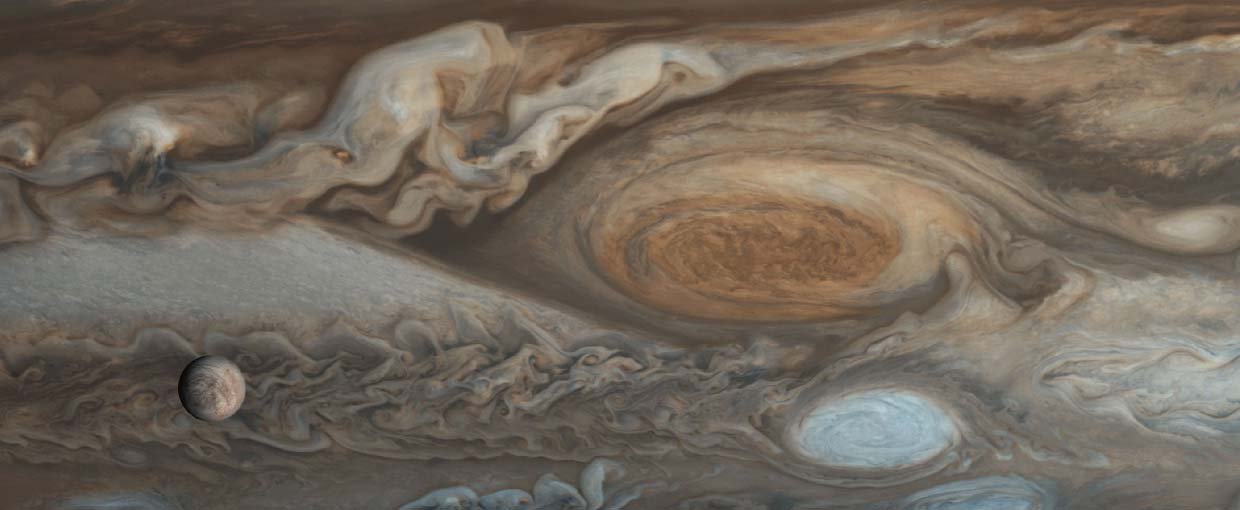
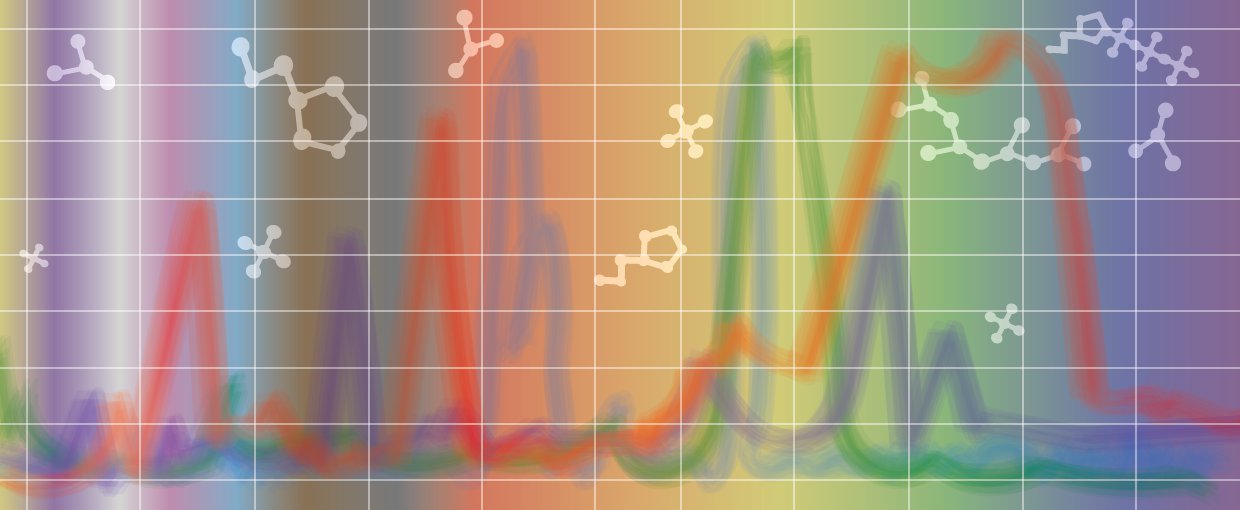
A volcanically active planet is shown in closeup at the left side of the image with glowing eruptions and lines of lava on the surface. To the right and in the distance is a faint blue glowing ball representing the more massive planet in the system.Sixteen frames from Voyager 1's flyby of Jupiter in 1979 were merged to create this image. Jupiter's Great Red Spot is visible in the center. Jupiter's moon Europa can be seen in the foreground at the bottom left of the image.The frame is a horizontal rainbow of color on a grid. Shadows of molecules can be seen through the light as well as the jagged peaks and troughs of spectral lines.
Fizzy Super Earths and Lava Worlds“Fizzy Super-Earths: Impacts of Magma Composition on the Bulk Density and Structure of Lava Worlds.” in The Astrophysical Journal.01/03
Identifying Hydrothermal Activity on Icy Ocean Worlds“Ethene-ethanol ratios as potential indicators of hydrothermal activity at Enceladus, Europa, and other icy ocean worlds.” In Icarus.02/03
NASA Raman Spectroscopic Database"The NASA Raman spectroscopic database: Ramdb version 1.00.” In Icarus.03/03
NextPrevious
Go Explore
December 2018Considering planetary environments in origin of life studies

Barge, L. M. (2018). Considering planetary environments in origin of life studies. Nature Communications, 9(1), None. doi:10.1038/s41467-018-07493-3

Scientific Domain Knowledge Improves Exoplanet Transit Classification with Deep Learning

Ansdell, M., Ioannou, Y., Osborn, H. P., Sasdelli, M., Smith, J. C., Caldwell, D., … , . (2018). Scientific Domain Knowledge Improves Exoplanet Transit Classification with Deep Learning. The Astrophysical Journal, 869(1), L7. doi:10.3847/2041-8213/aaf23b

Climate Modeling of a Potential ExoVenus

Kane, S. R., Ceja, A. Y., Way, M. J., & Quintana, E. V. (2018). Climate Modeling of a Potential ExoVenus. The Astrophysical Journal, 869(1), 46. doi:10.3847/1538-4357/aaec68

Excess 180W in IIAB iron meteorites: Identification of cosmogenic, radiogenic, and nucleosynthetic components

Cook, D. L., Smith, T., Leya, I., Hilton, C. D., Walker, R. J., & Schönbächler, M. (2018). Excess 180W in IIAB iron meteorites: Identification of cosmogenic, radiogenic, and nucleosynthetic components. Earth and Planetary Science Letters, 503, 29–36. doi:10.1016/j.epsl.2018.09.021

November 2018Constraining the period of the ringed secondary companion to the young star J1407 with photographic plates

Mentel, R. T., Kenworthy, M. A., Cameron, D. A., Scott, E. L., Mellon, S. N., Hudec, R., … Kuhn, R. B. (2018). Constraining the period of the ringed secondary companion to the young star J1407 with photographic plates. Astronomy & Astrophysics, 619, A157. doi:10.1051/0004-6361/201834004

Siderophile Element Constraints on the Thermal History of the H Chondrite Parent body

Archer, G. J., Walker, R. J., Tino, J., Blackburn, T., Kruijer, T. S., & Hellmann, J. L. (2018). Siderophile Element Constraints on the Thermal History of the H Chondrite Parent body. Geochimica et Cosmochimica Acta. doi:10.1016/j.gca.2018.11.012

Selective Adsorption of Aspartate Facilitated by Calcium on Brucite [Mg(OH)2]

Estrada, C. F., Sverjensky, D. A., & Hazen, R. M. (2018). Selective Adsorption of Aspartate Facilitated by Calcium on Brucite [Mg(OH)<sub>2</sub>]. ACS Earth and Space Chemistry, 3(1), 1–7. doi:10.1021/acsearthspacechem.8b00081

Marginal protein stability drives subcellular proteome isoelectric point

Loell, K., & Nanda, V. (2018). Marginal protein stability drives subcellular proteome isoelectric point. Proceedings of the National Academy of Sciences, 115(46), 11778–11783. doi:10.1073/pnas.1809098115

Folding, Assembly, and Persistence: The Essential Nature and Origins of Biopolymers

Runnels, C. M., Lanier, K. A., Williams, J. K., Bowman, J. C., Petrov, A. S., Hud, N. V., & Williams, L. D. (2018). Folding, Assembly, and Persistence: The Essential Nature and Origins of Biopolymers. Journal of Molecular Evolution, 86(9), 598–610. doi:10.1007/s00239-018-9876-2

Paleolakes of Northeast Hellas: Precipitation, Groundwater-Fed, and Fluvial Lakes in the Navua–Hadriacus–Ausonia Region, Mars

Hargitai, H. I., Gulick, V. C., & Glines, N. H. (2018). Paleolakes of Northeast Hellas: Precipitation, Groundwater-Fed, and Fluvial Lakes in the Navua–Hadriacus–Ausonia Region, Mars. Astrobiology, 18(11), 1435–1459. doi:10.1089/ast.2018.1816