

This website is currently being migrated. For the most up-to-date astrobiology news, resources, and community announcements, please visit our new home at science.nasa.gov/astrobiology

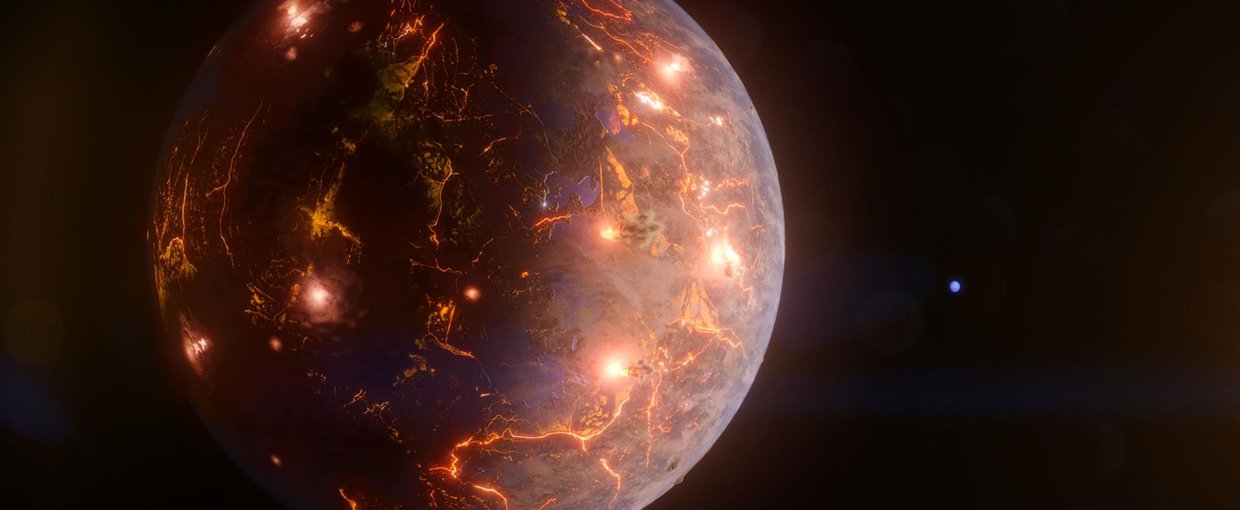
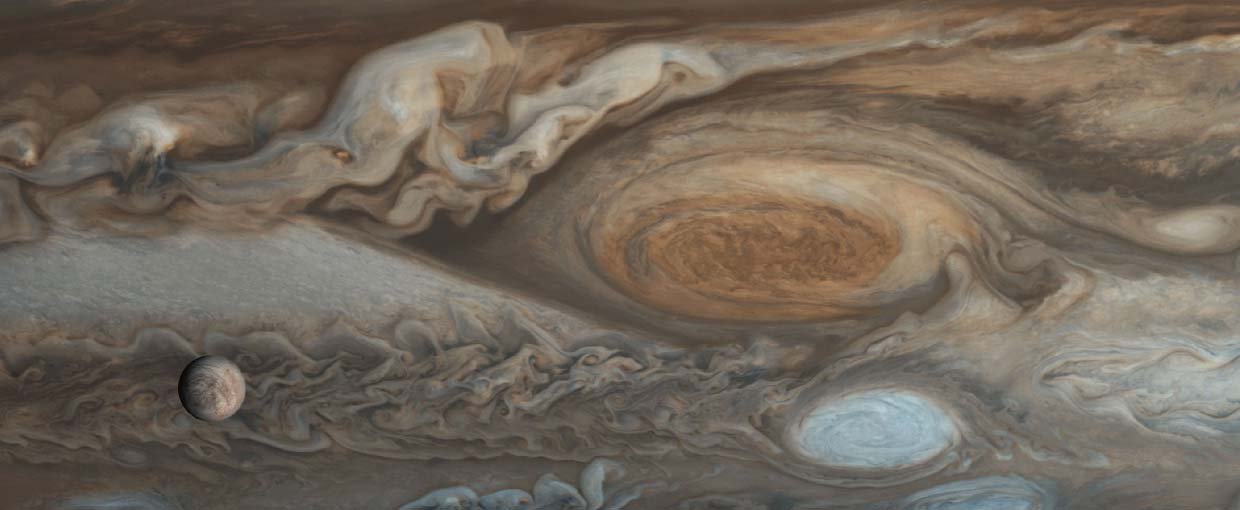
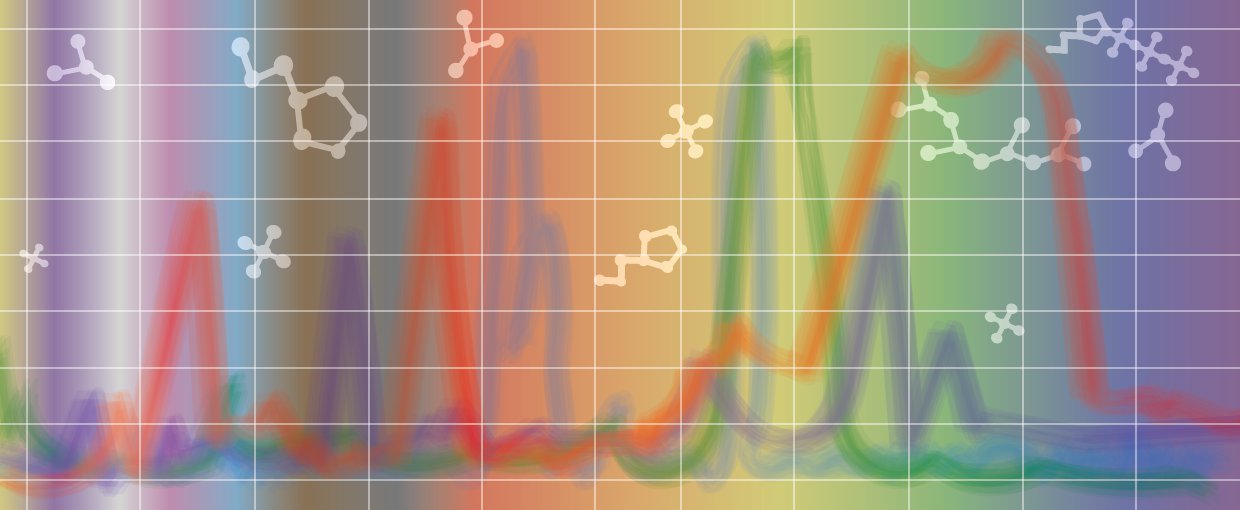
A volcanically active planet is shown in closeup at the left side of the image with glowing eruptions and lines of lava on the surface. To the right and in the distance is a faint blue glowing ball representing the more massive planet in the system.Sixteen frames from Voyager 1's flyby of Jupiter in 1979 were merged to create this image. Jupiter's Great Red Spot is visible in the center. Jupiter's moon Europa can be seen in the foreground at the bottom left of the image.The frame is a horizontal rainbow of color on a grid. Shadows of molecules can be seen through the light as well as the jagged peaks and troughs of spectral lines.
Fizzy Super Earths and Lava Worlds“Fizzy Super-Earths: Impacts of Magma Composition on the Bulk Density and Structure of Lava Worlds.” in The Astrophysical Journal.01/03
Identifying Hydrothermal Activity on Icy Ocean Worlds“Ethene-ethanol ratios as potential indicators of hydrothermal activity at Enceladus, Europa, and other icy ocean worlds.” In Icarus.02/03
NASA Raman Spectroscopic Database"The NASA Raman spectroscopic database: Ramdb version 1.00.” In Icarus.03/03
NextPrevious
Go Explore
December 2018Deoxyribose and deoxysugar derivatives from photoprocessed astrophysical ice analogues and comparison to meteorites

Nuevo, M., Cooper, G., & Sandford, S. A. (2018). Deoxyribose and deoxysugar derivatives from photoprocessed astrophysical ice analogues and comparison to meteorites. Nature Communications, 9(1), None. doi:10.1038/s41467-018-07693-x

New Formation Models for the Kepler-36 System

Bodenheimer, P., Stevenson, D. J., Lissauer, J. J., & D’Angelo, G. (2018). New Formation Models for the Kepler-36 System. The Astrophysical Journal, 868(2), 138. doi:10.3847/1538-4357/aae928

Searching for lost nucleotides of the pre-RNA World with a self-refining model of early Earth

Hud, N. V. (2018). Searching for lost nucleotides of the pre-RNA World with a self-refining model of early Earth. Nature Communications, 9(1), None. doi:10.1038/s41467-018-07389-2

Spontaneous Symmetry Breaking in the Formation of Supramolecular Polymers: Implications for the Origin of Biological Homochirality

Hud, N. V., Schuster, G., Karunakaran, S., Cafferty, B., & Weigert-Muñoz, A. (2018). Spontaneous Symmetry Breaking in the Formation of Supramolecular Polymers: Implications for the Origin of Biological Homochirality. Angewandte Chemie International Edition. doi:10.1002/anie.201812808

Experimentally investigating the origin of DNA/RNA on early Earth

Krishnamurthy, R. (2018). Experimentally investigating the origin of DNA/RNA on early Earth. Nature Communications, 9(1), None. doi:10.1038/s41467-018-07212-y

Primary Productivity was Limited by Electron Donors Prior to the Advent of Oxygenic Photosynthesis

Ward, L. M., Rasmussen, B., & Fischer, W. W. (2018). Primary Productivity was Limited by Electron Donors Prior to the Advent of Oxygenic Photosynthesis. Journal of Geophysical Research: Biogeosciences. doi:10.1029/2018jg004679

The Paleomineralogy of the Hadean Eon Revisited

Morrison, S., Runyon, S., & Hazen, R. (2018). The Paleomineralogy of the Hadean Eon Revisited. Life, 8(4), 64. doi:10.3390/life8040064

The little dippers: transits of star-grazing exocomets?

Ansdell, M., Gaidos, E., Jacobs, T. L., Mann, A., Manara, C. F., Kennedy, G. M., … Frasca, A. (2018). The little dippers: transits of star-grazing exocomets? Monthly Notices of the Royal Astronomical Society, 483(3), 3579–3591. doi:10.1093/mnras/sty3289

Exoplanet Science Strategy

, ., , ., , ., , ., & , . (2018). Exoplanet Science Strategy. None. doi:10.17226/25187

Biogeography of thermophiles and predominance of Thermus scotoductus in domestic water heaters

Wilpiszeski, R. L., Zhang, Z., & House, C. H. (2018). Biogeography of thermophiles and predominance of Thermus scotoductus in domestic water heaters. Extremophiles, 23(1), 119–132. doi:10.1007/s00792-018-1066-z