

This website is currently being migrated. For the most up-to-date astrobiology news, resources, and community announcements, please visit our new home at science.nasa.gov/astrobiology

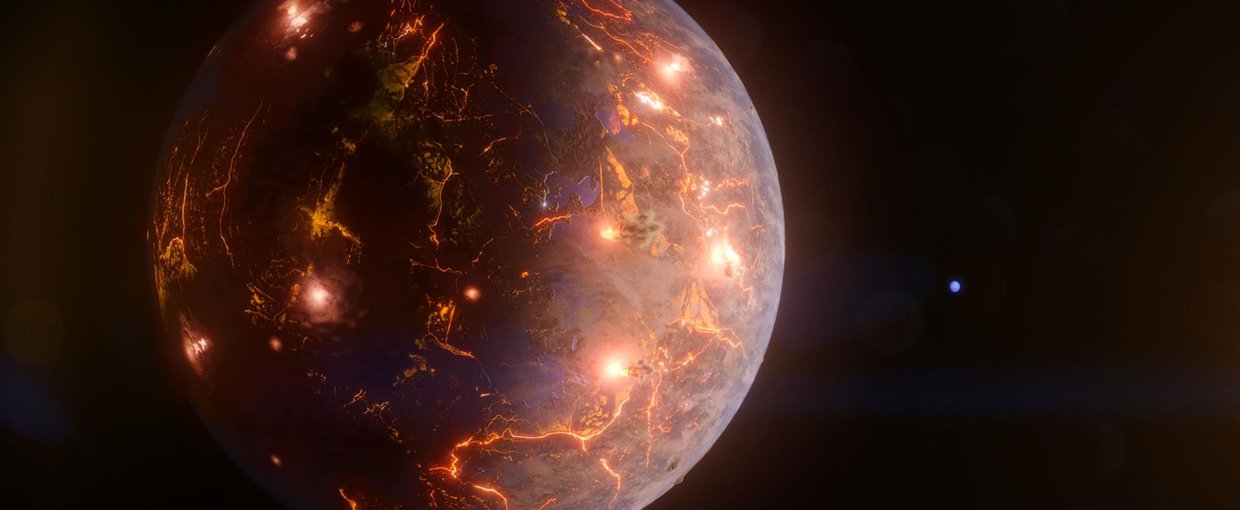
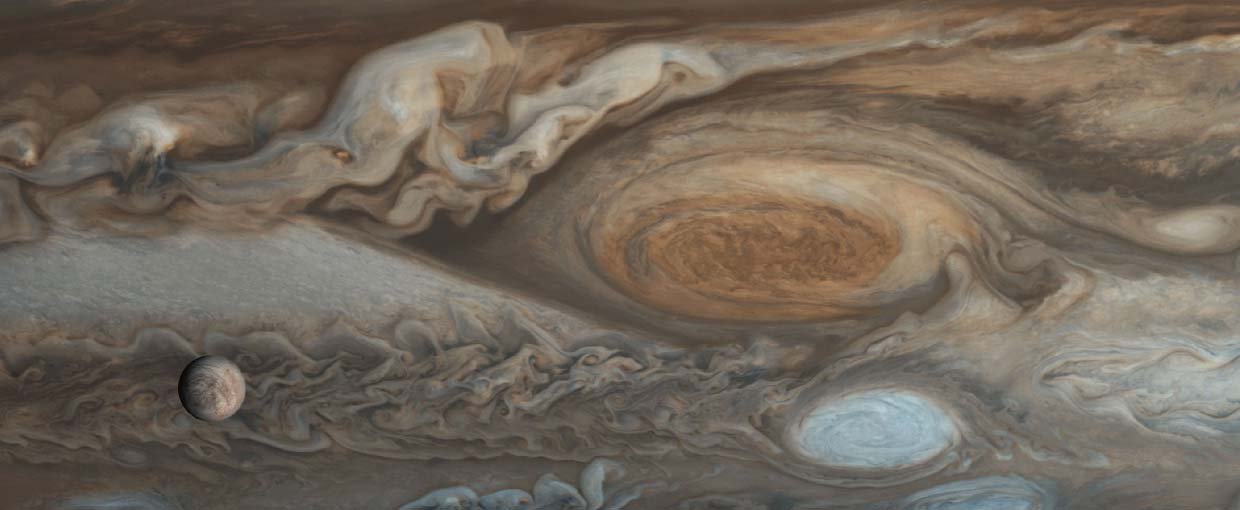
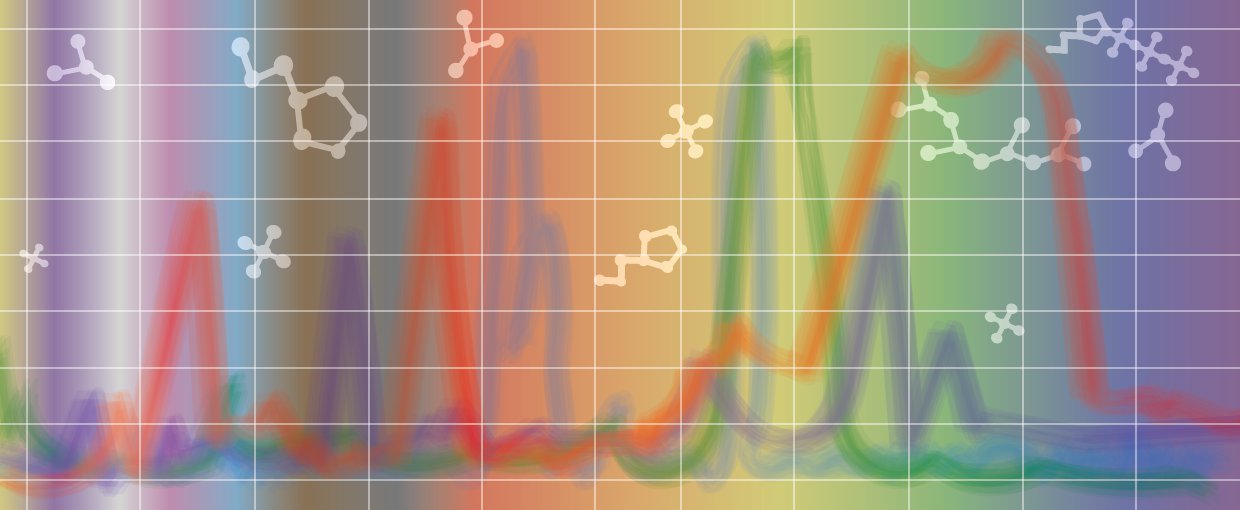
A volcanically active planet is shown in closeup at the left side of the image with glowing eruptions and lines of lava on the surface. To the right and in the distance is a faint blue glowing ball representing the more massive planet in the system.Sixteen frames from Voyager 1's flyby of Jupiter in 1979 were merged to create this image. Jupiter's Great Red Spot is visible in the center. Jupiter's moon Europa can be seen in the foreground at the bottom left of the image.The frame is a horizontal rainbow of color on a grid. Shadows of molecules can be seen through the light as well as the jagged peaks and troughs of spectral lines.
Fizzy Super Earths and Lava Worlds“Fizzy Super-Earths: Impacts of Magma Composition on the Bulk Density and Structure of Lava Worlds.” in The Astrophysical Journal.01/03
Identifying Hydrothermal Activity on Icy Ocean Worlds“Ethene-ethanol ratios as potential indicators of hydrothermal activity at Enceladus, Europa, and other icy ocean worlds.” In Icarus.02/03
NASA Raman Spectroscopic Database"The NASA Raman spectroscopic database: Ramdb version 1.00.” In Icarus.03/03
NextPrevious
Go Explore
February 2019A Near-coplanar Stellar Flyby of the Planet Host Star HD 106906

De Rosa, R. J., & Kalas, P. (2019). A Near-coplanar Stellar Flyby of the Planet Host Star HD 106906. The Astronomical Journal, 157(3), 125. doi:10.3847/1538-3881/ab0109

The Planet Formation Potential around a 45 Myr Old Accreting M Dwarf

Flaherty, K., Hughes, A. M., Mamajek, E. E., & Murphy, S. J. (2019). The Planet Formation Potential around a 45 Myr Old Accreting M Dwarf. The Astrophysical Journal, 872(1), 92. doi:10.3847/1538-4357/aaf794

Predicting the Extreme Ultraviolet Radiation Environment of Exoplanets around Low-mass Stars: The TRAPPIST-1 System

Peacock, S., Barman, T., Shkolnik, E. L., Hauschildt, P. H., & Baron, E. (2019). Predicting the Extreme Ultraviolet Radiation Environment of Exoplanets around Low-mass Stars: The TRAPPIST-1 System. The Astrophysical Journal, 871(2), 235. doi:10.3847/1538-4357/aaf891

The Transit Light Source Effect. II. The Impact of Stellar Heterogeneity on Transmission Spectra of Planets Orbiting Broadly Sun-like Stars

Rackham, B. V., Apai, D., & Giampapa, M. S. (2019). The Transit Light Source Effect. II. The Impact of Stellar Heterogeneity on Transmission Spectra of Planets Orbiting Broadly Sun-like Stars. The Astronomical Journal, 157(3), 96. doi:10.3847/1538-3881/aaf892

Microfluidic Production of Pyrophosphate Catalyzed by Mineral Membranes with Steep pH Gradients

Wang, Q., Barge, L. M., & Steinbock, O. (2019). Microfluidic Production of Pyrophosphate Catalyzed by Mineral Membranes with Steep pH Gradients. Chemistry – A European Journal. doi:10.1002/chem.201805950

Carboxydotrophy potential of uncultivated Hydrothermarchaeota from the subseafloor crustal biosphere

Carr, S. A., Jungbluth, S. P., Eloe-Fadrosh, E. A., Stepanauskas, R., Woyke, T., Rappé, M. S., & Orcutt, B. N. (2019). Carboxydotrophy potential of uncultivated Hydrothermarchaeota from the subseafloor crustal biosphere. The ISME Journal. doi:10.1038/s41396-019-0352-9

Highly siderophile element and 187 Re-187 Os isotopic systematics of ungrouped achondrite Northwest Africa 7325: Evidence for complex planetary processes

Archer, G. J., Walker, R. J., & Irving, A. J. (2019). Highly siderophile element and 187 Re-187 Os isotopic systematics of ungrouped achondrite Northwest Africa 7325: Evidence for complex planetary processes. Meteoritics & Planetary Science. doi:10.1111/maps.13261

Volatile distributions in and on the Moon revealed by Cu and Fe isotopes in the ‘Rusty Rock’ 66095

Day, J. M. D., Sossi, P. A., Shearer, C. K., & Moynier, F. (2019). Volatile distributions in and on the Moon revealed by Cu and Fe isotopes in the ‘Rusty Rock’ 66095. Geochimica et Cosmochimica Acta. doi:10.1016/j.gca.2019.02.036

Genetics, crystallization sequence, and age of the South Byron Trio iron meteorites: New insights to carbonaceous chondrite (CC) type parent bodies

Hilton, C. D., Bermingham, K. R., Walker, R. J., & McCoy, T. J. (2019). Genetics, crystallization sequence, and age of the South Byron Trio iron meteorites: New insights to carbonaceous chondrite (CC) type parent bodies. Geochimica et Cosmochimica Acta. doi:10.1016/j.gca.2019.02.035

A novel organic-rich meteoritic clast from the outer solar system

Kebukawa, Y., Ito, M., Zolensky, M. E., Greenwood, R. C., Rahman, Z., Suga, H., … Kobayashi, K. (2019). A novel organic-rich meteoritic clast from the outer solar system. Scientific Reports, 9(1), None. doi:10.1038/s41598-019-39357-1