

This website is currently being migrated. For the most up-to-date astrobiology news, resources, and community announcements, please visit our new home at science.nasa.gov/astrobiology

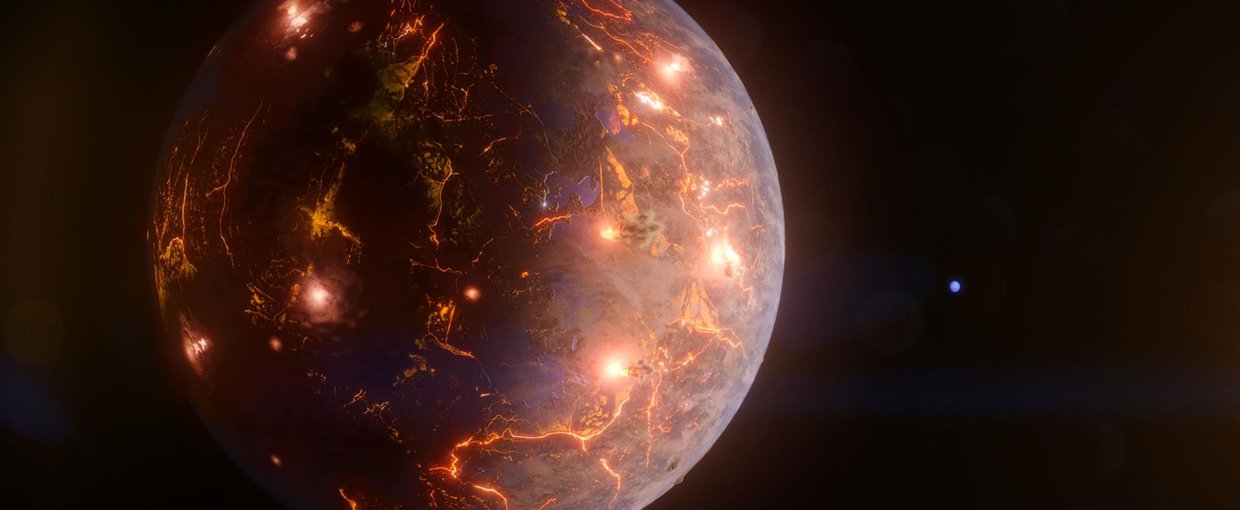
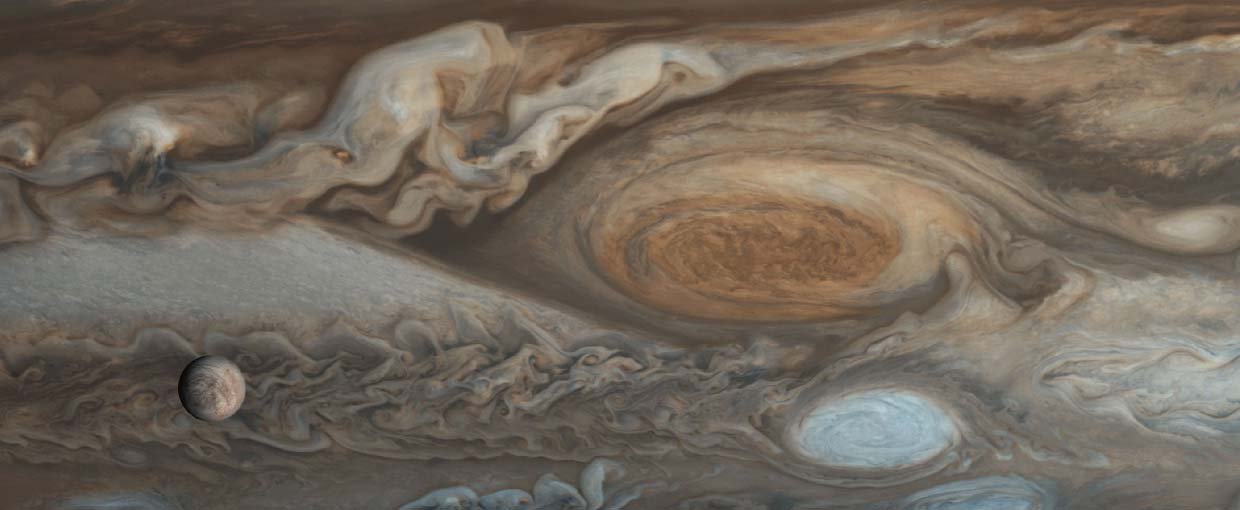
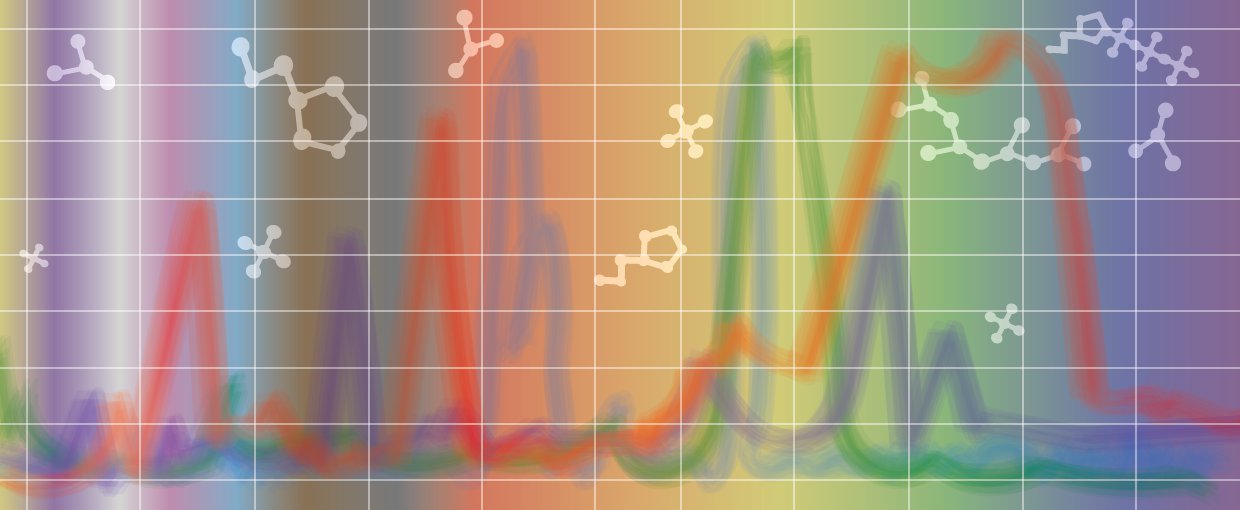
A volcanically active planet is shown in closeup at the left side of the image with glowing eruptions and lines of lava on the surface. To the right and in the distance is a faint blue glowing ball representing the more massive planet in the system.Sixteen frames from Voyager 1's flyby of Jupiter in 1979 were merged to create this image. Jupiter's Great Red Spot is visible in the center. Jupiter's moon Europa can be seen in the foreground at the bottom left of the image.The frame is a horizontal rainbow of color on a grid. Shadows of molecules can be seen through the light as well as the jagged peaks and troughs of spectral lines.
Fizzy Super Earths and Lava Worlds“Fizzy Super-Earths: Impacts of Magma Composition on the Bulk Density and Structure of Lava Worlds.” in The Astrophysical Journal.01/03
Identifying Hydrothermal Activity on Icy Ocean Worlds“Ethene-ethanol ratios as potential indicators of hydrothermal activity at Enceladus, Europa, and other icy ocean worlds.” In Icarus.02/03
NASA Raman Spectroscopic Database"The NASA Raman spectroscopic database: Ramdb version 1.00.” In Icarus.03/03
NextPrevious
Go Explore
June 2010K and Cl concentrations on the Martian surface determined by the Mars Odyssey Gamma Ray Spectrometer: Implications for bulk halogen abundances in Mars

Taylor, G. J., Boynton, W. V., McLennan, S. M., & Martel, L. M. V. (2010). Geophysical Research Letters, 37(12), n/a–n/a. doi:10.1029/2010gl043528

VAPoR – Volatile Analysis by Pyrolysis of Regolith – an instrument for in situ detection of water, noble gases, and organics on the Moon

Ten Kate, I. L., Cardiff, E. H., Dworkin, J. P., Feng, S. H., Holmes, V., Malespin, C., … Stern, J. G. (2010). Planetary and Space Science, 58(7-8), 1007–1017. doi:10.1016/j.pss.2010.03.006

Confocal analysis of nervous system architecture in direct-developing juveniles of Neanthes arenaceodentata (Annelida, Nereididae)

Winchell, C. J., Valencia, J. E., & Jacobs, D. K. (2010). Frontiers in Zoology, 7(1), 17. doi:10.1186/1742-9994-7-17

May 2010Understanding the evolutionary relationships and major traits of Bacillus through comparative genomics

Alcaraz, L., Moreno-Hagelsieb, G., Eguiarte, L. E., Souza, V., Herrera-Estrella, L., & Olmedo, G. (2010). BMC Genomics, 11(1), 332. doi:10.1186/1471-2164-11-332

COMMISSION 53: EXTRA-SOLAR PLANETS

Boss, A., Lecavelier Des Etangs, A., Mayor, M., Bodenheimer, P., Collier-Cameron, A., Kokubo, E., … Mardling, R. (2010). Proceedings of the International Astronomical Union, 6(T27B), 182–183. doi:10.1017/s1743921310004990

DIVISION III: PLANETARY SYSTEMS SCIENCE

Bowell, E. L. G., Meech, K. J., Williams, I. P., Boss, A., Courtin, R., Gustafson, B. Å. S., … Levasseur-Regourd, A-C. (2010). Proceedings of the International Astronomical Union, 6(T27B), 158–167. doi:10.1017/s174392131000493x

Accurate fundamental parameters for 23 bright solar-type stars

Bruntt, H., Bedding, T. R., Quirion, P-O., Lo Curto, G., Carrier, F., Smalley, B., … Dall, T. H. (2010). Monthly Notices of the Royal Astronomical Society, None(None), no–no. doi:10.1111/j.1365-2966.2010.16575.x

History of biological metal utilization inferred through phylogenomic analysis of protein structures

Dupont, C. L., Butcher, A., Valas, R. E., Bourne, P. E., & Caetano-Anolles, G. (2010). Proceedings of the National Academy of Sciences, 107(23), 10567–10572. doi:10.1073/pnas.0912491107