

This website is currently being migrated. For the most up-to-date astrobiology news, resources, and community announcements, please visit our new home at science.nasa.gov/astrobiology

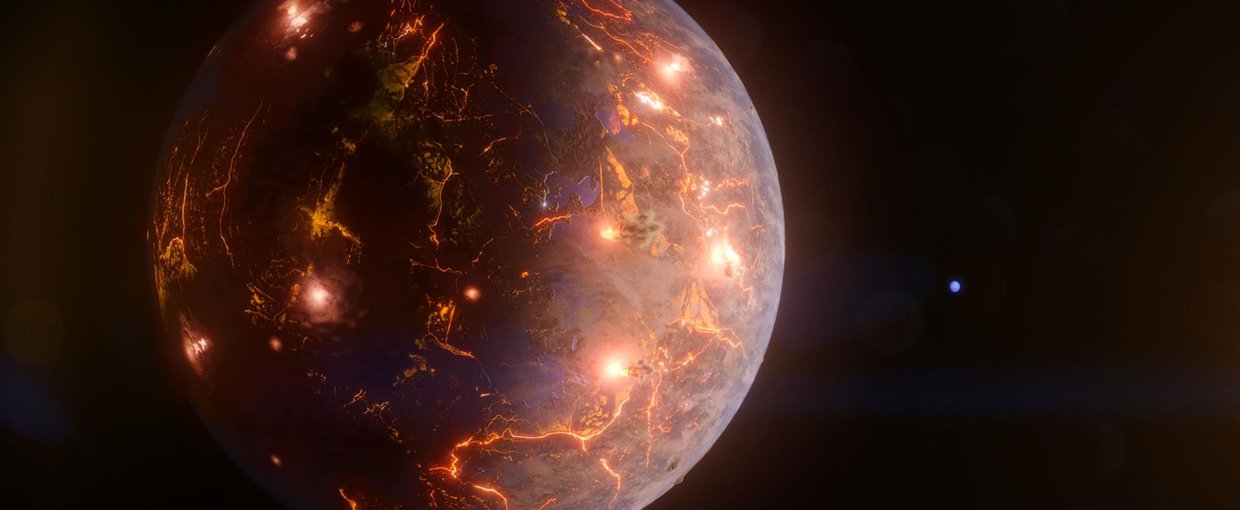
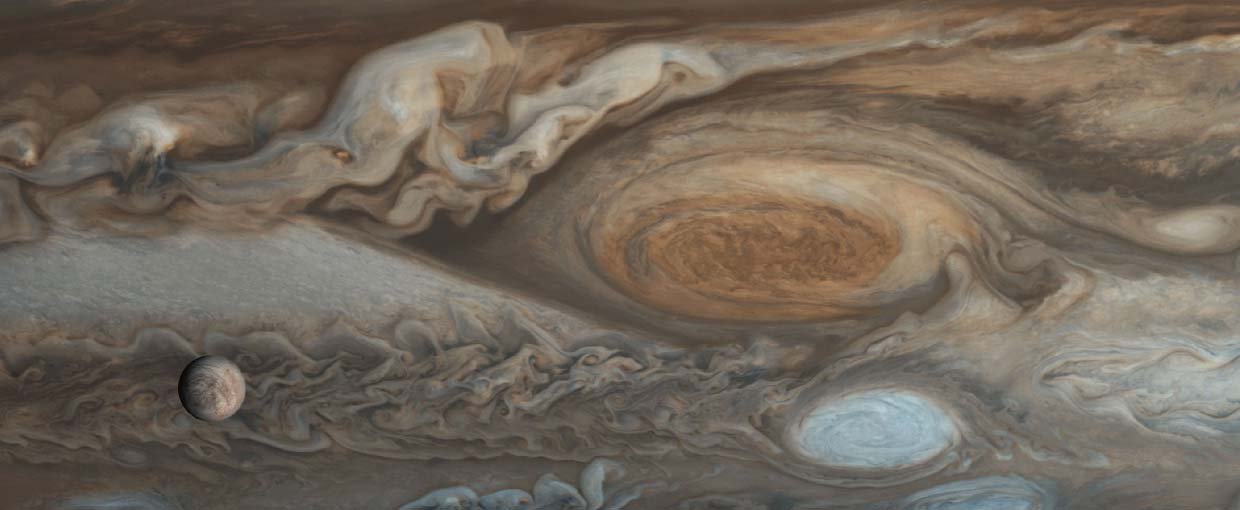
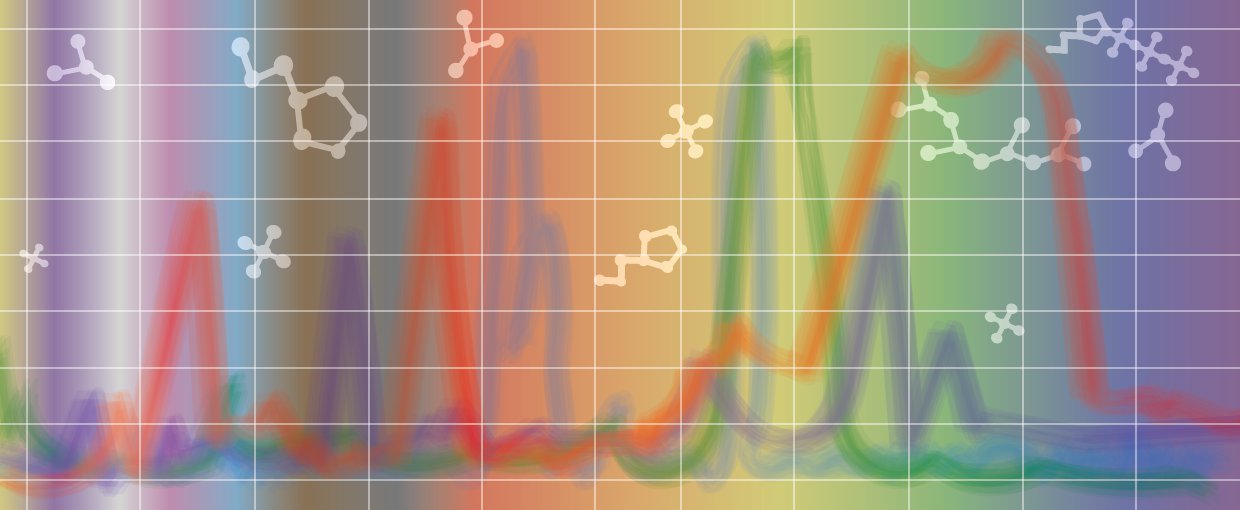
A volcanically active planet is shown in closeup at the left side of the image with glowing eruptions and lines of lava on the surface. To the right and in the distance is a faint blue glowing ball representing the more massive planet in the system.Sixteen frames from Voyager 1's flyby of Jupiter in 1979 were merged to create this image. Jupiter's Great Red Spot is visible in the center. Jupiter's moon Europa can be seen in the foreground at the bottom left of the image.The frame is a horizontal rainbow of color on a grid. Shadows of molecules can be seen through the light as well as the jagged peaks and troughs of spectral lines.
Fizzy Super Earths and Lava Worlds“Fizzy Super-Earths: Impacts of Magma Composition on the Bulk Density and Structure of Lava Worlds.” in The Astrophysical Journal.01/03
Identifying Hydrothermal Activity on Icy Ocean Worlds“Ethene-ethanol ratios as potential indicators of hydrothermal activity at Enceladus, Europa, and other icy ocean worlds.” In Icarus.02/03
NASA Raman Spectroscopic Database"The NASA Raman spectroscopic database: Ramdb version 1.00.” In Icarus.03/03
NextPrevious
Go Explore
April 2011A late methanogen origin for molybdenum-dependent nitrogenase

Boyd, E. S., Anbar, A. D., Miller, S., Hamilton, T. L., Lavin, M., & Peters, J. W. (2011). Geobiology, 9(3), 221–232. doi:10.1111/j.1472-4669.2011.00278.x

Signal Enhancement of Abiotically-Synthesized RNA Oligonucleotides and other Biopolymers using Unmodified Fused Silica in MALDI-MS

Cassidy, L. M., Dong, Y., Joshi, P. C., Aldersley, M. F., Ferris, J. P., & McGown, L. B. (2011). Journal of The American Society for Mass Spectrometry, 22(6), 1100–1104. doi:10.1007/s13361-011-0113-0

Establishing a molecular relationship between chondritic and cometary organic solids

Cody, G. D., Heying, E., Alexander, C. M. O., Nittler, L. R., Kilcoyne, A. L. D., Sandford, S. A., & Stroud, R. M. (2011). Proceedings of the National Academy of Sciences, 108(48), 19171–19176. doi:10.1073/pnas.1015913108

On the formation of ozone in oxygen-rich solar system ices via ionizing radiation

Ennis, C. P., Bennett, C. J., & Kaiser, R. I. (2011). Physical Chemistry Chemical Physics, 13(20), 9469. doi:10.1039/c1cp20434c

Enigmatic origin of the largest-known carbon isotope excursion in Earth's history

Grotzinger, J. P., Fike, D. A., & Fischer, W. W. (2011). Nature Geosci, 4(5), 285–292. doi:10.1038/ngeo1138

C 84 : A Prototype of Larger Fullerenes. Laboratory Spectroscopy and Astronomical Relevance

Halasinski, T. M., Ruiterkamp, R., Salama, F., Foing, B. H., & Ehrenfreund, P. (2011). Fullerenes, Nanotubes and Carbon Nanostructures, 19(5), 398–409. doi:10.1080/15363831003721807

Joule heating of the south polar terrain on Enceladus

Hand, K. P., Khurana, K. K., & Chyba, C. F. (2011). Journal of Geophysical Research, 116(E4), None. doi:10.1029/2010je003776

IMPROVED ORBITAL PARAMETERS AND TRANSIT MONITORING FOR HD 156846b

Kane, S. R., Howard, A. W., Pilyavsky, G., Mahadevan, S., Henry, G. W., Von Braun, K., … Ciardi, D. R. (2011). The Astrophysical Journal, 733(1), 28. doi:10.1088/0004-637x/733/1/28

APOSTLE OBSERVATIONS OF GJ 1214b: SYSTEM PARAMETERS AND EVIDENCE FOR STELLAR ACTIVITY

Kundurthy, P., Agol, E., Becker, A. C., Barnes, R., Williams, B., & Mukadam, A. (2011). The Astrophysical Journal, 731(2), 123. doi:10.1088/0004-637x/731/2/123

Exchange and fractionation of Mg isotopes between epsomite and saturated MgSO4 solution

Li, W., Beard, B. L., & Johnson, C. M. (2011). Geochimica et Cosmochimica Acta, 75(7), 1814–1828. doi:10.1016/j.gca.2011.01.023