

This website is currently being migrated. For the most up-to-date astrobiology news, resources, and community announcements, please visit our new home at science.nasa.gov/astrobiology

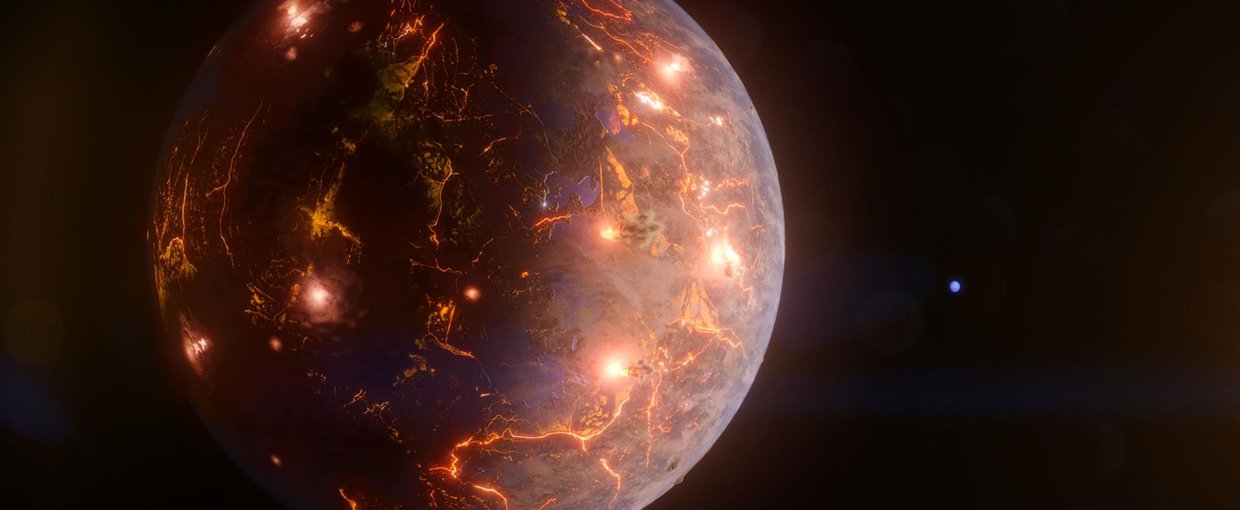
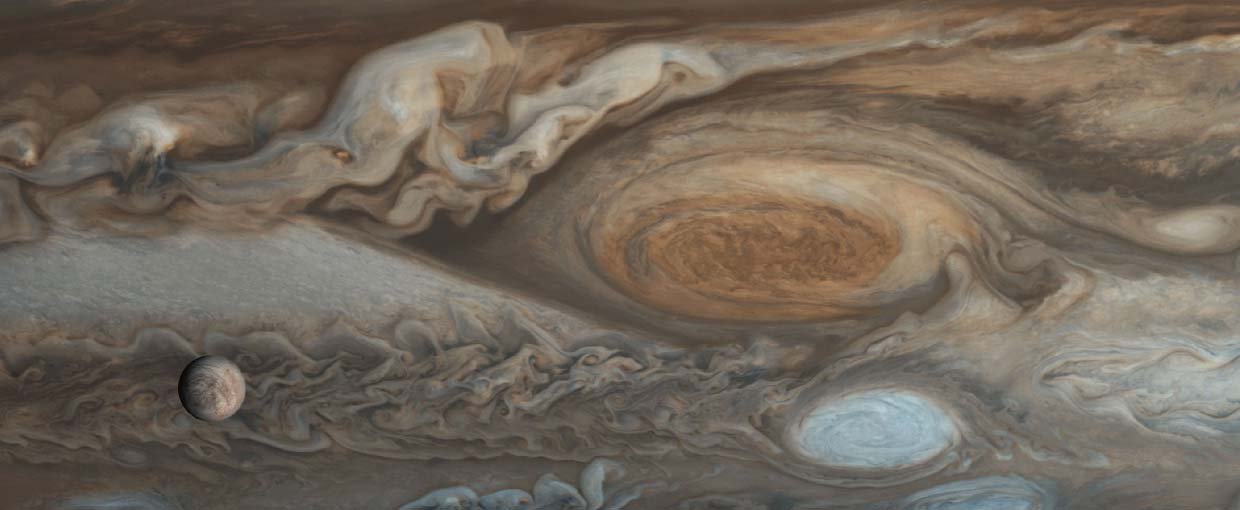
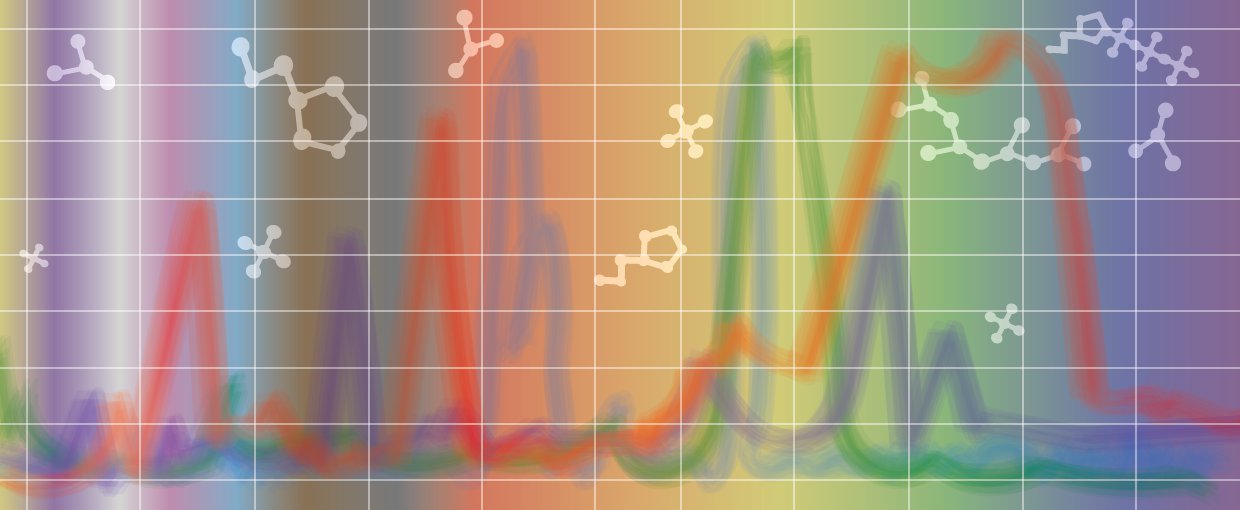
A volcanically active planet is shown in closeup at the left side of the image with glowing eruptions and lines of lava on the surface. To the right and in the distance is a faint blue glowing ball representing the more massive planet in the system.Sixteen frames from Voyager 1's flyby of Jupiter in 1979 were merged to create this image. Jupiter's Great Red Spot is visible in the center. Jupiter's moon Europa can be seen in the foreground at the bottom left of the image.The frame is a horizontal rainbow of color on a grid. Shadows of molecules can be seen through the light as well as the jagged peaks and troughs of spectral lines.
Fizzy Super Earths and Lava Worlds“Fizzy Super-Earths: Impacts of Magma Composition on the Bulk Density and Structure of Lava Worlds.” in The Astrophysical Journal.01/03
Identifying Hydrothermal Activity on Icy Ocean Worlds“Ethene-ethanol ratios as potential indicators of hydrothermal activity at Enceladus, Europa, and other icy ocean worlds.” In Icarus.02/03
NASA Raman Spectroscopic Database"The NASA Raman spectroscopic database: Ramdb version 1.00.” In Icarus.03/03
NextPrevious
Go Explore
September 2011MicroRNAs and phylogenomics resolve the relationships of Tardigrada and suggest that velvet worms are the sister group of Arthropoda

Campbell, L. I., Rota-Stabelli, O., Edgecombe, G. D., Marchioro, T., Longhorn, S. J., Telford, M. J., … Philippe, H. (2011). Proceedings of the National Academy of Sciences, 108(38), 15920–15924. doi:10.1073/pnas.1105499108

Organic materials in planetary and protoplanetary systems: nature or nurture?

Dalle Ore, C. M., Fulchignoni, M., Cruikshank, D. P., Barucci, M. A., Brunetto, R., Campins, H., … De Bergh, C. (2011). A&A, 533(None), A98. doi:10.1051/0004-6361/201116599

Structural properties of DNA oligomers containing (GACX)n and (GAXC)n tandem repeats

Dasgupta, I., Gao, X., & Fox, G. E. (2011). Biopolymers, 97(3), 155–164. doi:10.1002/bip.21719

Correlated microanalysis of cometary organic grains returned by Stardust

De GREGORIO, B. T., Stroud, R. M., Cody, G. D., Nittler, L. R., David Kilcoyne, A. L., & Wirick, S. (2011). Meteoritics & Planetary Science, 46(9), 1376–1396. doi:10.1111/j.1945-5100.2011.01237.x

Kepler-16: A Transiting Circumbinary Planet

Doyle, L. R., Carter, J. A., Fabrycky, D. C., Slawson, R. W., Howell, S. B., Winn, J. N., … Orosz, J. A. (2011). Science, 333(6049), 1602–1606. doi:10.1126/science.1210923

On the chemical processing of hydrocarbon surfaces by fast oxygen ions

Ennis, C., Yuan, H., Sibener, S. J., & Kaiser, R. I. (2011). Physical Chemistry Chemical Physics, 13(39), 17870. doi:10.1039/c1cp21800j

Evolutionary uniformitarianism

Erwin, D. H. (2011). Developmental Biology, 357(1), 27–34. doi:10.1016/j.ydbio.2011.01.020

The environment of early Mars and the missing carbonates

FERNÁNDEZ-REMOLAR, D. C., SÁNCHEZ-ROMÁN, M., Hill, A. C., GÓMEZ-ORTÍZ, D., Ballesteros, O. P., Romanek, C. S., & Amils, R. (2011). Meteoritics & Planetary Science, 46(10), 1447–1469. doi:10.1111/j.1945-5100.2011.01238.x

Preparation and injection of fluid tracers during IODP Expedition 327, eastern flank of Juan de Fuca Ridge

Fisher, A. T., Cowen, J., Wheat, C. G., & Clark, J. F. (2011). Proceedings of the IODP. doi:10.2204/iodp.proc.327.108.2011

Exoplanets

Haghighipour, N. (2011). Meteoritics & Planetary Science, 46(10), 1617–1618. doi:10.1111/j.1945-5100.2011.01258.x