

This website is currently being migrated. For the most up-to-date astrobiology news, resources, and community announcements, please visit our new home at science.nasa.gov/astrobiology

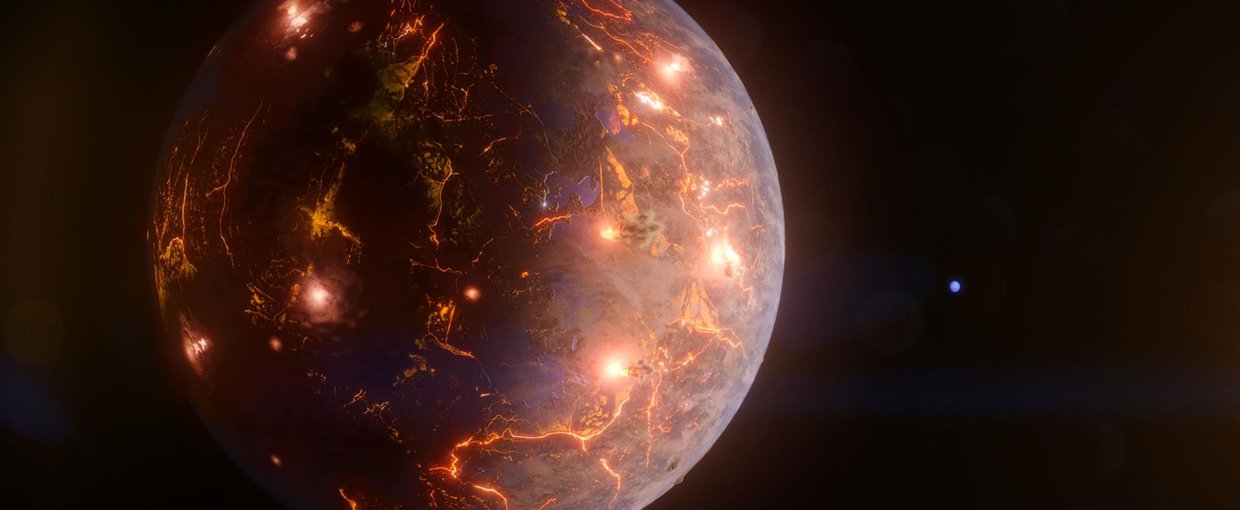
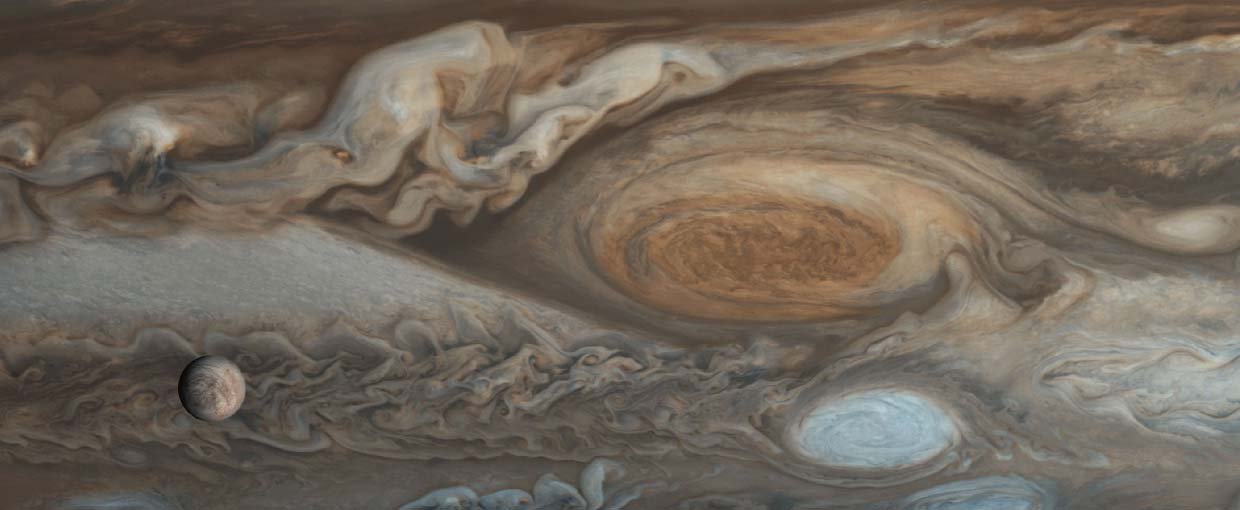
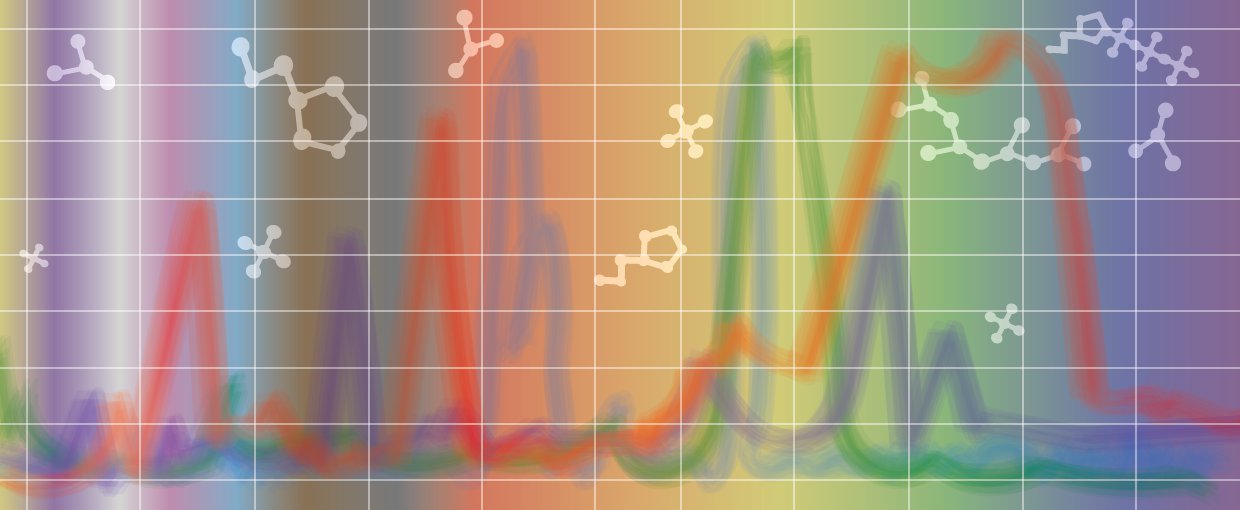
A volcanically active planet is shown in closeup at the left side of the image with glowing eruptions and lines of lava on the surface. To the right and in the distance is a faint blue glowing ball representing the more massive planet in the system.Sixteen frames from Voyager 1's flyby of Jupiter in 1979 were merged to create this image. Jupiter's Great Red Spot is visible in the center. Jupiter's moon Europa can be seen in the foreground at the bottom left of the image.The frame is a horizontal rainbow of color on a grid. Shadows of molecules can be seen through the light as well as the jagged peaks and troughs of spectral lines.
Fizzy Super Earths and Lava Worlds“Fizzy Super-Earths: Impacts of Magma Composition on the Bulk Density and Structure of Lava Worlds.” in The Astrophysical Journal.01/03
Identifying Hydrothermal Activity on Icy Ocean Worlds“Ethene-ethanol ratios as potential indicators of hydrothermal activity at Enceladus, Europa, and other icy ocean worlds.” In Icarus.02/03
NASA Raman Spectroscopic Database"The NASA Raman spectroscopic database: Ramdb version 1.00.” In Icarus.03/03
NextPrevious
Go Explore
October 2011Copper toxicity and the origin of bacterial resistance—new insights and applications

Dupont, C. L., Grass, G., & Rensing, C. (2011). Metallomics, 3(11), 1109. doi:10.1039/c1mt00107h

A Multiple-Choice Essay

Ehrenfreund, P. (2011). Astrobiology, 11(8), 737–741. doi:10.1089/ast.2011.0697

Comparisons of the four Miller Range nakhlites, MIL 03346, 090030, 090032 and 090136: Textural and compositional observations of primary and secondary mineral assemblages

Hallis, L. J., & Taylor, G. J. (2011). Meteoritics & Planetary Science, 46(12), 1787–1803. doi:10.1111/j.1945-5100.2011.01293.x

Ocean-like water in the Jupiter-family comet 103P/Hartley 2

Hartogh, P., Lis, D. C., Bockelée-Morvan, D., De Val-Borro, M., Biver, N., Küppers, M., … Emprechtinger, M. (2011). Nature, 478(7368), 218–220. doi:10.1038/nature10519

SIMS analyses of silicon and oxygen isotope ratios for quartz from Archean and Paleoproterozoic banded iron formations

Heck, P. R., Huberty, J. M., Kita, N. T., Ushikubo, T., Kozdon, R., & Valley, J. W. (2011). Geochimica et Cosmochimica Acta, 75(20), 5879–5891. doi:10.1016/j.gca.2011.07.023

Detection of the Water Reservoir in a Forming Planetary System

Hogerheijde, M. R., Bergin, E. A., Brinch, C., Cleeves, L. I., Fogel, J. K. J., Blake, G. A., … Dominik, C. (2011). Science, 334(6054), 338–340. doi:10.1126/science.1208931

Progress in demonstrating total homochiral selection in montmorillonite-catalyzed RNA synthesis

Joshi, P. C., Aldersley, M. F., & Ferris, J. P. (2011). Biochemical and Biophysical Research Communications, 413(4), 594–598. doi:10.1016/j.bbrc.2011.09.008

Sedna and the Oort Cloud around a migrating Sun

Kaib, N. A., Roškar, R., & Quinn, T. (2011). Icarus, 215(2), 491–507. doi:10.1016/j.icarus.2011.07.037

Aerobic bacterial pyrite oxidation and acid rock drainage during the Great Oxidation Event

Konhauser, K. O., Lalonde, S. V., Planavsky, N. J., Pecoits, E., Lyons, T. W., Mojzsis, S. J., … Rouxel, O. J. (2011). Nature, 478(7369), 369–373. doi:10.1038/nature10511

Jarosite, argon diffusion, and dating aqueous mineralization on Earth and Mars

Kula, J., & Baldwin, S. L. (2011). Earth and Planetary Science Letters, 310(3-4), 314–318. doi:10.1016/j.epsl.2011.08.006