

This website is currently being migrated. For the most up-to-date astrobiology news, resources, and community announcements, please visit our new home at science.nasa.gov/astrobiology

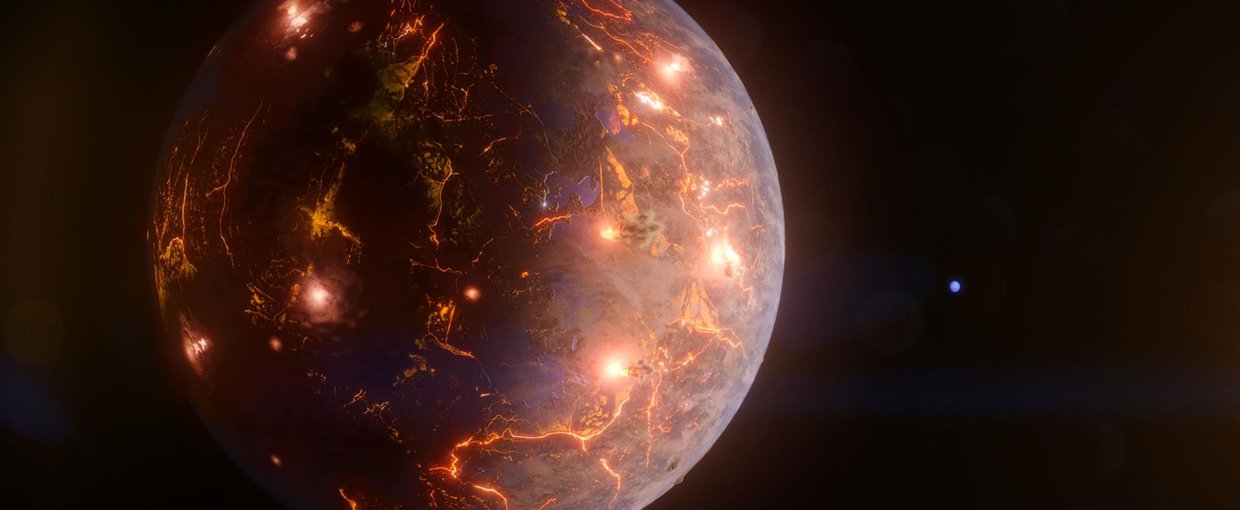
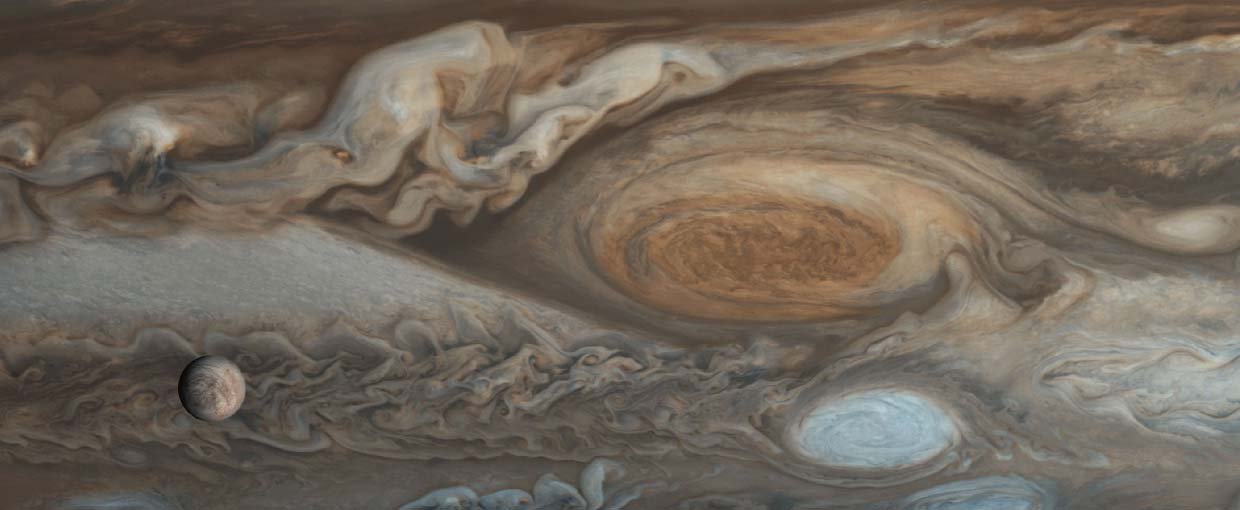
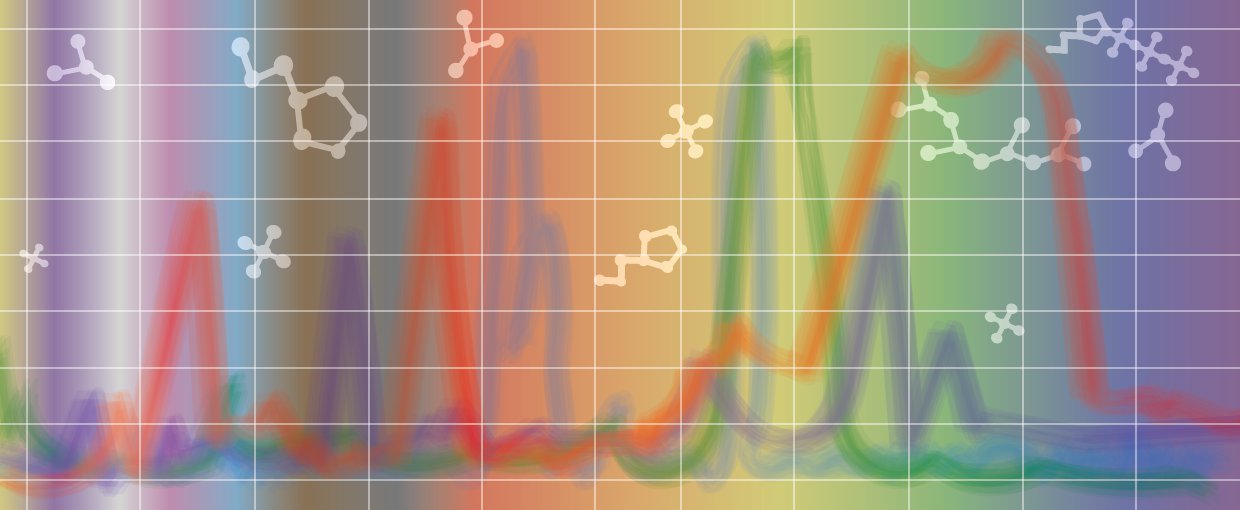
A volcanically active planet is shown in closeup at the left side of the image with glowing eruptions and lines of lava on the surface. To the right and in the distance is a faint blue glowing ball representing the more massive planet in the system.Sixteen frames from Voyager 1's flyby of Jupiter in 1979 were merged to create this image. Jupiter's Great Red Spot is visible in the center. Jupiter's moon Europa can be seen in the foreground at the bottom left of the image.The frame is a horizontal rainbow of color on a grid. Shadows of molecules can be seen through the light as well as the jagged peaks and troughs of spectral lines.
Fizzy Super Earths and Lava Worlds“Fizzy Super-Earths: Impacts of Magma Composition on the Bulk Density and Structure of Lava Worlds.” in The Astrophysical Journal.01/03
Identifying Hydrothermal Activity on Icy Ocean Worlds“Ethene-ethanol ratios as potential indicators of hydrothermal activity at Enceladus, Europa, and other icy ocean worlds.” In Icarus.02/03
NASA Raman Spectroscopic Database"The NASA Raman spectroscopic database: Ramdb version 1.00.” In Icarus.03/03
NextPrevious
Go Explore
November 2011OBSERVATIONAL CONSTRAINTS ON METHANOL PRODUCTION IN INTERSTELLAR AND PREPLANETARY ICES

Whittet, D. C. B., Cook, A. M., Herbst, E., Chiar, J. E., & Shenoy, S. S. (2011). The Astrophysical Journal, 742(1), 28. doi:10.1088/0004-637x/742/1/28

Structural study of the coherent dehydration of wadsleyite

Ye, Y., Smyth, J. R., & Frost, D. J. (2011). American Mineralogist, 96(11-12), 1760–1767. doi:10.2138/am.2011.3852

October 2011The influence of multivariate analysis methods and target grain size on the accuracy of remote quantitative chemical analysis of rocks using laser induced breakdown spectroscopy

Anderson, R. B., Morris, R. V., Clegg, S. M., Bell, J. F., Wiens, R. C., Humphries, S. D., … Mertzman, S. A. (2011). Icarus, 215(2), 608–627. doi:10.1016/j.icarus.2011.07.034

Putative Cryogenian ciliates from Mongolia

Bosak, T., Macdonald, F., Lahr, D., & Matys, E. (2011). Geology, 39(12), 1123–1126. doi:10.1130/g32384.1

Giant planet formation by disc instability: flux-limited radiative diffusion and protostellar wobbles

Boss, A. P. (2011). Monthly Notices of the Royal Astronomical Society, 419(3), 1930–1936. doi:10.1111/j.1365-2966.2011.19858.x

An Alternative Path for the Evolution of Biological Nitrogen Fixation

Boyd, E. S., Hamilton, T. L., & Peters, J. W. (2011). Frontiers in Microbiology, 2(None), None. doi:10.3389/fmicb.2011.00205

Rapid expansion of oceanic anoxia immediately before the end-Permian mass extinction

Brennecka, G. A., Herrmann, A. D., Algeo, T. J., & Anbar, A. D. (2011). Proceedings of the National Academy of Sciences, 108(43), 17631–17634. doi:10.1073/pnas.1106039108

Hydrogen production in photosynthetic microbial mats in the Elkhorn Slough estuary, Monterey Bay

Burow, L. C., Woebken, D., Bebout, B. M., McMurdie, P. J., Singer, S. W., Pett-Ridge, J., … Prufert-Bebout, L. (2011). ISME J, 6(4), 863–874. doi:10.1038/ismej.2011.142

Heterogeneous distributions of amino acids provide evidence of multiple sources within the Almahata Sitta parent body, asteroid 2008 TC3

Burton, A. S., Glavin, D. P., Callahan, M. P., Dworkin, J. P., Jenniskens, P., & Shaddad, M. H. (2011). Meteoritics & Planetary Science, 46(11), 1703–1712. doi:10.1111/j.1945-5100.2011.01257.x

Refugium for surface life on Snowball Earth in a nearly-enclosed sea? A first simple model for sea-glacier invasion

Campbell, A. J., Waddington, E. D., & Warren, S. G. (2011). Geophysical Research Letters, 38(19), n/a–n/a. doi:10.1029/2011gl048846