

This website is currently being migrated. For the most up-to-date astrobiology news, resources, and community announcements, please visit our new home at science.nasa.gov/astrobiology

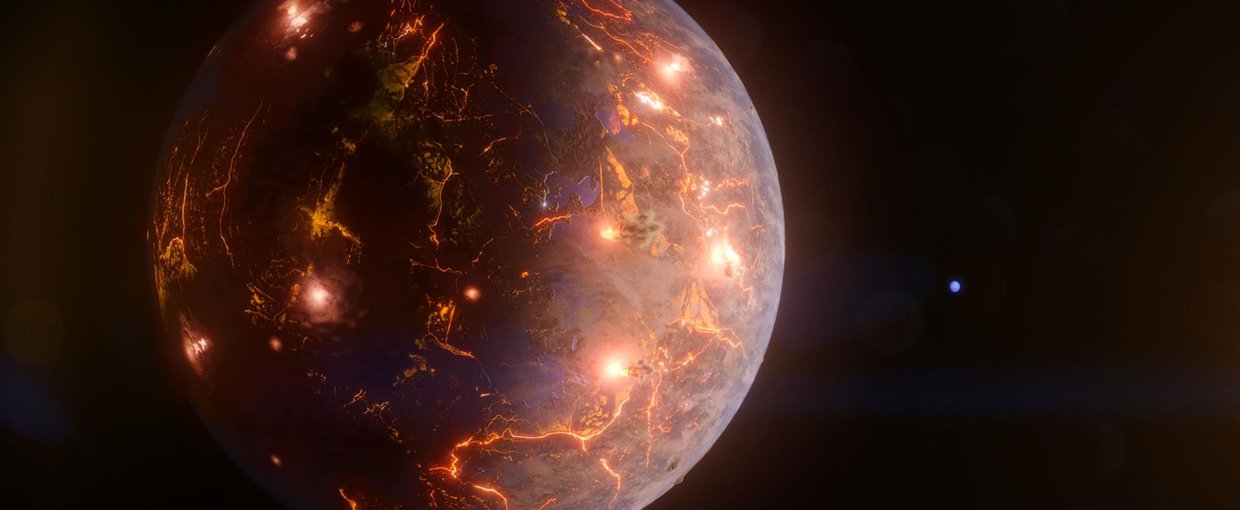
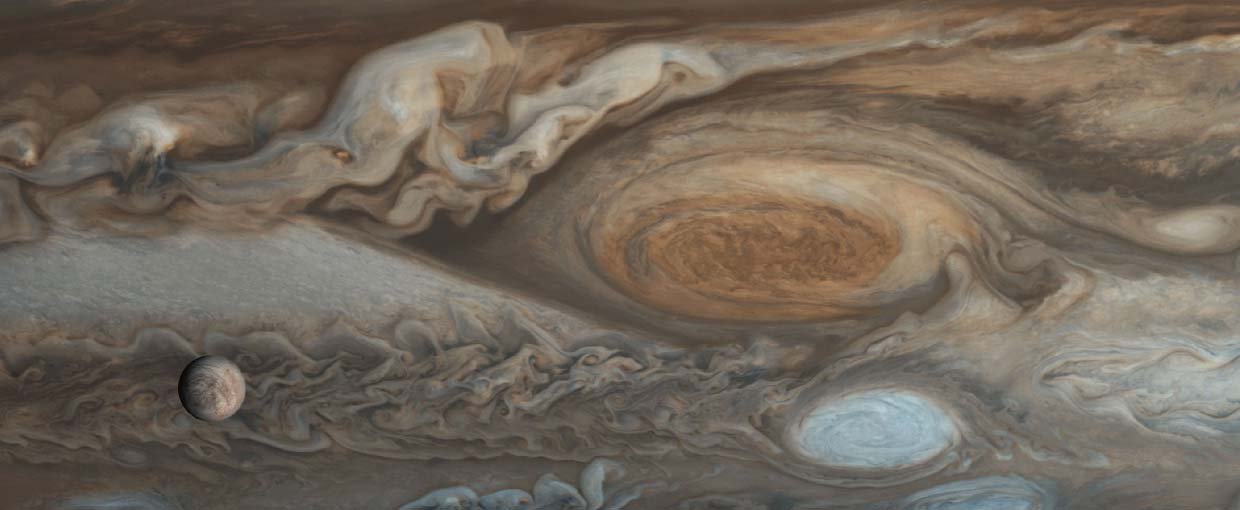
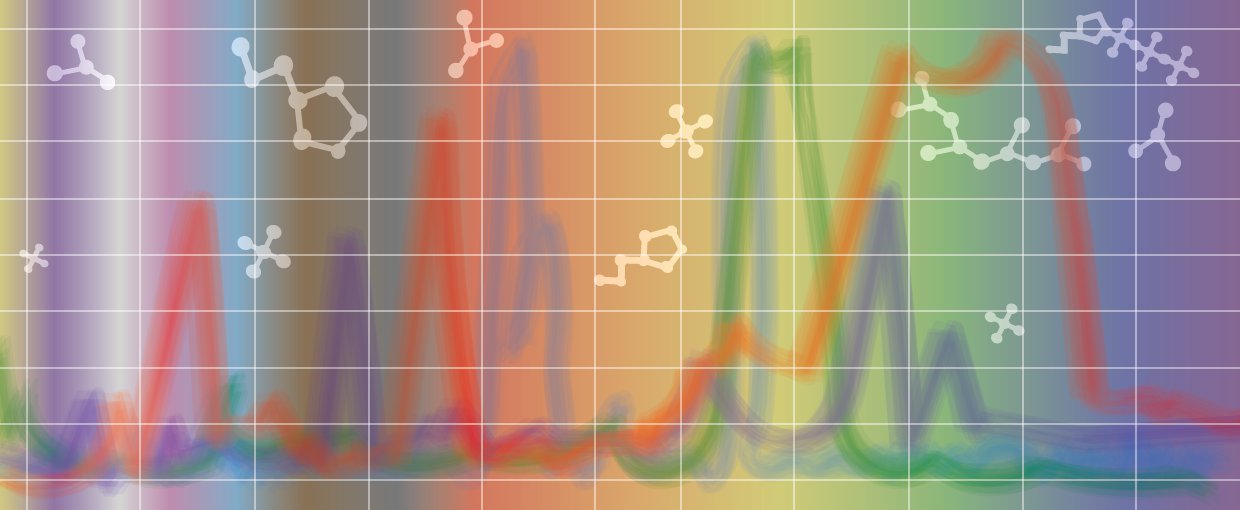
A volcanically active planet is shown in closeup at the left side of the image with glowing eruptions and lines of lava on the surface. To the right and in the distance is a faint blue glowing ball representing the more massive planet in the system.Sixteen frames from Voyager 1's flyby of Jupiter in 1979 were merged to create this image. Jupiter's Great Red Spot is visible in the center. Jupiter's moon Europa can be seen in the foreground at the bottom left of the image.The frame is a horizontal rainbow of color on a grid. Shadows of molecules can be seen through the light as well as the jagged peaks and troughs of spectral lines.
Fizzy Super Earths and Lava Worlds“Fizzy Super-Earths: Impacts of Magma Composition on the Bulk Density and Structure of Lava Worlds.” in The Astrophysical Journal.01/03
Identifying Hydrothermal Activity on Icy Ocean Worlds“Ethene-ethanol ratios as potential indicators of hydrothermal activity at Enceladus, Europa, and other icy ocean worlds.” In Icarus.02/03
NASA Raman Spectroscopic Database"The NASA Raman spectroscopic database: Ramdb version 1.00.” In Icarus.03/03
NextPrevious
Go Explore
November 2011Species-specific responses of Late Quaternary megafauna to climate and humans

Lorenzen, E. D., Nogués-Bravo, D., Orlando, L., Weinstock, J., Binladen, J., Marske, K. A., … Ugan, A. (2011). Nature, 479(7373), 359–364. doi:10.1038/nature10574

Redox bifurcations: Mechanisms and importance to life now, and at its origin

Nitschke, W., & Russell, M. J. (2011). BioEssays, 34(2), 106–109. doi:10.1002/bies.201100134

Reaction–diffusion model of nutrient uptake in a biofilm: Theory and experiment

Petroff, A. P., Wu, T-D., Liang, B., Mui, J., Guerquin-Kern, J-L., Vali, H., … Rothman, D. H. (2011). Journal of Theoretical Biology, 289(None), 90–95. doi:10.1016/j.jtbi.2011.08.004

Mineralogical characterization of Baptistina Asteroid Family: Implications for K/T impactor source

Reddy, V., Carvano, J. M., Lazzaro, D., Michtchenko, T. A., Gaffey, M. J., Kelley, M. S., … Mothé-Diniz, T. (2011). Icarus, 216(1), 184–197. doi:10.1016/j.icarus.2011.08.027

Light scattering by complex particles in the Moon's exosphere: Toward a taxonomy of models for the realistic simulation of the scattering behavior of lunar dust

Richard, D. T., Glenar, D. A., Stubbs, T. J., Davis, S. S., & Colaprete, A. (2011). Planetary and Space Science, 59(14), 1804–1814. doi:10.1016/j.pss.2011.01.003

Calibrating the End-Permian Mass Extinction

Shen, S-Z., Crowley, J. L., Wang, Y., Bowring, S. A., Erwin, D. H., Sadler, P. M., … Cao, C-Q. (2011). Science, 334(6061), 1367–1372. doi:10.1126/science.1213454

ON THE FORMATION OF INTERSTELLAR WATER ICE: CONSTRAINTS FROM A SEARCH FOR HYDROGEN PEROXIDE ICE IN MOLECULAR CLOUDS

Smith, R. G., Charnley, S. B., Pendleton, Y. J., Wright, C. M., Maldoni, M. M., & Robinson, G. (2011). The Astrophysical Journal, 743(2), 131. doi:10.1088/0004-637x/743/2/131

Characterization of a novel biosurfactant producing Pseudomonas koreensis lineage that is endemic to Cuatro Ciénegas Basin

Toribio, J., Escalante, A. E., Caballero-Mellado, J., González-González, A., Zavala, S., Souza, V., & Soberón-Chávez, G. (2011). Systematic and Applied Microbiology, 34(7), 531–535. doi:10.1016/j.syapm.2011.01.007

The oxidation state of Hadean magmas and implications for early Earth’s atmosphere

Trail, D., Watson, E. B., & Tailby, N. D. (2011). Nature, 480(7375), 79–82. doi:10.1038/nature10655

The molecular composition of Comet C/2007 W1 (Boattini): Evidence of a peculiar outgassing and a rich chemistry

Villanueva, G. L., Mumma, M. J., DiSanti, M. A., Bonev, B. P., Gibb, E. L., Magee-Sauer, K., … Blake, G. A. (2011). Icarus, 216(1), 227–240. doi:10.1016/j.icarus.2011.08.024